

251
In the work by Lin and co-workers ( 2011 ), following results have been reported:
“The micro-indentation hardness of the external layer (550 MPa) of A. gigas
scale is considerably higher than that of the internal layer (200 MPa), consistent
with its higher degree of mineralization. Tensile testing of the scales carried out in
the dry and wet conditions shows that the strength and stiffness are hydration dependent. As is the case of most biological materials, the elastic modulus of the scale is
strain-rate dependent. The strain-rate dependence of the elastic modulus, as
expressed by the Ramberg-Osgood equation, is equal to 0.26, approximately ten
times higher than that of bone. This is attributed to the higher fraction of collagen in
the scales and to the high degree of hydration (30 % H 2 O). Deproteinization of the
scale reveals the structure of the mineral component consisting of an interconnected
network of platelets with a thickness of ~50 nm and diameter of ~500 nm,” (Lin
et al. 2011 ).
The hydration state of fi sh scale seems to play an important role for obtaining of
experimental data. For example, it was reported about signifi cant differences in
mechanical properties of scales from carp ( Cyprinus carpio ) as a function of their
anatomical position and hydration. Garrano et al. ( 2012 ) showed that “fully hydrated
scales from the head exhibited an elastic modulus and strength nearly twice that of
those properties for the tail. However, after dehydration there were no signifi cant
differences in the mechanical properties as a function of anatomical position.
Considering all three regions of evaluation, dehydration had the largest infl uence on
changes in the elastic modulus, and scales from the tail underwent the most signifi -
cant changes in properties with moisture loss,” (Garrano et al. 2012 ).
Unfortunately, with exception of works by Ikom et al. ( 2003 ) and Song ( 2011 ),
there are no detailed studies on mechanical properties of scales from marine fi sh
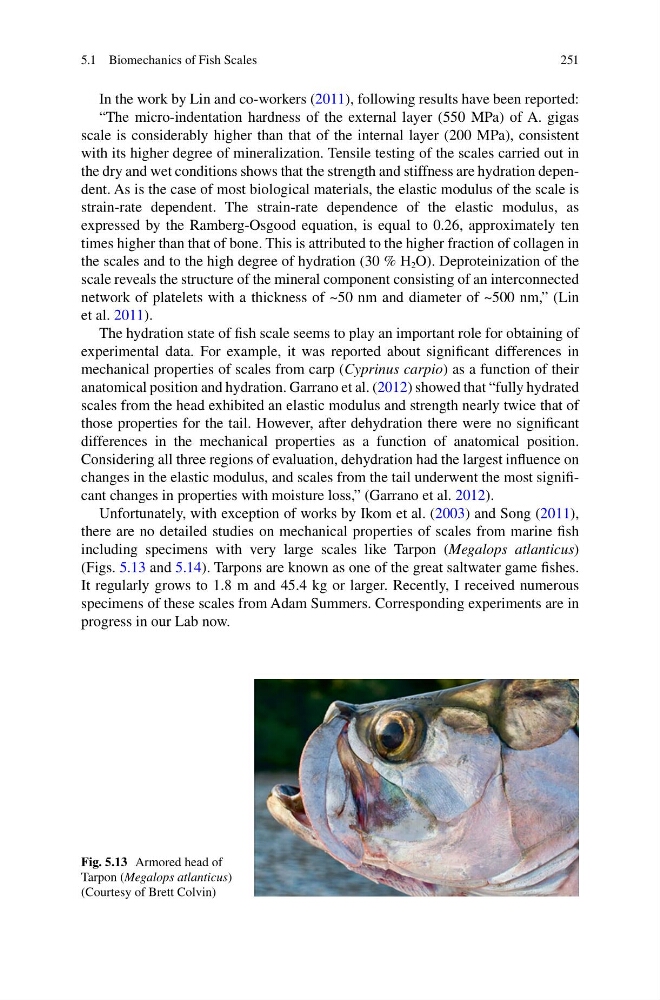
including specimens with very large scales like Tarpon ( Megalops atlanticus )
(Figs. 5.13 and 5.14 ). Tarpons are known as one of the great saltwater game fi shes.
It regularly grows to 1.8 m and 45.4 kg or larger. Recently, I received numerous
specimens of these scales from Adam Summers. Corresponding experiments are in
progress in our Lab now.
Fig. 5.13 Armored head of
Tarpon ( Megalops atlanticus )
(Courtesy of Brett Colvin)
5.1 Biomechanics of Fish Scales
In the work by Lin and co-workers ( 2011 ), following results have been reported:
“The micro-indentation hardness of the external layer (550 MPa) of A. gigas
scale is considerably higher than that of the internal layer (200 MPa), consistent
with its higher degree of mineralization. Tensile testing of the scales carried out in
the dry and wet conditions shows that the strength and stiffness are hydration dependent. As is the case of most biological materials, the elastic modulus of the scale is
strain-rate dependent. The strain-rate dependence of the elastic modulus, as
expressed by the Ramberg-Osgood equation, is equal to 0.26, approximately ten
times higher than that of bone. This is attributed to the higher fraction of collagen in
the scales and to the high degree of hydration (30 % H 2 O). Deproteinization of the
scale reveals the structure of the mineral component consisting of an interconnected
network of platelets with a thickness of ~50 nm and diameter of ~500 nm,” (Lin
et al. 2011 ).
The hydration state of fi sh scale seems to play an important role for obtaining of
experimental data. For example, it was reported about signifi cant differences in
mechanical properties of scales from carp ( Cyprinus carpio ) as a function of their
anatomical position and hydration. Garrano et al. ( 2012 ) showed that “fully hydrated
scales from the head exhibited an elastic modulus and strength nearly twice that of
those properties for the tail. However, after dehydration there were no signifi cant
differences in the mechanical properties as a function of anatomical position.
Considering all three regions of evaluation, dehydration had the largest infl uence on
changes in the elastic modulus, and scales from the tail underwent the most signifi -
cant changes in properties with moisture loss,” (Garrano et al. 2012 ).
Unfortunately, with exception of works by Ikom et al. ( 2003 ) and Song ( 2011 ),
there are no detailed studies on mechanical properties of scales from marine fi sh
including specimens with very large scales like Tarpon ( Megalops atlanticus )
(Figs. 5.13 and 5.14 ). Tarpons are known as one of the great saltwater game fi shes.
It regularly grows to 1.8 m and 45.4 kg or larger. Recently, I received numerous
specimens of these scales from Adam Summers. Corresponding experiments are in
progress in our Lab now.
Fig. 5.13 Armored head of
Tarpon ( Megalops atlanticus )
(Courtesy of Brett Colvin)
5.1 Biomechanics of Fish Scales