

242
habituates in lakes, streams and oceans, across the northern hemisphere. Subspecies
from freshwater niches differ from their ocean-dwelling relatives with respect to the
amount of protective armor that covers fi sh bodies. In contrast to freshwater
sticklebacks with only several plates that sit closer to the front of the body, oceanic
specimens possess about 30 armored plates extending from head to tail. “The dermal
plates of the three-spine stickleback are anisotropic in shape (oval to rectangular),
conformal to the body of the fi sh, porous, and composed of acellular lamellar bone,”
(Song et al. 2010 ). Recently, the fi sh was investigated by Christine Ortiz and coworkers at MIT as model system for better understanding of material design principles in naturally occurring armors. These researchers used micro-computed
tomography (μCT) techniques for quantitative comparative studies on armor structures of both marine and freshwater G. aculeatus . As reported by Song ( 2011 ).
“The convolution of plate geometry in conjunction with plate-to-plate overlap
allows a relatively constant armor thickness to be maintained throughout the assembly, promoting spatially homogeneous protection and thereby avoiding weakness at
the armor unit interconnections. Plate-to-plate junctures act to register and join the
plates while permitting compliance in sliding and rotation in selected directions.
SEM and μCT revealed a porous, sandwich-like cross-section of lateral plates benefi cial for bending stiffness and strength at minimum weight,” (Song et al. 2010 )
The armor assembly of marine G. aculeatus possesses a signifi cant amount of
porosity: “the larger pores occupy the centrally thickened region of the lateral plates,
while the smaller pores are located throughout the plate,” (Song et al. 2010 ). The
internal porosity lateral to the sandwich-like structure of the G. aculeatus provides
plates with special microarchitecture that provides stiffness and strength in bending
at minimum weight. Moreover, this internal microstructure plays important role
against the penetration of predator’s teeth. According to Song et al. ( 2010 ).
“a penetrating tooth will fi rst indent and bend the textured outer surface layer of
the plate which would provide a greater resilience to penetration events compared
to a fully dense internal structure. This structure would also provide greatly different dissipative deformation mechanisms during more aggressive penetration loading, where indentation will be accommodated by more distributed deformation
events compared to a dense structure,” (Song et al. 2010 ).
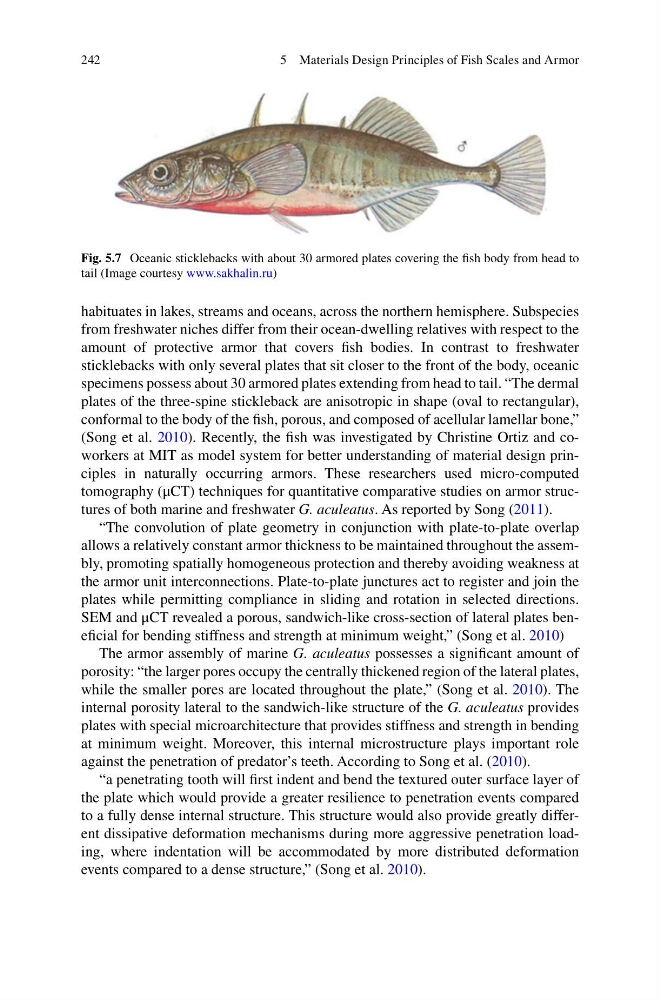
Fig. 5.7 Oceanic sticklebacks with about 30 armored plates covering the fi sh body from head to
tail (Image courtesy www.sakhalin.ru )
5 Materials Design Principles of Fish Scales and Armor
habituates in lakes, streams and oceans, across the northern hemisphere. Subspecies
from freshwater niches differ from their ocean-dwelling relatives with respect to the
amount of protective armor that covers fi sh bodies. In contrast to freshwater
sticklebacks with only several plates that sit closer to the front of the body, oceanic
specimens possess about 30 armored plates extending from head to tail. “The dermal
plates of the three-spine stickleback are anisotropic in shape (oval to rectangular),
conformal to the body of the fi sh, porous, and composed of acellular lamellar bone,”
(Song et al. 2010 ). Recently, the fi sh was investigated by Christine Ortiz and coworkers at MIT as model system for better understanding of material design principles in naturally occurring armors. These researchers used micro-computed
tomography (μCT) techniques for quantitative comparative studies on armor structures of both marine and freshwater G. aculeatus . As reported by Song ( 2011 ).
“The convolution of plate geometry in conjunction with plate-to-plate overlap
allows a relatively constant armor thickness to be maintained throughout the assembly, promoting spatially homogeneous protection and thereby avoiding weakness at
the armor unit interconnections. Plate-to-plate junctures act to register and join the
plates while permitting compliance in sliding and rotation in selected directions.
SEM and μCT revealed a porous, sandwich-like cross-section of lateral plates benefi cial for bending stiffness and strength at minimum weight,” (Song et al. 2010 )
The armor assembly of marine G. aculeatus possesses a signifi cant amount of
porosity: “the larger pores occupy the centrally thickened region of the lateral plates,
while the smaller pores are located throughout the plate,” (Song et al. 2010 ). The
internal porosity lateral to the sandwich-like structure of the G. aculeatus provides
plates with special microarchitecture that provides stiffness and strength in bending
at minimum weight. Moreover, this internal microstructure plays important role
against the penetration of predator’s teeth. According to Song et al. ( 2010 ).
“a penetrating tooth will fi rst indent and bend the textured outer surface layer of
the plate which would provide a greater resilience to penetration events compared
to a fully dense internal structure. This structure would also provide greatly different dissipative deformation mechanisms during more aggressive penetration loading, where indentation will be accommodated by more distributed deformation
events compared to a dense structure,” (Song et al. 2010 ).
Fig. 5.7 Oceanic sticklebacks with about 30 armored plates covering the fi sh body from head to
tail (Image courtesy www.sakhalin.ru )
5 Materials Design Principles of Fish Scales and Armor