

241
third century AD (see for review Bishop 2002 ). In contrast to other types of plate
armour, the pieces are not raised/dished, but rather curved. In this construct, a wide
piece of metal pipe can be used as an anvil. The main idea was to have the abdomen
protected by a series of overlapping hoops which hung from vertical leather straps.
The plates which form the shoulder assembly are also held together by straps. Plate
overlap was akin to roof shingles, with everything pointing down.
There are a couple guidelines in Internet today on how to adjust all the pieces to
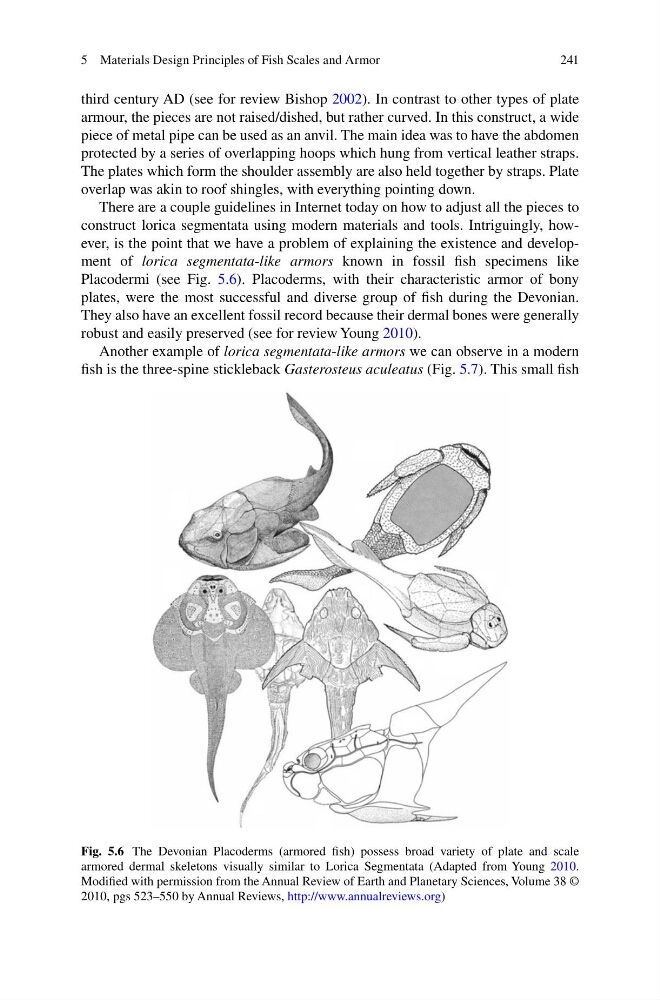
construct lorica segmentata using modern materials and tools. Intriguingly, however, is the point that we have a problem of explaining the existence and development of lorica segmentata - like armors known in fossil fi sh specimens like
Placodermi (see Fig. 5.6 ). Placoderms, with their characteristic armor of bony
plates, were the most successful and diverse group of fi sh during the Devonian.
They also have an excellent fossil record because their dermal bones were generally
robust and easily preserved (see for review Young 2010 ).
Another example of lorica segmentata - like armors we can observe in a modern
fi sh is the three-spine stickleback Gasterosteus aculeatus (Fig. 5.7 ). This small fi sh
Fig. 5.6 The Devonian Placoderms (armored fi sh) possess broad variety of plate and scale
armored dermal skeletons visually similar to Lorica Segmentata (Adapted from Young 2010 .
Modifi ed with permission from the Annual Review of Earth and Planetary Sciences, Volume 38 ©
2010, pgs 523–550 by Annual Reviews, http://www.annualreviews.org )
5 Materials Design Principles of Fish Scales and Armor
third century AD (see for review Bishop 2002 ). In contrast to other types of plate
armour, the pieces are not raised/dished, but rather curved. In this construct, a wide
piece of metal pipe can be used as an anvil. The main idea was to have the abdomen
protected by a series of overlapping hoops which hung from vertical leather straps.
The plates which form the shoulder assembly are also held together by straps. Plate
overlap was akin to roof shingles, with everything pointing down.
There are a couple guidelines in Internet today on how to adjust all the pieces to
construct lorica segmentata using modern materials and tools. Intriguingly, however, is the point that we have a problem of explaining the existence and development of lorica segmentata - like armors known in fossil fi sh specimens like
Placodermi (see Fig. 5.6 ). Placoderms, with their characteristic armor of bony
plates, were the most successful and diverse group of fi sh during the Devonian.
They also have an excellent fossil record because their dermal bones were generally
robust and easily preserved (see for review Young 2010 ).
Another example of lorica segmentata - like armors we can observe in a modern
fi sh is the three-spine stickleback Gasterosteus aculeatus (Fig. 5.7 ). This small fi sh
Fig. 5.6 The Devonian Placoderms (armored fi sh) possess broad variety of plate and scale
armored dermal skeletons visually similar to Lorica Segmentata (Adapted from Young 2010 .
Modifi ed with permission from the Annual Review of Earth and Planetary Sciences, Volume 38 ©
2010, pgs 523–550 by Annual Reviews, http://www.annualreviews.org )
5 Materials Design Principles of Fish Scales and Armor