

243
This special naturally designed structure observed in three-spine stickleback is
used as bioinspired model for development of novel and highly effective lightweight
armor systems (Song 2011 ).
Armor made of scales and plates remained popular long after the decline of the
Roman Empire, fi nally falling out of fashion during the Middle Ages. It was cheap
to produce, could be made by unskilled personnel, and was easy to repair in the
fi eld. It is thought that it was at least as common as mail armour. Although scale
armour declined in popularity with the advent of modern warfare, using scales to
provide fl exible protection persists. There are no doubts that infl exible and heavy
body armors limit soldier’s speed and agility on the battlefi eld. Therefore, for example the US Army laboratories and affi liated companies showed great interest in
designing more fl exible body armor systems.
The overlapping scales motive on the skin of teleost fi sh is an example of
“multilayer system that alternates hard and soft layers in an arrangement reminiscent of the design of bulletproof glass,” (Zhu et al. 2012b ). It was analysed that “in
addition, overlapping scales ensures compliance and breathability, two highly desirable properties for personal armors. A biomimetic design at the individual scale
level could therefore be combined with a clever arrangement of the scales at the
macroscale to yield a hierarchical protective system with attractive properties,”
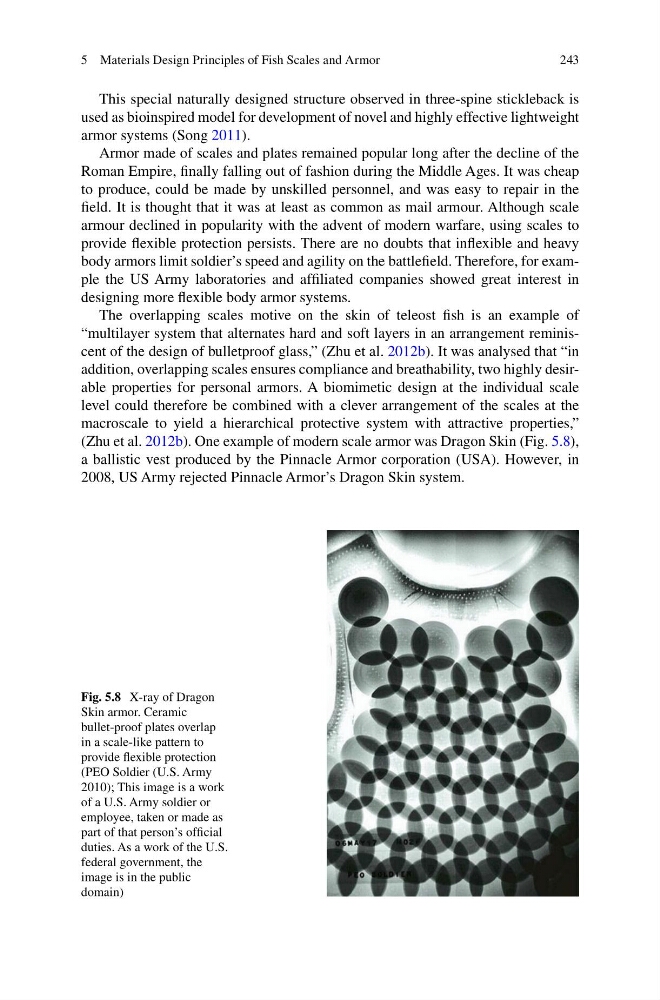
(Zhu et al. 2012b ). One example of modern scale armor was Dragon Skin (Fig. 5.8 ),
a ballistic vest produced by the Pinnacle Armor corporation (USA). However, in
2008, US Army rejected Pinnacle Armor’s Dragon Skin system.
Fig. 5.8 X-ray of Dragon
Skin armor. Ceramic
bullet-proof plates overlap
in a scale-like pattern to
provide fl exible protection
(PEO Soldier (U.S. Army
2010); This image is a work
of a U.S. Army soldier or
employee, taken or made as
part of that person’s offi cial
duties. As a work of the U.S.
federal government, the
image is in the public
domain)
5 Materials Design Principles of Fish Scales and Armor
This special naturally designed structure observed in three-spine stickleback is
used as bioinspired model for development of novel and highly effective lightweight
armor systems (Song 2011 ).
Armor made of scales and plates remained popular long after the decline of the
Roman Empire, fi nally falling out of fashion during the Middle Ages. It was cheap
to produce, could be made by unskilled personnel, and was easy to repair in the
fi eld. It is thought that it was at least as common as mail armour. Although scale
armour declined in popularity with the advent of modern warfare, using scales to
provide fl exible protection persists. There are no doubts that infl exible and heavy
body armors limit soldier’s speed and agility on the battlefi eld. Therefore, for example the US Army laboratories and affi liated companies showed great interest in
designing more fl exible body armor systems.
The overlapping scales motive on the skin of teleost fi sh is an example of
“multilayer system that alternates hard and soft layers in an arrangement reminiscent of the design of bulletproof glass,” (Zhu et al. 2012b ). It was analysed that “in
addition, overlapping scales ensures compliance and breathability, two highly desirable properties for personal armors. A biomimetic design at the individual scale
level could therefore be combined with a clever arrangement of the scales at the
macroscale to yield a hierarchical protective system with attractive properties,”
(Zhu et al. 2012b ). One example of modern scale armor was Dragon Skin (Fig. 5.8 ),
a ballistic vest produced by the Pinnacle Armor corporation (USA). However, in
2008, US Army rejected Pinnacle Armor’s Dragon Skin system.
Fig. 5.8 X-ray of Dragon
Skin armor. Ceramic
bullet-proof plates overlap
in a scale-like pattern to
provide fl exible protection
(PEO Soldier (U.S. Army
2010); This image is a work
of a U.S. Army soldier or
employee, taken or made as
part of that person’s offi cial
duties. As a work of the U.S.
federal government, the
image is in the public
domain)
5 Materials Design Principles of Fish Scales and Armor