

226
Richter 2001 ). Morphology of odontodes in their nearly unchanged form can be
observed only in Chondrichthyans. “In contrast, in the osteichthyan lineage, the
odontodes have been progressively modifi ed into various types of ‘scales’, including ganoid scales, dermal bony scales and elasmoid scales. Given their ‘dental’
structure, the ‘placoid scales’ must be distinguished from the other scale types,”
(Sire and Akimenko 2004 ; see also Sire 2001 ; Sire and Huysseune 2003 ). The
importance of placoid scale morphology and structure for biomechanics and fi sh
locomotion is discussed in the next chapter.
Thelodont scales Thelodonts are extinct jawless vertebrates, which characteristically possess a dermal skeleton composed of thousands of microscopic scales that
were commonly dispersed after death and the decay of supporting soft tissues. Thus,
the fossil record of these animals is dominated by jumbled collections of scales that
are recovered by acid dissolution of limestones (e.g. Turner 1984 ).
The scales of Ordovican period origin belonging to loganiid thelodonts are the
most distributed structures localized in the Harding Sandstone, Colorado. These
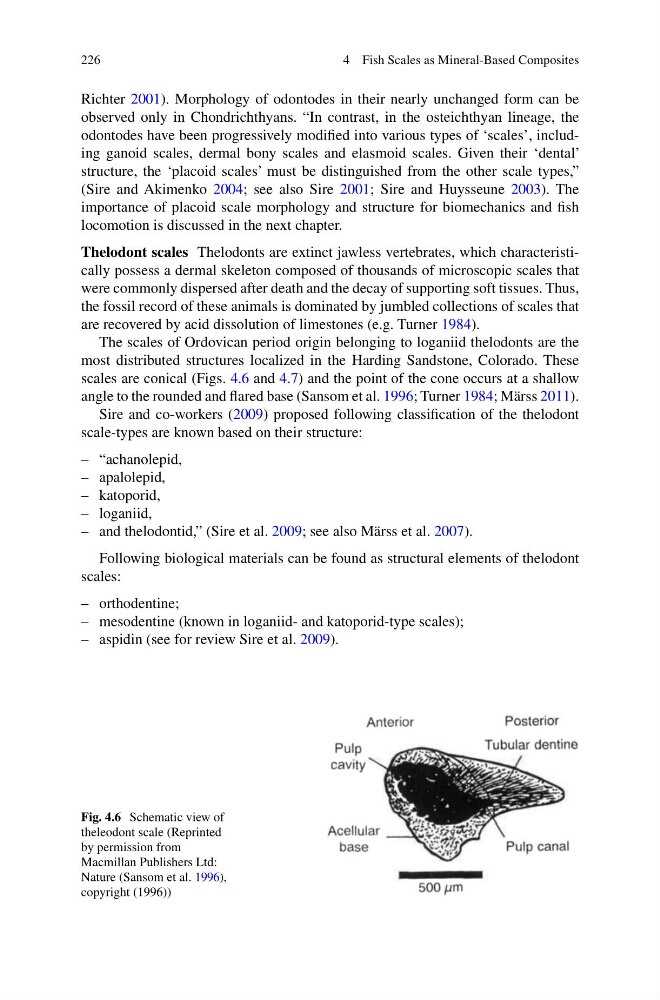
scales are conical (Figs. 4.6 and 4.7 ) and the point of the cone occurs at a shallow
angle to the rounded and fl ared base (Sansom et al. 1996 ; Turner 1984 ; Märss 2011 ).
Sire and co-workers ( 2009 ) proposed following classifi cation of the thelodont
scale-types are known based on their structure:
– “achanolepid,
– apalolepid,
– katoporid,
– loganiid,
– and thelodontid,” (Sire et al. 2009 ; see also Märss et al. 2007 ).
Following biological materials can be found as structural elements of thelodont
scales:
– orthodentine;
– mesodentine (known in loganiid- and katoporid-type scales);
– aspidin (see for review Sire et al. 2009 ).
Fig. 4.6 Schematic view of
theleodont scale (Reprinted
by permission from
Macmillan Publishers Ltd:
Nature (Sansom et al. 1996 ),
copyright (1996))
4 Fish Scales as Mineral-Based Composites
Richter 2001 ). Morphology of odontodes in their nearly unchanged form can be
observed only in Chondrichthyans. “In contrast, in the osteichthyan lineage, the
odontodes have been progressively modifi ed into various types of ‘scales’, including ganoid scales, dermal bony scales and elasmoid scales. Given their ‘dental’
structure, the ‘placoid scales’ must be distinguished from the other scale types,”
(Sire and Akimenko 2004 ; see also Sire 2001 ; Sire and Huysseune 2003 ). The
importance of placoid scale morphology and structure for biomechanics and fi sh
locomotion is discussed in the next chapter.
Thelodont scales Thelodonts are extinct jawless vertebrates, which characteristically possess a dermal skeleton composed of thousands of microscopic scales that
were commonly dispersed after death and the decay of supporting soft tissues. Thus,
the fossil record of these animals is dominated by jumbled collections of scales that
are recovered by acid dissolution of limestones (e.g. Turner 1984 ).
The scales of Ordovican period origin belonging to loganiid thelodonts are the
most distributed structures localized in the Harding Sandstone, Colorado. These
scales are conical (Figs. 4.6 and 4.7 ) and the point of the cone occurs at a shallow
angle to the rounded and fl ared base (Sansom et al. 1996 ; Turner 1984 ; Märss 2011 ).
Sire and co-workers ( 2009 ) proposed following classifi cation of the thelodont
scale-types are known based on their structure:
– “achanolepid,
– apalolepid,
– katoporid,
– loganiid,
– and thelodontid,” (Sire et al. 2009 ; see also Märss et al. 2007 ).
Following biological materials can be found as structural elements of thelodont
scales:
– orthodentine;
– mesodentine (known in loganiid- and katoporid-type scales);
– aspidin (see for review Sire et al. 2009 ).
Fig. 4.6 Schematic view of
theleodont scale (Reprinted
by permission from
Macmillan Publishers Ltd:
Nature (Sansom et al. 1996 ),
copyright (1996))
4 Fish Scales as Mineral-Based Composites