

225
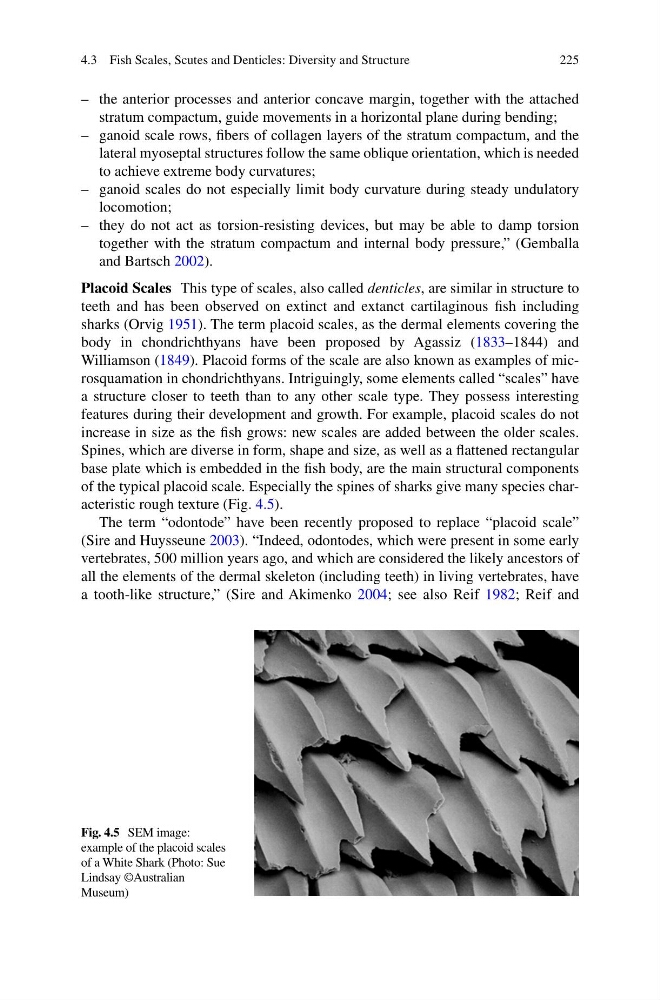
Fig. 4.5 SEM image:
example of the placoid scales
of a White Shark (Photo: Sue
Lindsay ©Australian
Museum)
– the anterior processes and anterior concave margin, together with the attached
stratum compactum, guide movements in a horizontal plane during bending;
– ganoid scale rows, fi bers of collagen layers of the stratum compactum, and the
lateral myoseptal structures follow the same oblique orientation, which is needed
to achieve extreme body curvatures;
– ganoid scales do not especially limit body curvature during steady undulatory
locomotion;
– they do not act as torsion-resisting devices, but may be able to damp torsion
together with the stratum compactum and internal body pressure,” (Gemballa
and Bartsch 2002 ).
Placoid Scales This type of scales, also called denticles , are similar in structure to
teeth and has been observed on extinct and extanct cartilaginous fi sh including
sharks (Orvig 1951 ). The term placoid scales, as the dermal elements covering the
body in chondrichthyans have been proposed by Agassiz ( 1833 –1844) and
Williamson ( 1849 ). Placoid forms of the scale are also known as examples of microsquamation in chondrichthyans. Intriguingly, some elements called “scales” have
a structure closer to teeth than to any other scale type. They possess interesting
features during their development and growth. For example, placoid scales do not
increase in size as the fi sh grows: new scales are added between the older scales.
Spines, which are diverse in form, shape and size, as well as a fl attened rectangular
base plate which is embedded in the fi sh body, are the main structural components
of the typical placoid scale. Especially the spines of sharks give many species characteristic rough texture (Fig. 4.5 ).
The term “odontode” have been recently proposed to replace “placoid scale”
(Sire and Huysseune 2003 ). “Indeed, odontodes, which were present in some early
vertebrates, 500 million years ago, and which are considered the likely ancestors of
all the elements of the dermal skeleton (including teeth) in living vertebrates, have
a tooth-like structure,” (Sire and Akimenko 2004 ; see also Reif 1982 ; Reif and
4.3 Fish Scales, Scutes and Denticles: Diversity and Structure
Fig. 4.5 SEM image:
example of the placoid scales
of a White Shark (Photo: Sue
Lindsay ©Australian
Museum)
– the anterior processes and anterior concave margin, together with the attached
stratum compactum, guide movements in a horizontal plane during bending;
– ganoid scale rows, fi bers of collagen layers of the stratum compactum, and the
lateral myoseptal structures follow the same oblique orientation, which is needed
to achieve extreme body curvatures;
– ganoid scales do not especially limit body curvature during steady undulatory
locomotion;
– they do not act as torsion-resisting devices, but may be able to damp torsion
together with the stratum compactum and internal body pressure,” (Gemballa
and Bartsch 2002 ).
Placoid Scales This type of scales, also called denticles , are similar in structure to
teeth and has been observed on extinct and extanct cartilaginous fi sh including
sharks (Orvig 1951 ). The term placoid scales, as the dermal elements covering the
body in chondrichthyans have been proposed by Agassiz ( 1833 –1844) and
Williamson ( 1849 ). Placoid forms of the scale are also known as examples of microsquamation in chondrichthyans. Intriguingly, some elements called “scales” have
a structure closer to teeth than to any other scale type. They possess interesting
features during their development and growth. For example, placoid scales do not
increase in size as the fi sh grows: new scales are added between the older scales.
Spines, which are diverse in form, shape and size, as well as a fl attened rectangular
base plate which is embedded in the fi sh body, are the main structural components
of the typical placoid scale. Especially the spines of sharks give many species characteristic rough texture (Fig. 4.5 ).
The term “odontode” have been recently proposed to replace “placoid scale”
(Sire and Huysseune 2003 ). “Indeed, odontodes, which were present in some early
vertebrates, 500 million years ago, and which are considered the likely ancestors of
all the elements of the dermal skeleton (including teeth) in living vertebrates, have
a tooth-like structure,” (Sire and Akimenko 2004 ; see also Reif 1982 ; Reif and
4.3 Fish Scales, Scutes and Denticles: Diversity and Structure