

224
Ganoid scales are examples of very hard, diamond-shaped, structures in which
a layer of ganoin lies over the cosmine layer and under the enamel in contrast to
cosmoid scales. Fish species, which possess ganoid scales, are related to reedfi shes
(family Polypteridae ), gars (family Lepisosteidae ) and bichirs. The schematic view
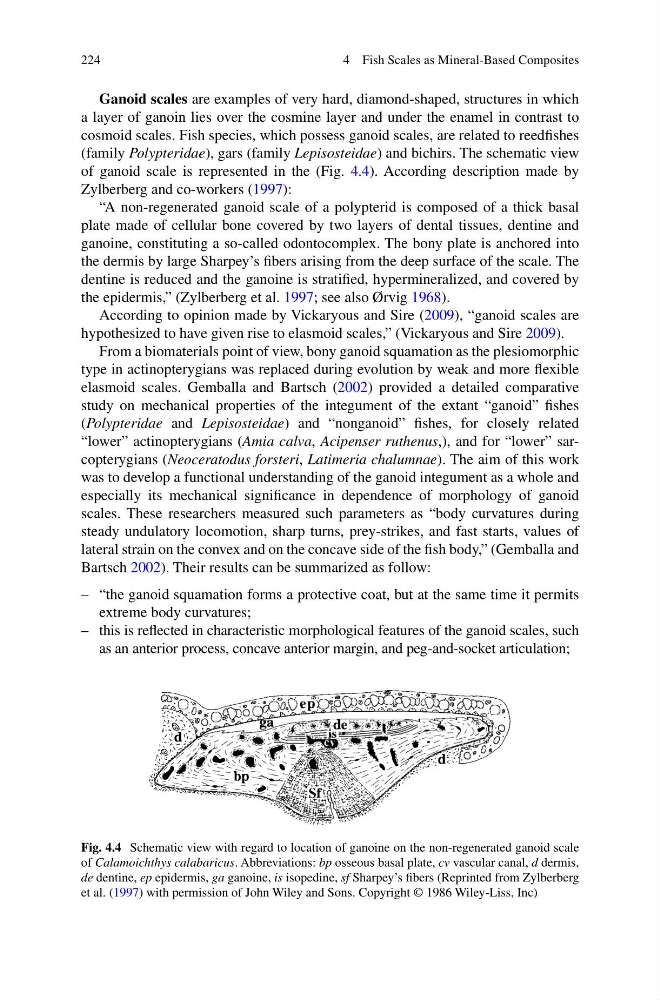
of ganoid scale is represented in the (Fig. 4.4 ). According description made by
Zylberberg and co-workers ( 1997 ):
“A non-regenerated ganoid scale of a polypterid is composed of a thick basal
plate made of cellular bone covered by two layers of dental tissues, dentine and
ganoine, constituting a so-called odontocomplex. The bony plate is anchored into
the dermis by large Sharpey’s fi bers arising from the deep surface of the scale. The
dentine is reduced and the ganoine is stratifi ed, hypermineralized, and covered by
the epidermis,” (Zylberberg et al. 1997 ; see also Ørvig 1968 ).
According to opinion made by Vickaryous and Sire ( 2009 ), “ganoid scales are
hypothesized to have given rise to elasmoid scales,” (Vickaryous and Sire 2009 ).
From a biomaterials point of view, bony ganoid squamation as the plesiomorphic
type in actinopterygians was replaced during evolution by weak and more fl exible
elasmoid scales. Gemballa and Bartsch ( 2002 ) provided a detailed comparative
study on mechanical properties of the integument of the extant “ganoid” fi shes
( Polypteridae and Lepisosteidae ) and “nonganoid” fi shes, for closely related
“lower” actinopterygians ( Amia calva , Acipenser ruthenus ,), and for “lower” sarcopterygians ( Neoceratodus forsteri , Latimeria chalumnae ). The aim of this work
was to develop a functional understanding of the ganoid integument as a whole and
especially its mechanical signifi cance in dependence of morphology of ganoid
scales. These researchers measured such parameters as “body curvatures during
steady undulatory locomotion, sharp turns, prey-strikes, and fast starts, values of
lateral strain on the convex and on the concave side of the fi sh body,” (Gemballa and
Bartsch 2002 ). Their results can be summarized as follow:
– “the ganoid squamation forms a protective coat, but at the same time it permits
extreme body curvatures;
– this is refl ected in characteristic morphological features of the ganoid scales, such
as an anterior process, concave anterior margin, and peg-and-socket articulation;
Fig. 4.4 Schematic view with regard to location of ganoine on the non-regenerated ganoid scale
of Calamoichthys calabaricus . Abbreviations: bp osseous basal plate, cv vascular canal, d dermis,
de dentine, ep epidermis, ga ganoine, is isopedine, sf Sharpey’s fi bers (Reprinted from Zylberberg
et al. ( 1997 ) with permission of John Wiley and Sons. Copyright © 1986 Wiley-Liss, Inc)
4 Fish Scales as Mineral-Based Composites
Ganoid scales are examples of very hard, diamond-shaped, structures in which
a layer of ganoin lies over the cosmine layer and under the enamel in contrast to
cosmoid scales. Fish species, which possess ganoid scales, are related to reedfi shes
(family Polypteridae ), gars (family Lepisosteidae ) and bichirs. The schematic view
of ganoid scale is represented in the (Fig. 4.4 ). According description made by
Zylberberg and co-workers ( 1997 ):
“A non-regenerated ganoid scale of a polypterid is composed of a thick basal
plate made of cellular bone covered by two layers of dental tissues, dentine and
ganoine, constituting a so-called odontocomplex. The bony plate is anchored into
the dermis by large Sharpey’s fi bers arising from the deep surface of the scale. The
dentine is reduced and the ganoine is stratifi ed, hypermineralized, and covered by
the epidermis,” (Zylberberg et al. 1997 ; see also Ørvig 1968 ).
According to opinion made by Vickaryous and Sire ( 2009 ), “ganoid scales are
hypothesized to have given rise to elasmoid scales,” (Vickaryous and Sire 2009 ).
From a biomaterials point of view, bony ganoid squamation as the plesiomorphic
type in actinopterygians was replaced during evolution by weak and more fl exible
elasmoid scales. Gemballa and Bartsch ( 2002 ) provided a detailed comparative
study on mechanical properties of the integument of the extant “ganoid” fi shes
( Polypteridae and Lepisosteidae ) and “nonganoid” fi shes, for closely related
“lower” actinopterygians ( Amia calva , Acipenser ruthenus ,), and for “lower” sarcopterygians ( Neoceratodus forsteri , Latimeria chalumnae ). The aim of this work
was to develop a functional understanding of the ganoid integument as a whole and
especially its mechanical signifi cance in dependence of morphology of ganoid
scales. These researchers measured such parameters as “body curvatures during
steady undulatory locomotion, sharp turns, prey-strikes, and fast starts, values of
lateral strain on the convex and on the concave side of the fi sh body,” (Gemballa and
Bartsch 2002 ). Their results can be summarized as follow:
– “the ganoid squamation forms a protective coat, but at the same time it permits
extreme body curvatures;
– this is refl ected in characteristic morphological features of the ganoid scales, such
as an anterior process, concave anterior margin, and peg-and-socket articulation;
Fig. 4.4 Schematic view with regard to location of ganoine on the non-regenerated ganoid scale
of Calamoichthys calabaricus . Abbreviations: bp osseous basal plate, cv vascular canal, d dermis,
de dentine, ep epidermis, ga ganoine, is isopedine, sf Sharpey’s fi bers (Reprinted from Zylberberg
et al. ( 1997 ) with permission of John Wiley and Sons. Copyright © 1986 Wiley-Liss, Inc)
4 Fish Scales as Mineral-Based Composites