

131
have tusks as well as males. Belcher ( 1885 ) described a Walrus hauling itself out
of the water onto an ice-fl oe: “ It then dug its tusks with a terrifi c force into the
ice that I feared for its brain. Leech-like, the animal hauled itself forward by the
enormous muscular power of the neck, repeating the operation until it was secure.
The force with which the tusks were struck into the ice appeared not only suffi cient
to break them, but the concussion was so heavy that I was surprised that any brain
could bear it, ” (Belcher 1885 ). It was also suggested that the tusks can play a
social role because animals use them in dominance and mating. Without doubts,
these strong formations are dangerous when walruses cross them, however used
only secondarily as weapons. Tusking is confi rmed due to observations of the scars
on the necks and shoulders of adult males (Kastelein and Mosterd 1989 ; Kastelein
et al. 1991 ).
Unfortunately, there is no detailed information regarding the ultra- and microstructure as well as material properties of walrus tusk.
Brody et al. ( 2001 ) reported that there are some possibilities to identify walrus
tusk from bone and teeth of other animals using FT Raman spectroscopy. When
viewed on its cross-section, the tusk has a wavy oval outline. The centre of each tusk
is fi lled with an identifying core of “rice bubble”- like osteo-dentine. This core is
surrounded by lighter coloured, silky, radially arrayed fi brous primary dentine, and
an outer layer of lighter coloured cementum (Fig. 3.22 ).
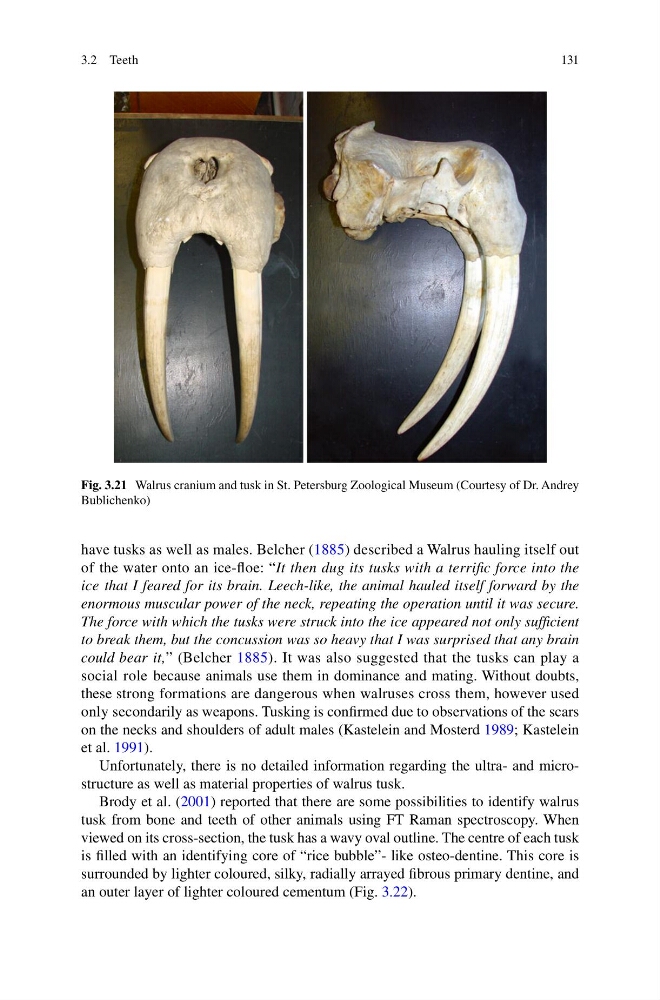
Fig. 3.21 Walrus cranium and tusk in St. Petersburg Zoological Museum (Courtesy of Dr. Andrey
Bublichenko)
3.2 Teeth
have tusks as well as males. Belcher ( 1885 ) described a Walrus hauling itself out
of the water onto an ice-fl oe: “ It then dug its tusks with a terrifi c force into the
ice that I feared for its brain. Leech-like, the animal hauled itself forward by the
enormous muscular power of the neck, repeating the operation until it was secure.
The force with which the tusks were struck into the ice appeared not only suffi cient
to break them, but the concussion was so heavy that I was surprised that any brain
could bear it, ” (Belcher 1885 ). It was also suggested that the tusks can play a
social role because animals use them in dominance and mating. Without doubts,
these strong formations are dangerous when walruses cross them, however used
only secondarily as weapons. Tusking is confi rmed due to observations of the scars
on the necks and shoulders of adult males (Kastelein and Mosterd 1989 ; Kastelein
et al. 1991 ).
Unfortunately, there is no detailed information regarding the ultra- and microstructure as well as material properties of walrus tusk.
Brody et al. ( 2001 ) reported that there are some possibilities to identify walrus
tusk from bone and teeth of other animals using FT Raman spectroscopy. When
viewed on its cross-section, the tusk has a wavy oval outline. The centre of each tusk
is fi lled with an identifying core of “rice bubble”- like osteo-dentine. This core is
surrounded by lighter coloured, silky, radially arrayed fi brous primary dentine, and
an outer layer of lighter coloured cementum (Fig. 3.22 ).
Fig. 3.21 Walrus cranium and tusk in St. Petersburg Zoological Museum (Courtesy of Dr. Andrey
Bublichenko)
3.2 Teeth