

130
3.2.6.6 Walrus Tusk
The two subspecies, the Atlantic walrus ( Odobenus. r. rosmarus ) and the Pacifi c
walrus ( O. r. divergens ), are representatives of the Odobenidae family, which
occur in geographically isolated populations. Male Pacifi c walruses weigh about
800–1,700 kg and are about 2.7–3.6 m long. Female Pacifi c walruses weigh about
400–1,250 kg and are about 2.3–3.1 m long. Specimens of Odobenus. r. rosmarus
are slightly smaller: females weigh about 794 kg and reach lengths of 2.4 m,
however, males weigh about 908 kg and reach lengths of 2.9 m (see for review von
Baer 1837 ; Murie 1871 ; Schmidt 1885 ; Chapskii 1936 ; Fay 1955 , 1982 ; Outridge
et al. 2003 ; Wilson and Reeder 2005 ).
Most of these marine mammals possess 18 teeth. Their upper canine teeth are
modifi ed into long ivory tusks (Fig. 3.21 ). The skull does not only have to withstand
blows when the tusks hit the substrate, but it also has to withstand the tractive force
produced from the tusks when they act as levers. Fay ( 1955 ) reported that on average they grow in length of about 36 cm, but they may be up to 100 cm. The feeding
diet of walruses includes mostly mollusks. Correspondingly their cheek teeth are
specialized for crushing shells. These animals use their tusks for prying shellfi sh
from the sea bottom as well as they can dive to a depth of 70 m to fi nd the prey.
However, two other important mechanical functions of Walrus tusks are to aid in
hauling out onto land or ice ( Odobenus rosmarus means ‘tooth walking sea horse’)
(Kastelein and Gerrits 1990 ), and to work as a chisel to keep holes in the ice open
(Fay 1982 ). These two functions of the tusks could explain the fact that females
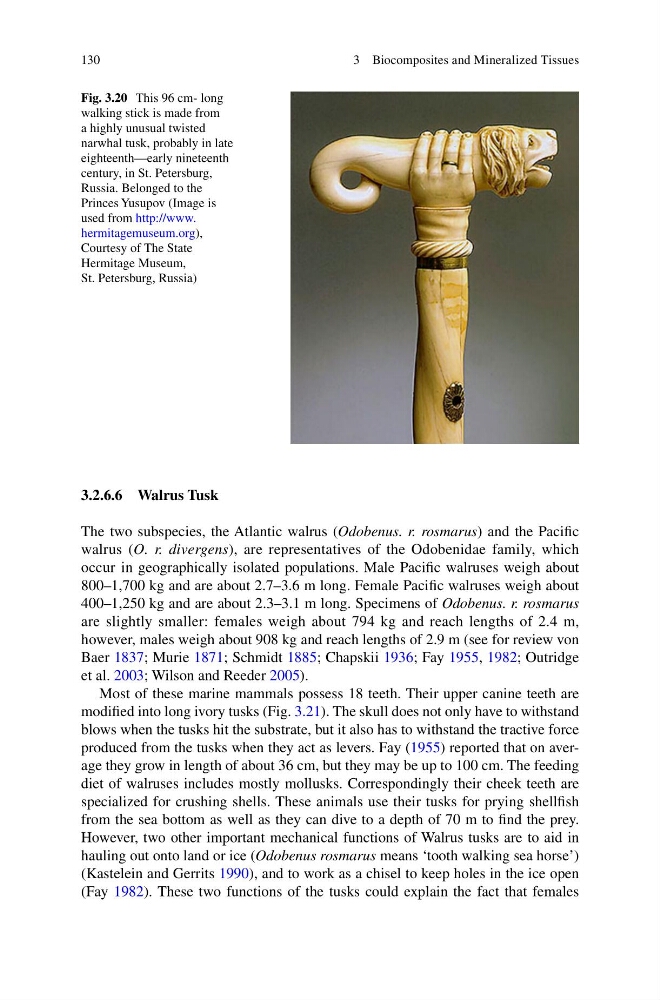
Fig. 3.20 This 96 cm- long
walking stick is made from
a highly unusual twisted
narwhal tusk, probably in late
eighteenth—early nineteenth
century, in St. Petersburg,
Russia. Belonged to the
Princes Yusupov (Image is
used from http://www.
hermitagemuseum.org ),
Courtesy of The State
Hermitage Museum,
St. Petersburg, Russia)
3 Biocomposites and Mineralized Tissues
3.2.6.6 Walrus Tusk
The two subspecies, the Atlantic walrus ( Odobenus. r. rosmarus ) and the Pacifi c
walrus ( O. r. divergens ), are representatives of the Odobenidae family, which
occur in geographically isolated populations. Male Pacifi c walruses weigh about
800–1,700 kg and are about 2.7–3.6 m long. Female Pacifi c walruses weigh about
400–1,250 kg and are about 2.3–3.1 m long. Specimens of Odobenus. r. rosmarus
are slightly smaller: females weigh about 794 kg and reach lengths of 2.4 m,
however, males weigh about 908 kg and reach lengths of 2.9 m (see for review von
Baer 1837 ; Murie 1871 ; Schmidt 1885 ; Chapskii 1936 ; Fay 1955 , 1982 ; Outridge
et al. 2003 ; Wilson and Reeder 2005 ).
Most of these marine mammals possess 18 teeth. Their upper canine teeth are
modifi ed into long ivory tusks (Fig. 3.21 ). The skull does not only have to withstand
blows when the tusks hit the substrate, but it also has to withstand the tractive force
produced from the tusks when they act as levers. Fay ( 1955 ) reported that on average they grow in length of about 36 cm, but they may be up to 100 cm. The feeding
diet of walruses includes mostly mollusks. Correspondingly their cheek teeth are
specialized for crushing shells. These animals use their tusks for prying shellfi sh
from the sea bottom as well as they can dive to a depth of 70 m to fi nd the prey.
However, two other important mechanical functions of Walrus tusks are to aid in
hauling out onto land or ice ( Odobenus rosmarus means ‘tooth walking sea horse’)
(Kastelein and Gerrits 1990 ), and to work as a chisel to keep holes in the ice open
(Fay 1982 ). These two functions of the tusks could explain the fact that females
Fig. 3.20 This 96 cm- long
walking stick is made from
a highly unusual twisted
narwhal tusk, probably in late
eighteenth—early nineteenth
century, in St. Petersburg,
Russia. Belonged to the
Princes Yusupov (Image is
used from http://www.
hermitagemuseum.org ),
Courtesy of The State
Hermitage Museum,
St. Petersburg, Russia)
3 Biocomposites and Mineralized Tissues