

132
The root and the tusk proper are the structural components of the walrus tusks.
In their classical work, Espinoza and Mann ( 2000 ) described the structural organization of this hard tissue as follow:
“ The tip of a walrus tusk has an enamel coating which is worn away during the
animal’s youth. Fine longitudinal cracks, which appear as radial cracks in cross- section,
originate in the cementum and penetrate the dentine. These cracks can be seen
throughout the length of the tusk. Whole cross-sections of walrus tusks are generally
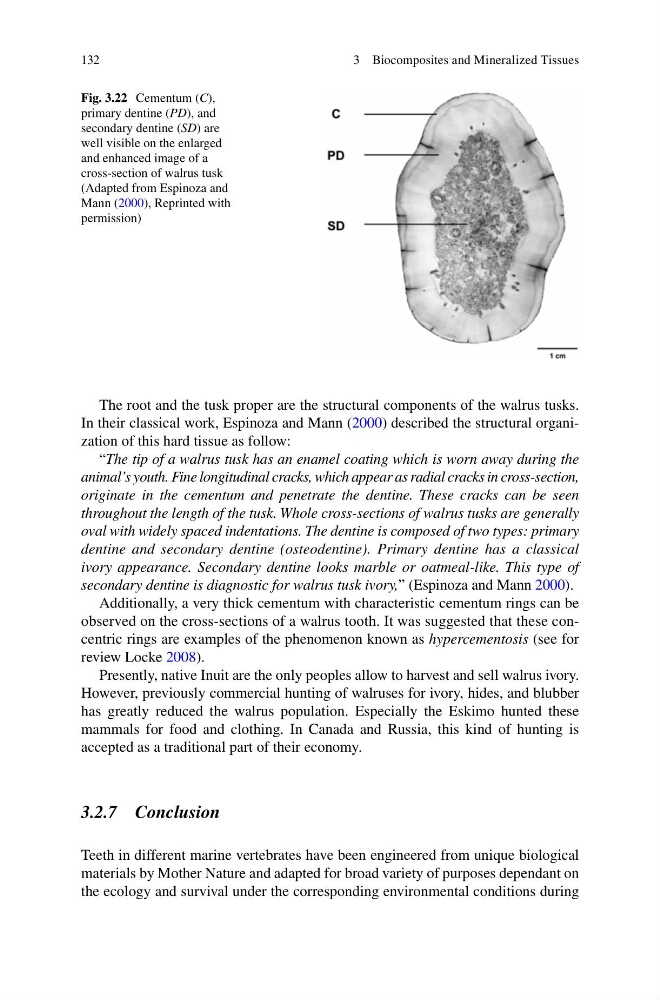
oval with widely spaced indentations. The dentine is composed of two types: primary
dentine and secondary dentine (osteodentine). Primary dentine has a classical
ivory appearance. Secondary dentine looks marble or oatmeal-like. This type of
secondary dentine is diagnostic for walrus tusk ivory, ” (Espinoza and Mann 2000 ).
Additionally, a very thick cementum with characteristic cementum rings can be
observed on the cross-sections of a walrus tooth. It was suggested that these concentric rings are examples of the phenomenon known as hypercementosis (see for
review Locke 2008 ).
Presently, native Inuit are the only peoples allow to harvest and sell walrus ivory.
However, previously commercial hunting of walruses for ivory, hides, and blubber
has greatly reduced the walrus population. Especially the Eskimo hunted these
mammals for food and clothing. In Canada and Russia, this kind of hunting is
accepted as a traditional part of their economy.
3.2.7 Conclusion
Teeth in different marine vertebrates have been engineered from unique biological
materials by Mother Nature and adapted for broad variety of purposes dependant on
the ecology and survival under the corresponding environmental conditions during
Fig. 3.22 Cementum ( C ),
primary dentine ( PD ), and
secondary dentine ( SD ) are
well visible on the enlarged
and enhanced image of a
cross-section of walrus tusk
(Adapted from Espinoza and
Mann ( 2000 ), Reprinted with
permission)
3 Biocomposites and Mineralized Tissues
The root and the tusk proper are the structural components of the walrus tusks.
In their classical work, Espinoza and Mann ( 2000 ) described the structural organization of this hard tissue as follow:
“ The tip of a walrus tusk has an enamel coating which is worn away during the
animal’s youth. Fine longitudinal cracks, which appear as radial cracks in cross- section,
originate in the cementum and penetrate the dentine. These cracks can be seen
throughout the length of the tusk. Whole cross-sections of walrus tusks are generally
oval with widely spaced indentations. The dentine is composed of two types: primary
dentine and secondary dentine (osteodentine). Primary dentine has a classical
ivory appearance. Secondary dentine looks marble or oatmeal-like. This type of
secondary dentine is diagnostic for walrus tusk ivory, ” (Espinoza and Mann 2000 ).
Additionally, a very thick cementum with characteristic cementum rings can be
observed on the cross-sections of a walrus tooth. It was suggested that these concentric rings are examples of the phenomenon known as hypercementosis (see for
review Locke 2008 ).
Presently, native Inuit are the only peoples allow to harvest and sell walrus ivory.
However, previously commercial hunting of walruses for ivory, hides, and blubber
has greatly reduced the walrus population. Especially the Eskimo hunted these
mammals for food and clothing. In Canada and Russia, this kind of hunting is
accepted as a traditional part of their economy.
3.2.7 Conclusion
Teeth in different marine vertebrates have been engineered from unique biological
materials by Mother Nature and adapted for broad variety of purposes dependant on
the ecology and survival under the corresponding environmental conditions during
Fig. 3.22 Cementum ( C ),
primary dentine ( PD ), and
secondary dentine ( SD ) are
well visible on the enlarged
and enhanced image of a
cross-section of walrus tusk
(Adapted from Espinoza and
Mann ( 2000 ), Reprinted with
permission)
3 Biocomposites and Mineralized Tissues