

123
with enamel,” (Meredith et al. 2009 ; see also Uhen 2010 ). Recently, Fitzgerald
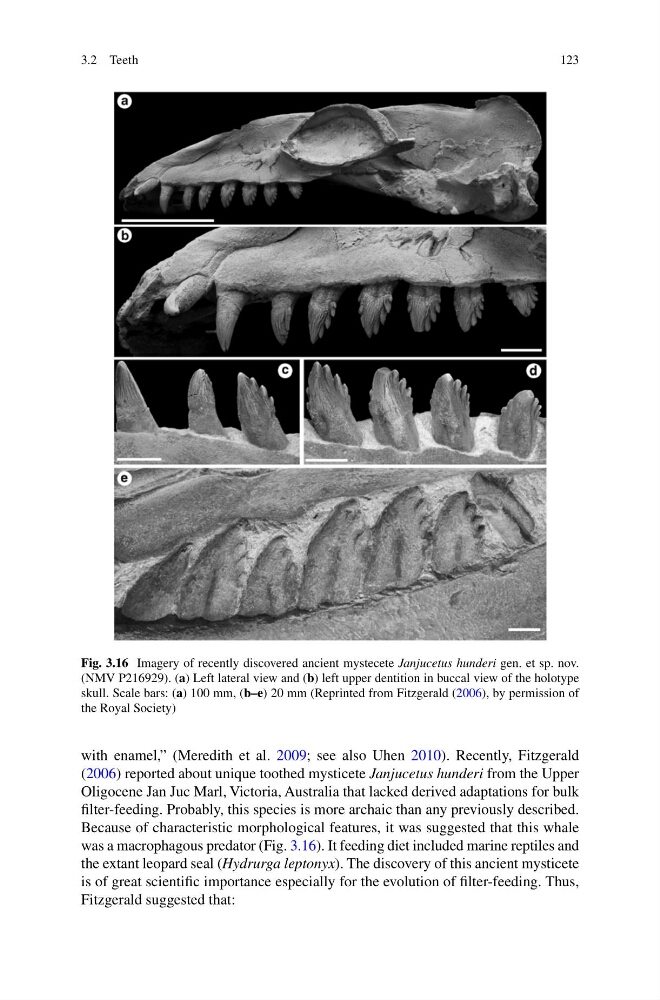
( 2006 ) reported about unique toothed mysticete Janjucetus hunderi from the Upper
Oligocene Jan Juc Marl, Victoria, Australia that lacked derived adaptations for bulk
fi lter-feeding. Probably, this species is more archaic than any previously described.
Because of characteristic morphological features, it was suggested that this whale
was a macrophagous predator (Fig. 3.16 ). It feeding diet included marine reptiles and
the extant leopard seal ( Hydrurga leptonyx ). The discovery of this ancient mysticete
is of great scientifi c importance especially for the evolution of fi lter-feeding. Thus,
Fitzgerald suggested that:
Fig. 3.16 Imagery of recently discovered ancient mystecete Janjucetus hunderi gen. et sp. nov.
(NMV P216929). ( a ) Left lateral view and ( b ) left upper dentition in buccal view of the holotype
skull. Scale bars: ( a ) 100 mm, ( b–e ) 20 mm (Reprinted from Fitzgerald ( 2006 ), by permission of
the Royal Society)
3.2 Teeth
with enamel,” (Meredith et al. 2009 ; see also Uhen 2010 ). Recently, Fitzgerald
( 2006 ) reported about unique toothed mysticete Janjucetus hunderi from the Upper
Oligocene Jan Juc Marl, Victoria, Australia that lacked derived adaptations for bulk
fi lter-feeding. Probably, this species is more archaic than any previously described.
Because of characteristic morphological features, it was suggested that this whale
was a macrophagous predator (Fig. 3.16 ). It feeding diet included marine reptiles and
the extant leopard seal ( Hydrurga leptonyx ). The discovery of this ancient mysticete
is of great scientifi c importance especially for the evolution of fi lter-feeding. Thus,
Fitzgerald suggested that:
Fig. 3.16 Imagery of recently discovered ancient mystecete Janjucetus hunderi gen. et sp. nov.
(NMV P216929). ( a ) Left lateral view and ( b ) left upper dentition in buccal view of the holotype
skull. Scale bars: ( a ) 100 mm, ( b–e ) 20 mm (Reprinted from Fitzgerald ( 2006 ), by permission of
the Royal Society)
3.2 Teeth