

124
“ Mysticetes evidently radiated into a variety of disparate forms and feeding
ecologies before the evolution of baleen or fi lterfeeding. The phylogenetic context of
the new whale indicates that basal mysticetes were microphagous predators that
did not employ fi lter-feeding or echolocation, and that the evolution of characters
associated with bulk fi lter-feeding was gradual, ” (Fitzgerald 2006 ).
All odontoceti teeth are meant for holding prey, not ripping, tearing, or chewing.
Odontocetes take individual prey. Their feeding diet contains of cephalopod mollusks
like squids and fi shes (see for review Rice 1989 ). World oceans are the habituate for
orcas, or killer whales (Delphinidae family), which are known as top predator in all
aquatic niches where they occur. These animals have extremely large, curved teeth
and consume diverse forms of prey, ranging from small schooling fi sh to phocid,
bearded seals, and cetaceans like beluga, narwhal, and even large baleen whales
(Ferguson et al. 2012 ).
Sperm whale ( Physeter macrocephalus ) ivory is derived from one of the
forty- eight curved conical teeth that are located in the lower jaw of the animal
(see for review Boschma 1938 ). These cone-shaped teeth possess a nerve root that
goes to the tip as well as a hollow end. The distinguishing characteristic is a clear
line of transition between the dentine and cementum layers. Thus, Sperm whale
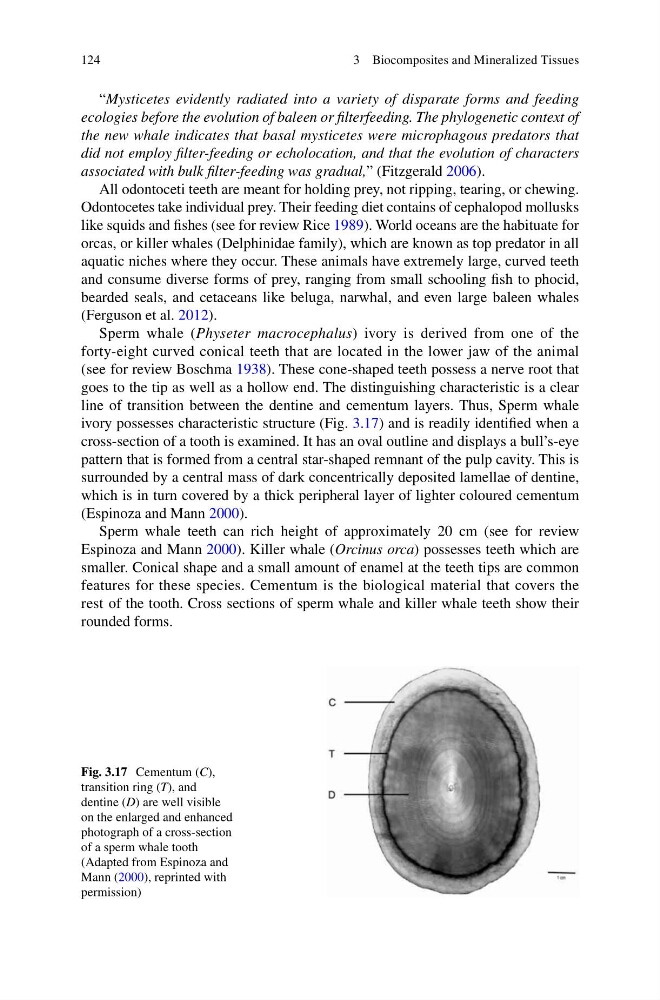
ivory possesses characteristic structure (Fig. 3.17 ) and is readily identifi ed when a
cross- section of a tooth is examined. It has an oval outline and displays a bull’s-eye
pattern that is formed from a central star-shaped remnant of the pulp cavity. This is
surrounded by a central mass of dark concentrically deposited lamellae of dentine,
which is in turn covered by a thick peripheral layer of lighter coloured cementum
(Espinoza and Mann 2000 ).
Sperm whale teeth can rich height of approximately 20 cm (see for review
Espinoza and Mann 2000 ). Killer whale ( Orcinus orca ) possesses teeth which are
smaller. Conical shape and a small amount of enamel at the teeth tips are common
features for these species. Cementum is the biological material that covers the
rest of the tooth. Cross sections of sperm whale and killer whale teeth show their
rounded forms.
Fig. 3.17 Cementum ( C ),
transition ring ( T ), and
dentine ( D ) are well visible
on the enlarged and enhanced
photograph of a cross-section
of a sperm whale tooth
(Adapted from Espinoza and
Mann ( 2000 ), reprinted with
permission)
3 Biocomposites and Mineralized Tissues
“ Mysticetes evidently radiated into a variety of disparate forms and feeding
ecologies before the evolution of baleen or fi lterfeeding. The phylogenetic context of
the new whale indicates that basal mysticetes were microphagous predators that
did not employ fi lter-feeding or echolocation, and that the evolution of characters
associated with bulk fi lter-feeding was gradual, ” (Fitzgerald 2006 ).
All odontoceti teeth are meant for holding prey, not ripping, tearing, or chewing.
Odontocetes take individual prey. Their feeding diet contains of cephalopod mollusks
like squids and fi shes (see for review Rice 1989 ). World oceans are the habituate for
orcas, or killer whales (Delphinidae family), which are known as top predator in all
aquatic niches where they occur. These animals have extremely large, curved teeth
and consume diverse forms of prey, ranging from small schooling fi sh to phocid,
bearded seals, and cetaceans like beluga, narwhal, and even large baleen whales
(Ferguson et al. 2012 ).
Sperm whale ( Physeter macrocephalus ) ivory is derived from one of the
forty- eight curved conical teeth that are located in the lower jaw of the animal
(see for review Boschma 1938 ). These cone-shaped teeth possess a nerve root that
goes to the tip as well as a hollow end. The distinguishing characteristic is a clear
line of transition between the dentine and cementum layers. Thus, Sperm whale
ivory possesses characteristic structure (Fig. 3.17 ) and is readily identifi ed when a
cross- section of a tooth is examined. It has an oval outline and displays a bull’s-eye
pattern that is formed from a central star-shaped remnant of the pulp cavity. This is
surrounded by a central mass of dark concentrically deposited lamellae of dentine,
which is in turn covered by a thick peripheral layer of lighter coloured cementum
(Espinoza and Mann 2000 ).
Sperm whale teeth can rich height of approximately 20 cm (see for review
Espinoza and Mann 2000 ). Killer whale ( Orcinus orca ) possesses teeth which are
smaller. Conical shape and a small amount of enamel at the teeth tips are common
features for these species. Cementum is the biological material that covers the
rest of the tooth. Cross sections of sperm whale and killer whale teeth show their
rounded forms.
Fig. 3.17 Cementum ( C ),
transition ring ( T ), and
dentine ( D ) are well visible
on the enlarged and enhanced
photograph of a cross-section
of a sperm whale tooth
(Adapted from Espinoza and
Mann ( 2000 ), reprinted with
permission)
3 Biocomposites and Mineralized Tissues