

122
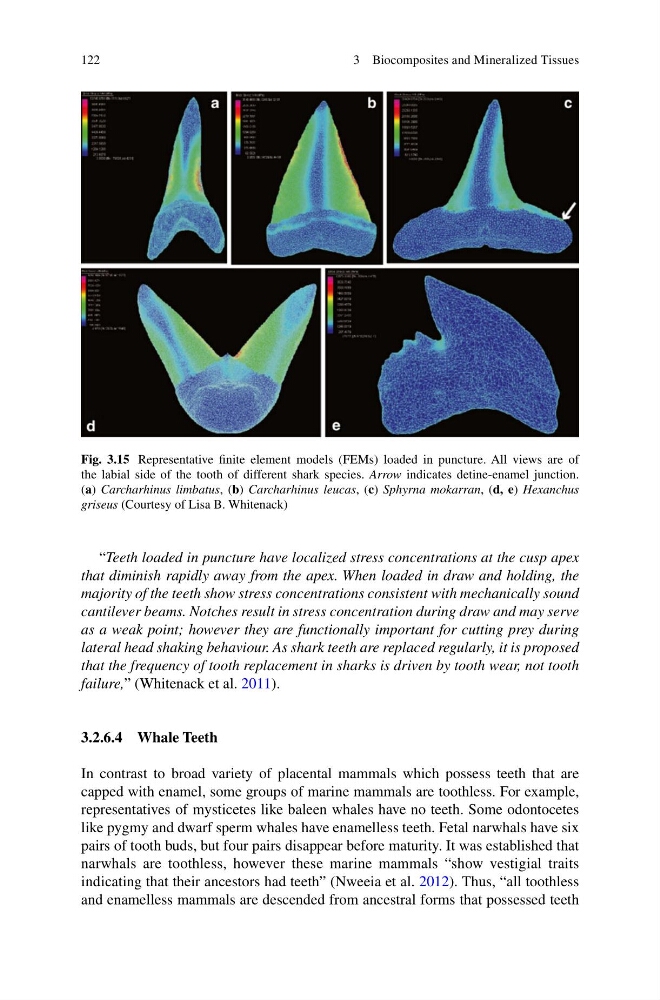
“ Teeth loaded in puncture have localized stress concentrations at the cusp apex
that diminish rapidly away from the apex. When loaded in draw and holding, the
majority of the teeth show stress concentrations consistent with mechanically sound
cantilever beams. Notches result in stress concentration during draw and may serve
as a weak point; however they are functionally important for cutting prey during
lateral head shaking behaviour. As shark teeth are replaced regularly, it is proposed
that the frequency of tooth replacement in sharks is driven by tooth wear, not tooth
failure, ” (Whitenack et al. 2011 ).
3.2.6.4 Whale Teeth
In contrast to broad variety of placental mammals which possess teeth that are
capped with enamel, some groups of marine mammals are toothless. For example,
representatives of mysticetes like baleen whales have no teeth. Some odontocetes
like pygmy and dwarf sperm whales have enamelless teeth. Fetal narwhals have six
pairs of tooth buds, but four pairs disappear before maturity. It was established that
narwhals are toothless, however these marine mammals “show vestigial traits
indicating that their ancestors had teeth” (Nweeia et al. 2012 ). Thus, “all toothless
and enamelless mammals are descended from ancestral forms that possessed teeth
Fig. 3.15 Representative fi nite element models (FEMs) loaded in puncture. All views are of
the labial side of the tooth of different shark species. Arrow indicates detine-enamel junction.
( a ) Carcharhinus limbatus , ( b ) Carcharhinus leucas , ( c ) Sphyrna mokarran , ( d, e ) Hexanchus
griseus (Courtesy of Lisa B. Whitenack)
3 Biocomposites and Mineralized Tissues
“ Teeth loaded in puncture have localized stress concentrations at the cusp apex
that diminish rapidly away from the apex. When loaded in draw and holding, the
majority of the teeth show stress concentrations consistent with mechanically sound
cantilever beams. Notches result in stress concentration during draw and may serve
as a weak point; however they are functionally important for cutting prey during
lateral head shaking behaviour. As shark teeth are replaced regularly, it is proposed
that the frequency of tooth replacement in sharks is driven by tooth wear, not tooth
failure, ” (Whitenack et al. 2011 ).
3.2.6.4 Whale Teeth
In contrast to broad variety of placental mammals which possess teeth that are
capped with enamel, some groups of marine mammals are toothless. For example,
representatives of mysticetes like baleen whales have no teeth. Some odontocetes
like pygmy and dwarf sperm whales have enamelless teeth. Fetal narwhals have six
pairs of tooth buds, but four pairs disappear before maturity. It was established that
narwhals are toothless, however these marine mammals “show vestigial traits
indicating that their ancestors had teeth” (Nweeia et al. 2012 ). Thus, “all toothless
and enamelless mammals are descended from ancestral forms that possessed teeth
Fig. 3.15 Representative fi nite element models (FEMs) loaded in puncture. All views are of
the labial side of the tooth of different shark species. Arrow indicates detine-enamel junction.
( a ) Carcharhinus limbatus , ( b ) Carcharhinus leucas , ( c ) Sphyrna mokarran , ( d, e ) Hexanchus
griseus (Courtesy of Lisa B. Whitenack)
3 Biocomposites and Mineralized Tissues