

106
development of dermal denticles and teeth from the same developmental platform.
Teeth and dermal denticles should to be homologous structures which were
developed at several body locations, however through the initiation of a common
gene regulatory network. Alternatively, Fraser and Smith ( 2011 ) suggested recently
“ that the patterning mechanism observed for the oral and pharyngeal dentition is
unique to the vertebrate oro-pharynx and independent of the skin system. Therefore,
a co- option of a successional iterative pattern occurred in evolution not from the
skin, but from mechanisms existing in the oro-pharynx of now extinct agnathans ,”
(Fraser and Smith 2011 ).
In contrast to “true” teeth, denticles are mineralized structures, located on
the dermal surface and within the oro-pharyngeal cavity of vertebrates like
Elasmobranchii. They consist of dentine and attachment bone. In some cases
denticles are covered with superfi cial layer of enameloid from a single papilla
origin (Fraser et al. 2010 ).
Three types of teeth, based on their origin, have been proposed: jaw, mouth and
pharyngeal (Koussoulakou et al. 2009 ). Diversity of the teeth-like structures
(e.g. pharyngeal denticles) and “true teeth”, their shape and forms, mechanisms of biomineralization, as well as the broad variety of biological materials (enameloid, enamel,
dentine, petrodentine, isopedine, plicidentine, durodentine, keratine etc.) they are
made of in marine vertebrates both within extinct and still existing taxa, is amazing
and represents a goldmine of interest and bioinspiration for material scientists.
3.2.1 Tooth-Like Structures
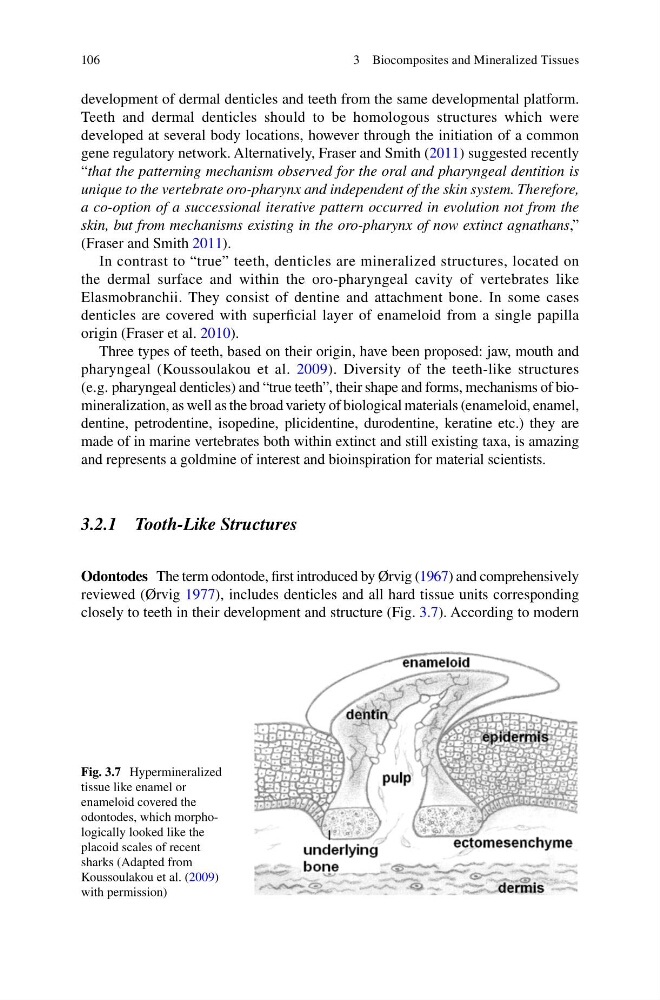
Odontodes The term odontode, fi rst introduced by Ørvig ( 1967 ) and comprehensively
reviewed (Ørvig 1977 ), includes denticles and all hard tissue units corresponding
closely to teeth in their development and structure (Fig. 3.7 ). According to modern
Fig. 3.7 Hypermineralized
tissue like enamel or
enameloid covered the
odontodes, which morphologically looked like the
placoid scales of recent
sharks (Adapted from
Koussoulakou et al. ( 2009 )
with permission)
3 Biocomposites and Mineralized Tissues
development of dermal denticles and teeth from the same developmental platform.
Teeth and dermal denticles should to be homologous structures which were
developed at several body locations, however through the initiation of a common
gene regulatory network. Alternatively, Fraser and Smith ( 2011 ) suggested recently
“ that the patterning mechanism observed for the oral and pharyngeal dentition is
unique to the vertebrate oro-pharynx and independent of the skin system. Therefore,
a co- option of a successional iterative pattern occurred in evolution not from the
skin, but from mechanisms existing in the oro-pharynx of now extinct agnathans ,”
(Fraser and Smith 2011 ).
In contrast to “true” teeth, denticles are mineralized structures, located on
the dermal surface and within the oro-pharyngeal cavity of vertebrates like
Elasmobranchii. They consist of dentine and attachment bone. In some cases
denticles are covered with superfi cial layer of enameloid from a single papilla
origin (Fraser et al. 2010 ).
Three types of teeth, based on their origin, have been proposed: jaw, mouth and
pharyngeal (Koussoulakou et al. 2009 ). Diversity of the teeth-like structures
(e.g. pharyngeal denticles) and “true teeth”, their shape and forms, mechanisms of biomineralization, as well as the broad variety of biological materials (enameloid, enamel,
dentine, petrodentine, isopedine, plicidentine, durodentine, keratine etc.) they are
made of in marine vertebrates both within extinct and still existing taxa, is amazing
and represents a goldmine of interest and bioinspiration for material scientists.
3.2.1 Tooth-Like Structures
Odontodes The term odontode, fi rst introduced by Ørvig ( 1967 ) and comprehensively
reviewed (Ørvig 1977 ), includes denticles and all hard tissue units corresponding
closely to teeth in their development and structure (Fig. 3.7 ). According to modern
Fig. 3.7 Hypermineralized
tissue like enamel or
enameloid covered the
odontodes, which morphologically looked like the
placoid scales of recent
sharks (Adapted from
Koussoulakou et al. ( 2009 )
with permission)
3 Biocomposites and Mineralized Tissues