

105
cavity, with a distinctive patterned oropharyngeal distribution with associated/
connected replacements developing in advance of their requirement, ” (Fraser et al.
2010 ). However, so called tooth-like structures odontodes have been proposed as
the examples of the earliest mineralized structures in the vertebrate lineage. Their
origin is still long-debated topic. Probably, odontodes emerged fi rst in the throats of
conodonts, the jawless, eel-like creatures with a notochord. From other point of view,
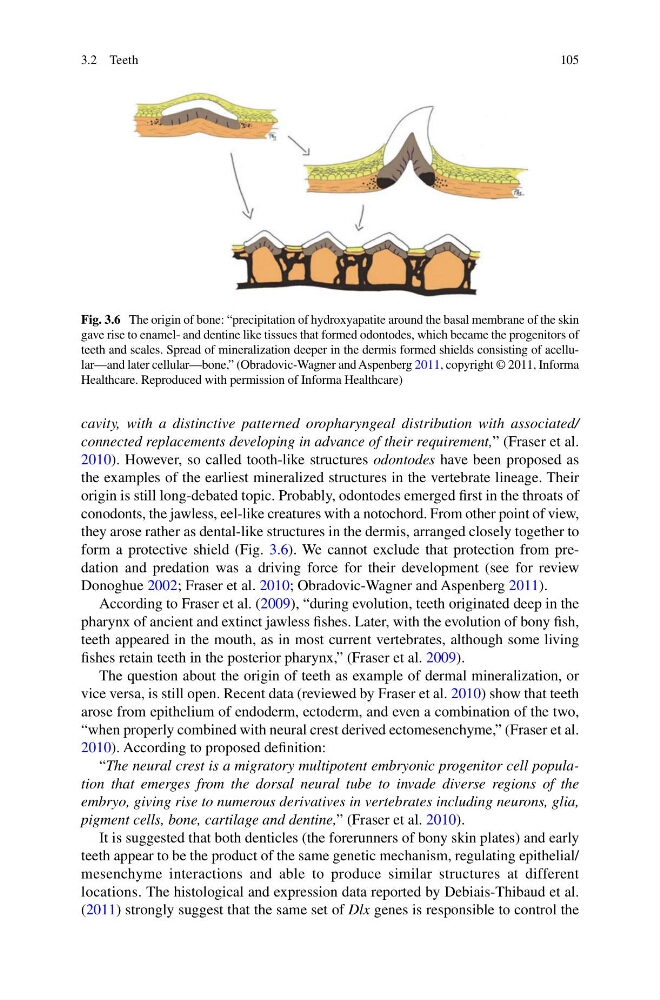
they arose rather as dental-like structures in the dermis, arranged closely together to
form a protective shield (Fig. 3.6 ). We cannot exclude that protection from predation and predation was a driving force for their development (see for review
Donoghue 2002 ; Fraser et al. 2010 ; Obradovic-Wagner and Aspenberg 2011 ).
According to Fraser et al. ( 2009 ), “during evolution, teeth originated deep in the
pharynx of ancient and extinct jawless fi shes. Later, with the evolution of bony fi sh,
teeth appeared in the mouth, as in most current vertebrates, although some living
fi shes retain teeth in the posterior pharynx,” (Fraser et al. 2009 ).
The question about the origin of teeth as example of dermal mineralization, or
vice versa, is still open. Recent data (reviewed by Fraser et al. 2010 ) show that teeth
arose from epithelium of endoderm, ectoderm, and even a combination of the two,
“when properly combined with neural crest derived ectomesenchyme,” (Fraser et al.
2010 ). According to proposed defi nition:
“ The neural crest is a migratory multipotent embryonic progenitor cell population that emerges from the dorsal neural tube to invade diverse regions of the
embryo, giving rise to numerous derivatives in vertebrates including neurons, glia,
pigment cells, bone, cartilage and dentine, ” (Fraser et al. 2010 ).
It is suggested that both denticles (the forerunners of bony skin plates) and early
teeth appear to be the product of the same genetic mechanism, regulating epithelial/
mesenchyme interactions and able to produce similar structures at different
locations. The histological and expression data reported by Debiais-Thibaud et al.
( 2011 ) strongly suggest that the same set of Dlx genes is responsible to control the
Fig. 3.6 The origin of bone: “precipitation of hydroxyapatite around the basal membrane of the skin
gave rise to enamel- and dentine like tissues that formed odontodes, which became the progenitors of
teeth and scales. Spread of mineralization deeper in the dermis formed shields consisting of acellular—and later cellular—bone,” (Obradovic-Wagner and Aspenberg 2011 , copyright © 2011, Informa
Healthcare. Reproduced with permission of Informa Healthcare)
3.2 Teeth
cavity, with a distinctive patterned oropharyngeal distribution with associated/
connected replacements developing in advance of their requirement, ” (Fraser et al.
2010 ). However, so called tooth-like structures odontodes have been proposed as
the examples of the earliest mineralized structures in the vertebrate lineage. Their
origin is still long-debated topic. Probably, odontodes emerged fi rst in the throats of
conodonts, the jawless, eel-like creatures with a notochord. From other point of view,
they arose rather as dental-like structures in the dermis, arranged closely together to
form a protective shield (Fig. 3.6 ). We cannot exclude that protection from predation and predation was a driving force for their development (see for review
Donoghue 2002 ; Fraser et al. 2010 ; Obradovic-Wagner and Aspenberg 2011 ).
According to Fraser et al. ( 2009 ), “during evolution, teeth originated deep in the
pharynx of ancient and extinct jawless fi shes. Later, with the evolution of bony fi sh,
teeth appeared in the mouth, as in most current vertebrates, although some living
fi shes retain teeth in the posterior pharynx,” (Fraser et al. 2009 ).
The question about the origin of teeth as example of dermal mineralization, or
vice versa, is still open. Recent data (reviewed by Fraser et al. 2010 ) show that teeth
arose from epithelium of endoderm, ectoderm, and even a combination of the two,
“when properly combined with neural crest derived ectomesenchyme,” (Fraser et al.
2010 ). According to proposed defi nition:
“ The neural crest is a migratory multipotent embryonic progenitor cell population that emerges from the dorsal neural tube to invade diverse regions of the
embryo, giving rise to numerous derivatives in vertebrates including neurons, glia,
pigment cells, bone, cartilage and dentine, ” (Fraser et al. 2010 ).
It is suggested that both denticles (the forerunners of bony skin plates) and early
teeth appear to be the product of the same genetic mechanism, regulating epithelial/
mesenchyme interactions and able to produce similar structures at different
locations. The histological and expression data reported by Debiais-Thibaud et al.
( 2011 ) strongly suggest that the same set of Dlx genes is responsible to control the
Fig. 3.6 The origin of bone: “precipitation of hydroxyapatite around the basal membrane of the skin
gave rise to enamel- and dentine like tissues that formed odontodes, which became the progenitors of
teeth and scales. Spread of mineralization deeper in the dermis formed shields consisting of acellular—and later cellular—bone,” (Obradovic-Wagner and Aspenberg 2011 , copyright © 2011, Informa
Healthcare. Reproduced with permission of Informa Healthcare)
3.2 Teeth