

12.3 Nacreous Organic Matrix
12.3.1 Chitin
Chitin is an insoluble component in the shells of mollusks, which is synthesized via
a complex transmembrane chitin synthase with an intracellular myosin motor
domain (Schonitzer and Weiss 2007). Chitin exists in the organic framework of
nacreous and prismatic layers, e.g., from Pinctada (Suzuki et al. 2007), Atrina
(Levi-Kalisman et al. 2001), to Haliotis (Bezares et al. 2008), and thought to play
important roles in shell biomineralization (Furuhashi et al. 2009). As the main
components of organic interlamellar sheets in nacre, highly ordered and aligned
beta-chitin constructs the scaffold as the template for nucleation of the calcium
carbonate aragonite crystals (Levi-Kalisman et al. 2001). In vitro experiments
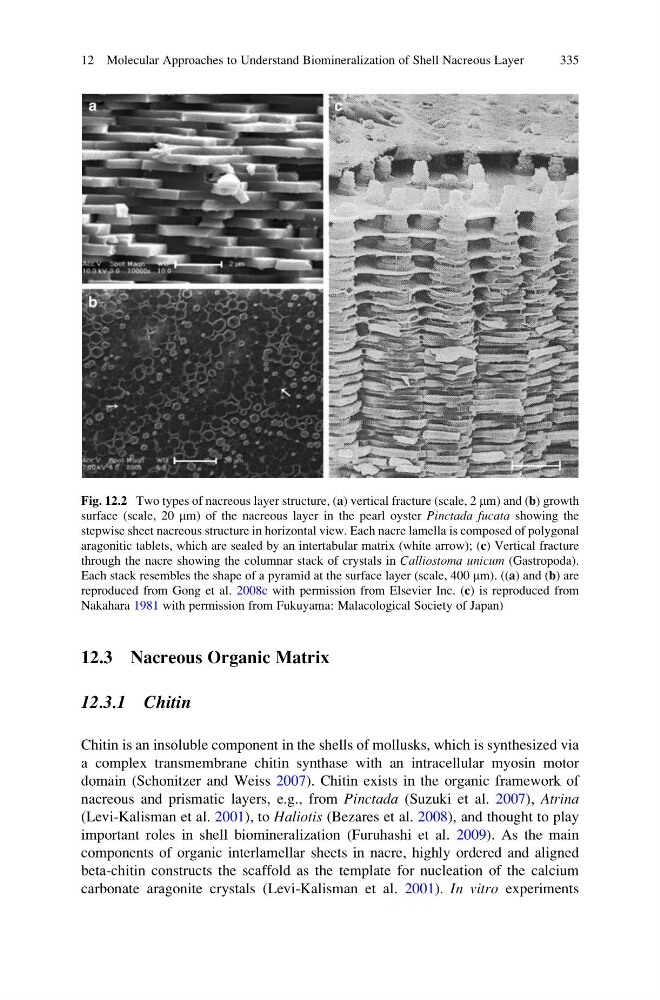
Fig. 12.2 Two types of nacreous layer structure, (a) vertical fracture (scale, 2 mm) and (b) growth
surface (scale, 20 mm) of the nacreous layer in the pearl oyster Pinctada fucata showing the
stepwise sheet nacreous structure in horizontal view. Each nacre lamella is composed of polygonal
aragonitic tablets, which are sealed by an intertabular matrix (white arrow); (c) Vertical fracture
through the nacre showing the columnar stack of crystals in Calliostoma unicum (Gastropoda).
Each stack resembles the shape of a pyramid at the surface layer (scale, 400 mm). ((a) and (b) are
reproduced from Gong et al. 2008c with permission from Elsevier Inc. (c) is reproduced from
Nakahara 1981 with permission from Fukuyama: Malacological Society of Japan)
12 Molecular Approaches to Understand Biomineralization of Shell Nacreous Layer
335
12.3.1 Chitin
Chitin is an insoluble component in the shells of mollusks, which is synthesized via
a complex transmembrane chitin synthase with an intracellular myosin motor
domain (Schonitzer and Weiss 2007). Chitin exists in the organic framework of
nacreous and prismatic layers, e.g., from Pinctada (Suzuki et al. 2007), Atrina
(Levi-Kalisman et al. 2001), to Haliotis (Bezares et al. 2008), and thought to play
important roles in shell biomineralization (Furuhashi et al. 2009). As the main
components of organic interlamellar sheets in nacre, highly ordered and aligned
beta-chitin constructs the scaffold as the template for nucleation of the calcium
carbonate aragonite crystals (Levi-Kalisman et al. 2001). In vitro experiments
Fig. 12.2 Two types of nacreous layer structure, (a) vertical fracture (scale, 2 mm) and (b) growth
surface (scale, 20 mm) of the nacreous layer in the pearl oyster Pinctada fucata showing the
stepwise sheet nacreous structure in horizontal view. Each nacre lamella is composed of polygonal
aragonitic tablets, which are sealed by an intertabular matrix (white arrow); (c) Vertical fracture
through the nacre showing the columnar stack of crystals in Calliostoma unicum (Gastropoda).
Each stack resembles the shape of a pyramid at the surface layer (scale, 400 mm). ((a) and (b) are
reproduced from Gong et al. 2008c with permission from Elsevier Inc. (c) is reproduced from
Nakahara 1981 with permission from Fukuyama: Malacological Society of Japan)
12 Molecular Approaches to Understand Biomineralization of Shell Nacreous Layer
335