

revealed that silk fibroin (framework protein) and chitin interact mainly through the
chitin acetyl groups, and it is thought that there is an interfacial plane between them,
in which the interactions are through the amide groups (Falini et al. 2003).
Another important function of chitin is in the development of the larval shell of
bivalve mollusks. The cDNA encoding chitin synthase, the enzyme responsible for
synthesis of chitin, has been cloned from Pinctada fucata (Suzuki et al. 2007),
Atrina rigida, and Mytilus galloprovincialis (Weiss et al. 2006). Chitinous material,
which exists in the larval shell of mussels, changes with the development of the
larvae (Weiss and Schonitzer 2006). During larval development, when the activity
of chitin synthase is partially inhibited by Nikkomycin Z in vivo, the structure of the
larval shell at various growth fronts is dramatically changed (Schonitzer and Weiss
2007).We also screened and obtained a partial fragment of the gene encoding chitin
synthase at the early stage of larval development of P. fucata (data not shown). All
these observations indicate that chitin fulfills an important function in the formation
and functionality of larval bivalve shells.
Moreover, the expression levels of genes involved in synthesis of chitin show
significant differences between the pearl oyster and abalone. A chitin synthase and
several chitin deacetylation genes are expressed at high levels in P. maxima,
whereas only one protein involved in chitin interactions is present in the H. asinina
dataset, suggesting that the organic matrix upon which nacre biomineralization
proceeds differs fundamentally between these species (Jackson et al. 2010).
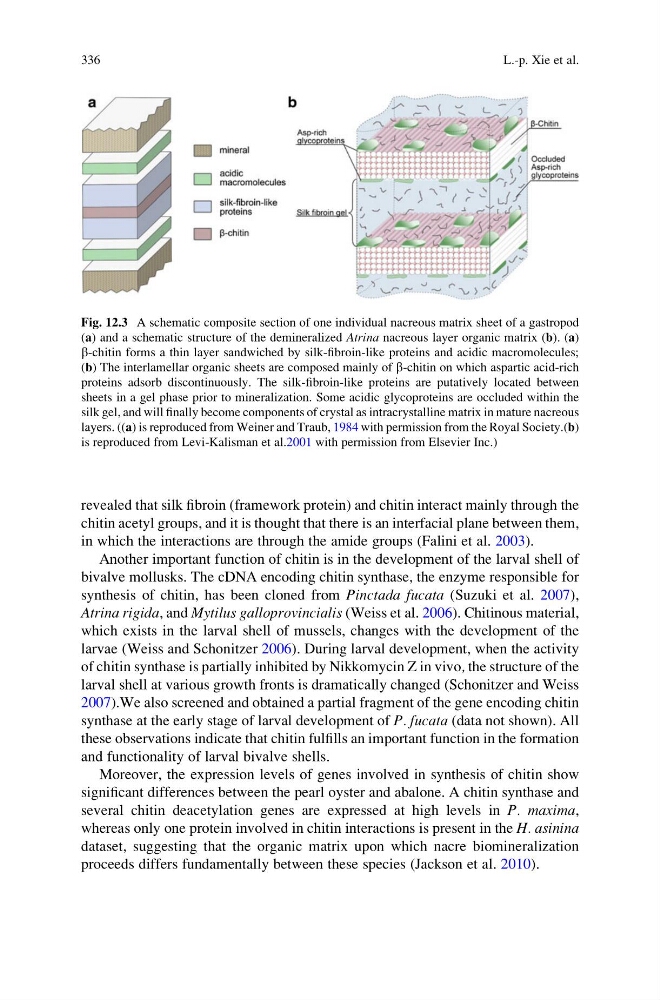
Fig. 12.3 A schematic composite section of one individual nacreous matrix sheet of a gastropod
(a) and a schematic structure of the demineralized Atrina nacreous layer organic matrix (b). (a)
b-chitin forms a thin layer sandwiched by silk-fibroin-like proteins and acidic macromolecules;
(b) The interlamellar organic sheets are composed mainly of b-chitin on which aspartic acid-rich
proteins adsorb discontinuously. The silk-fibroin-like proteins are putatively located between
sheets in a gel phase prior to mineralization. Some acidic glycoproteins are occluded within the
silk gel, and will finally become components of crystal as intracrystalline matrix in mature nacreous
layers. ((a) is reproduced from Weiner and Traub, 1984 with permission from the Royal Society.(b)
is reproduced from Levi-Kalisman et al.2001 with permission from Elsevier Inc.)
336
L.-p. Xie et al.
chitin acetyl groups, and it is thought that there is an interfacial plane between them,
in which the interactions are through the amide groups (Falini et al. 2003).
Another important function of chitin is in the development of the larval shell of
bivalve mollusks. The cDNA encoding chitin synthase, the enzyme responsible for
synthesis of chitin, has been cloned from Pinctada fucata (Suzuki et al. 2007),
Atrina rigida, and Mytilus galloprovincialis (Weiss et al. 2006). Chitinous material,
which exists in the larval shell of mussels, changes with the development of the
larvae (Weiss and Schonitzer 2006). During larval development, when the activity
of chitin synthase is partially inhibited by Nikkomycin Z in vivo, the structure of the
larval shell at various growth fronts is dramatically changed (Schonitzer and Weiss
2007).We also screened and obtained a partial fragment of the gene encoding chitin
synthase at the early stage of larval development of P. fucata (data not shown). All
these observations indicate that chitin fulfills an important function in the formation
and functionality of larval bivalve shells.
Moreover, the expression levels of genes involved in synthesis of chitin show
significant differences between the pearl oyster and abalone. A chitin synthase and
several chitin deacetylation genes are expressed at high levels in P. maxima,
whereas only one protein involved in chitin interactions is present in the H. asinina
dataset, suggesting that the organic matrix upon which nacre biomineralization
proceeds differs fundamentally between these species (Jackson et al. 2010).
Fig. 12.3 A schematic composite section of one individual nacreous matrix sheet of a gastropod
(a) and a schematic structure of the demineralized Atrina nacreous layer organic matrix (b). (a)
b-chitin forms a thin layer sandwiched by silk-fibroin-like proteins and acidic macromolecules;
(b) The interlamellar organic sheets are composed mainly of b-chitin on which aspartic acid-rich
proteins adsorb discontinuously. The silk-fibroin-like proteins are putatively located between
sheets in a gel phase prior to mineralization. Some acidic glycoproteins are occluded within the
silk gel, and will finally become components of crystal as intracrystalline matrix in mature nacreous
layers. ((a) is reproduced from Weiner and Traub, 1984 with permission from the Royal Society.(b)
is reproduced from Levi-Kalisman et al.2001 with permission from Elsevier Inc.)
336
L.-p. Xie et al.