

an important role in nacre biomineralization, researchers have paid more attention
to the interlamellar matrix sheets.
Examination of stained sections of individual matrix sheets from gastropod
nacreous layers showed that these may be composed of five layers (Weiner
and Traub 1984). The core of the matrix sheet consists of a layer of b-chitin.
The latter is sandwiched by layers of silk fibroin-like proteins which are coated by
Asp-rich proteins (Fig. 12.3a). The different organic layers show various levels of
mechanical resilience, which may be important factors contributing to the ductility and toughness of nacre (Yao et al. 2009). However, the matrix from bivalves,
such as Atrina, and the pearl oyster Pinctada, has a different structure. Under
cryo-transmission electron microscopy (Cryo-TEM), the interlamellar sheets of
Atrina nacreous layer appear to consist of three layers only (Fig. 12.3b) (LeviKalisman et al. 2001), with highly ordered and aligned beta-chitin fibrils
sandwiched by Asp-rich proteins. The silk fibroin-like proteins are thought to
be located between sheets in the form of a hydrated gel at least prior to mineralization, and are finally incorporated into the interlamellar or intertabular matrix
within mature nacreous layers. A similar matrix structure also exists in the pearl
oysters, Pinctada maxima (Pereira-Mouries et al. 2002) and P. margaritifera
(Nudelman et al. 2008).
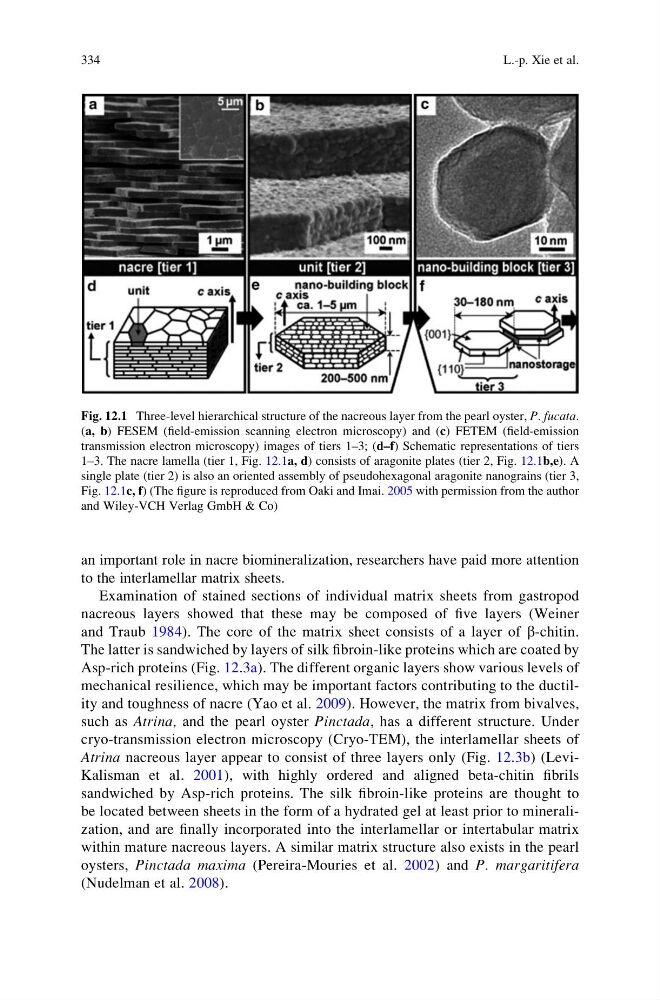
Fig. 12.1 Three-level hierarchical structure of the nacreous layer from the pearl oyster, P. fucata.
(a, b) FESEM (field-emission scanning electron microscopy) and (c) FETEM (field-emission
transmission electron microscopy) images of tiers 1–3; (d–f) Schematic representations of tiers
1–3. The nacre lamella (tier 1, Fig. 12.1a, d) consists of aragonite plates (tier 2, Fig. 12.1b,e). A
single plate (tier 2) is also an oriented assembly of pseudohexagonal aragonite nanograins (tier 3,
Fig. 12.1c, f) (The figure is reproduced from Oaki and Imai. 2005 with permission from the author
and Wiley-VCH Verlag GmbH & Co)
334
L.-p. Xie et al.
to the interlamellar matrix sheets.
Examination of stained sections of individual matrix sheets from gastropod
nacreous layers showed that these may be composed of five layers (Weiner
and Traub 1984). The core of the matrix sheet consists of a layer of b-chitin.
The latter is sandwiched by layers of silk fibroin-like proteins which are coated by
Asp-rich proteins (Fig. 12.3a). The different organic layers show various levels of
mechanical resilience, which may be important factors contributing to the ductility and toughness of nacre (Yao et al. 2009). However, the matrix from bivalves,
such as Atrina, and the pearl oyster Pinctada, has a different structure. Under
cryo-transmission electron microscopy (Cryo-TEM), the interlamellar sheets of
Atrina nacreous layer appear to consist of three layers only (Fig. 12.3b) (LeviKalisman et al. 2001), with highly ordered and aligned beta-chitin fibrils
sandwiched by Asp-rich proteins. The silk fibroin-like proteins are thought to
be located between sheets in the form of a hydrated gel at least prior to mineralization, and are finally incorporated into the interlamellar or intertabular matrix
within mature nacreous layers. A similar matrix structure also exists in the pearl
oysters, Pinctada maxima (Pereira-Mouries et al. 2002) and P. margaritifera
(Nudelman et al. 2008).
Fig. 12.1 Three-level hierarchical structure of the nacreous layer from the pearl oyster, P. fucata.
(a, b) FESEM (field-emission scanning electron microscopy) and (c) FETEM (field-emission
transmission electron microscopy) images of tiers 1–3; (d–f) Schematic representations of tiers
1–3. The nacre lamella (tier 1, Fig. 12.1a, d) consists of aragonite plates (tier 2, Fig. 12.1b,e). A
single plate (tier 2) is also an oriented assembly of pseudohexagonal aragonite nanograins (tier 3,
Fig. 12.1c, f) (The figure is reproduced from Oaki and Imai. 2005 with permission from the author
and Wiley-VCH Verlag GmbH & Co)
334
L.-p. Xie et al.