

11.2 Molting and Calcification
Before molting, crustaceans have to make new larger cuticle for the next growing
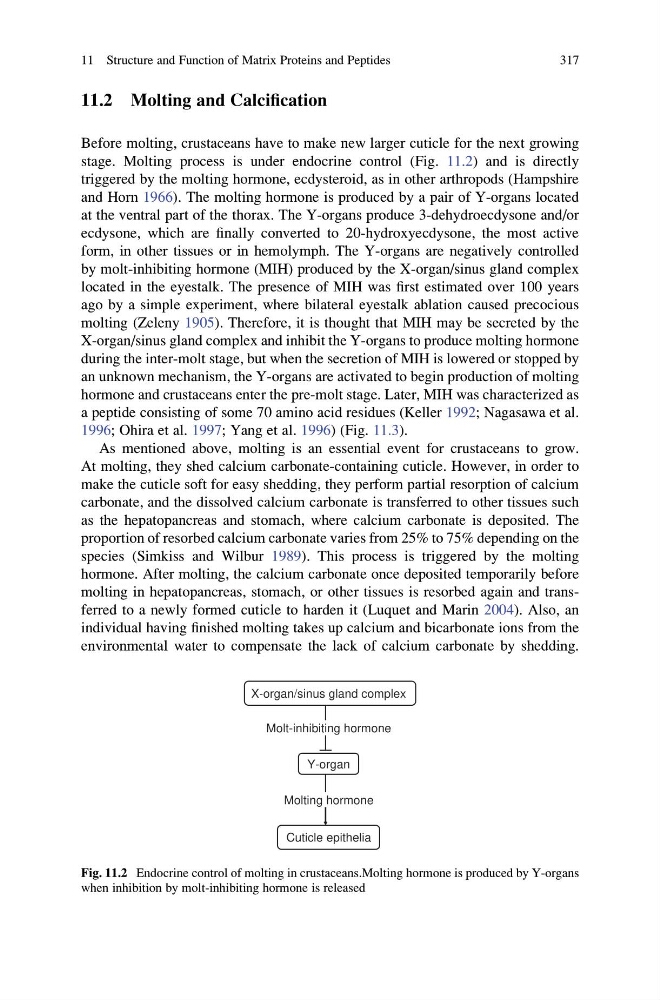
stage. Molting process is under endocrine control (Fig. 11.2) and is directly
triggered by the molting hormone, ecdysteroid, as in other arthropods (Hampshire
and Horn 1966). The molting hormone is produced by a pair of Y-organs located
at the ventral part of the thorax. The Y-organs produce 3-dehydroecdysone and/or
ecdysone, which are finally converted to 20-hydroxyecdysone, the most active
form, in other tissues or in hemolymph. The Y-organs are negatively controlled
by molt-inhibiting hormone (MIH) produced by the X-organ/sinus gland complex
located in the eyestalk. The presence of MIH was first estimated over 100 years
ago by a simple experiment, where bilateral eyestalk ablation caused precocious
molting (Zeleny 1905). Therefore, it is thought that MIH may be secreted by the
X-organ/sinus gland complex and inhibit the Y-organs to produce molting hormone
during the inter-molt stage, but when the secretion of MIH is lowered or stopped by
an unknown mechanism, the Y-organs are activated to begin production of molting
hormone and crustaceans enter the pre-molt stage. Later, MIH was characterized as
a peptide consisting of some 70 amino acid residues (Keller 1992; Nagasawa et al.
1996; Ohira et al. 1997; Yang et al. 1996) (Fig. 11.3).
As mentioned above, molting is an essential event for crustaceans to grow.
At molting, they shed calcium carbonate-containing cuticle. However, in order to
make the cuticle soft for easy shedding, they perform partial resorption of calcium
carbonate, and the dissolved calcium carbonate is transferred to other tissues such
as the hepatopancreas and stomach, where calcium carbonate is deposited. The
proportion of resorbed calcium carbonate varies from 25% to 75% depending on the
species (Simkiss and Wilbur 1989). This process is triggered by the molting
hormone. After molting, the calcium carbonate once deposited temporarily before
molting in hepatopancreas, stomach, or other tissues is resorbed again and transferred to a newly formed cuticle to harden it (Luquet and Marin 2004). Also, an
individual having finished molting takes up calcium and bicarbonate ions from the
environmental water to compensate the lack of calcium carbonate by shedding.
X-organ/sinus gland complex
Molt-inhibiting hormone
Y-organ
Molting hormone
Cuticle epithelia
Fig. 11.2 Endocrine control of molting in crustaceans.Molting hormone is produced by Y-organs
when inhibition by molt-inhibiting hormone is released
11 Structure and Function of Matrix Proteins and Peptides
317
Before molting, crustaceans have to make new larger cuticle for the next growing
stage. Molting process is under endocrine control (Fig. 11.2) and is directly
triggered by the molting hormone, ecdysteroid, as in other arthropods (Hampshire
and Horn 1966). The molting hormone is produced by a pair of Y-organs located
at the ventral part of the thorax. The Y-organs produce 3-dehydroecdysone and/or
ecdysone, which are finally converted to 20-hydroxyecdysone, the most active
form, in other tissues or in hemolymph. The Y-organs are negatively controlled
by molt-inhibiting hormone (MIH) produced by the X-organ/sinus gland complex
located in the eyestalk. The presence of MIH was first estimated over 100 years
ago by a simple experiment, where bilateral eyestalk ablation caused precocious
molting (Zeleny 1905). Therefore, it is thought that MIH may be secreted by the
X-organ/sinus gland complex and inhibit the Y-organs to produce molting hormone
during the inter-molt stage, but when the secretion of MIH is lowered or stopped by
an unknown mechanism, the Y-organs are activated to begin production of molting
hormone and crustaceans enter the pre-molt stage. Later, MIH was characterized as
a peptide consisting of some 70 amino acid residues (Keller 1992; Nagasawa et al.
1996; Ohira et al. 1997; Yang et al. 1996) (Fig. 11.3).
As mentioned above, molting is an essential event for crustaceans to grow.
At molting, they shed calcium carbonate-containing cuticle. However, in order to
make the cuticle soft for easy shedding, they perform partial resorption of calcium
carbonate, and the dissolved calcium carbonate is transferred to other tissues such
as the hepatopancreas and stomach, where calcium carbonate is deposited. The
proportion of resorbed calcium carbonate varies from 25% to 75% depending on the
species (Simkiss and Wilbur 1989). This process is triggered by the molting
hormone. After molting, the calcium carbonate once deposited temporarily before
molting in hepatopancreas, stomach, or other tissues is resorbed again and transferred to a newly formed cuticle to harden it (Luquet and Marin 2004). Also, an
individual having finished molting takes up calcium and bicarbonate ions from the
environmental water to compensate the lack of calcium carbonate by shedding.
X-organ/sinus gland complex
Molt-inhibiting hormone
Y-organ
Molting hormone
Cuticle epithelia
Fig. 11.2 Endocrine control of molting in crustaceans.Molting hormone is produced by Y-organs
when inhibition by molt-inhibiting hormone is released
11 Structure and Function of Matrix Proteins and Peptides
317