

tissues of crustaceans is amorphous in many cases. Crustaceans take a strategy to
induce and maintain amorphous calcium carbonate by using low-molecular-weight
phosphorus compounds.
11.1 Introduction
Molting is essential for crustaceans to grow. Crustaceans become bigger by shedding the old cuticle, which entirely surrounds the soft body. The cuticle is a hard
tissue and is therefore mechanically less flexible, which interrupts crustaceans
to grow. The hardness of the cuticle is maintained by a high content of mineral,
calcium carbonate, and is useful for protection from enemies and maintenance of
body structure. This property is one of the characteristics of crustaceans among
arthropods, while insects, spiders, and other arthropods have almost no minerals in
the cuticle. The cuticle consists mainly of chitin, proteins and calcium carbonate,
whose proportions depend on the species, the site of cuticle, and molting stage. The
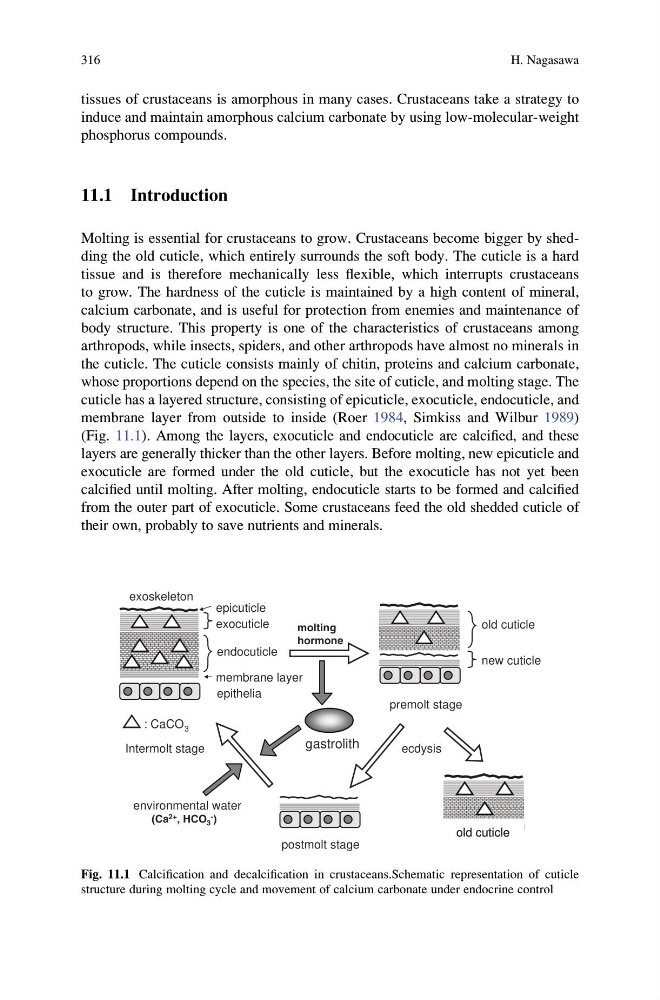
cuticle has a layered structure, consisting of epicuticle, exocuticle, endocuticle, and
membrane layer from outside to inside (Roer 1984, Simkiss and Wilbur 1989)
(Fig. 11.1). Among the layers, exocuticle and endocuticle are calcified, and these
layers are generally thicker than the other layers. Before molting, new epicuticle and
exocuticle are formed under the old cuticle, but the exocuticle has not yet been
calcified until molting. After molting, endocuticle starts to be formed and calcified
from the outer part of exocuticle. Some crustaceans feed the old shedded cuticle of
their own, probably to save nutrients and minerals.
epithelia
exoskeleton
epicuticle
exocuticle
endocuticle
membrane layer
: CaCO 3
premolt stage
new cuticle
ecdysis
postmolt stage
Intermolt stage
old cuticle
old cuticle
old cuticle
gastrolith
environmental water
(Ca 2+ , HCO 3
- )
molting
hormone
Fig. 11.1 Calcification and decalcification in crustaceans.Schematic representation of cuticle
structure during molting cycle and movement of calcium carbonate under endocrine control
316
H. Nagasawa
induce and maintain amorphous calcium carbonate by using low-molecular-weight
phosphorus compounds.
11.1 Introduction
Molting is essential for crustaceans to grow. Crustaceans become bigger by shedding the old cuticle, which entirely surrounds the soft body. The cuticle is a hard
tissue and is therefore mechanically less flexible, which interrupts crustaceans
to grow. The hardness of the cuticle is maintained by a high content of mineral,
calcium carbonate, and is useful for protection from enemies and maintenance of
body structure. This property is one of the characteristics of crustaceans among
arthropods, while insects, spiders, and other arthropods have almost no minerals in
the cuticle. The cuticle consists mainly of chitin, proteins and calcium carbonate,
whose proportions depend on the species, the site of cuticle, and molting stage. The
cuticle has a layered structure, consisting of epicuticle, exocuticle, endocuticle, and
membrane layer from outside to inside (Roer 1984, Simkiss and Wilbur 1989)
(Fig. 11.1). Among the layers, exocuticle and endocuticle are calcified, and these
layers are generally thicker than the other layers. Before molting, new epicuticle and
exocuticle are formed under the old cuticle, but the exocuticle has not yet been
calcified until molting. After molting, endocuticle starts to be formed and calcified
from the outer part of exocuticle. Some crustaceans feed the old shedded cuticle of
their own, probably to save nutrients and minerals.
epithelia
exoskeleton
epicuticle
exocuticle
endocuticle
membrane layer
: CaCO 3
premolt stage
new cuticle
ecdysis
postmolt stage
Intermolt stage
old cuticle
old cuticle
old cuticle
gastrolith
environmental water
(Ca 2+ , HCO 3
- )
molting
hormone
Fig. 11.1 Calcification and decalcification in crustaceans.Schematic representation of cuticle
structure during molting cycle and movement of calcium carbonate under endocrine control
316
H. Nagasawa