

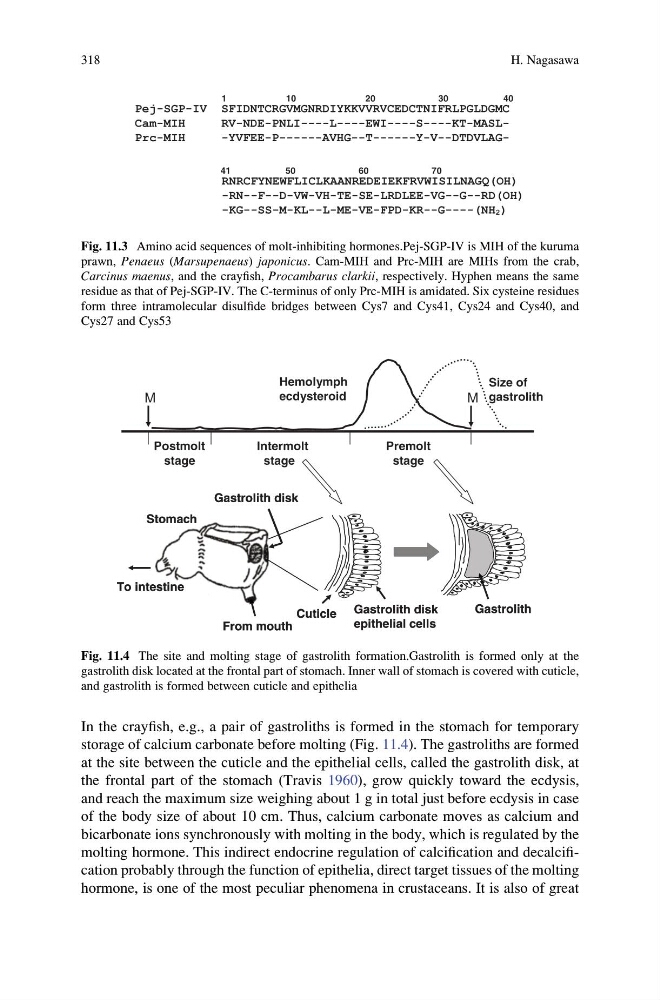
In the crayfish, e.g., a pair of gastroliths is formed in the stomach for temporary
storage of calcium carbonate before molting (Fig. 11.4). The gastroliths are formed
at the site between the cuticle and the epithelial cells, called the gastrolith disk, at
the frontal part of the stomach (Travis 1960), grow quickly toward the ecdysis,
and reach the maximum size weighing about 1 g in total just before ecdysis in case
of the body size of about 10 cm. Thus, calcium carbonate moves as calcium and
bicarbonate ions synchronously with molting in the body, which is regulated by the
molting hormone. This indirect endocrine regulation of calcification and decalcification probably through the function of epithelia, direct target tissues of the molting
hormone, is one of the most peculiar phenomena in crustaceans. It is also of great
M
M
Hemolymph
ecdysteroid
Postmolt
stage
Intermolt
stage
Premolt
stage
Size of
gastrolith
Stomach
Cuticle Gastrolith disk
epithelial cells
Gastrolith
Gastrolith disk
From mouth
To intestine
Stomach
Cuticle Gastrolith disk
epithelial cells
Gastrolith
Gastrolith disk
From mouth
To intestine
Fig. 11.4 The site and molting stage of gastrolith formation.Gastrolith is formed only at the
gastrolith disk located at the frontal part of stomach. Inner wall of stomach is covered with cuticle,
and gastrolith is formed between cuticle and epithelia
Pej-SGP-IV SFIDNTCRGVMGNRDIYKKVVRVCEDCTNIFRLPGLDGMC
Cam-MIH
RV-NDE-PNLI----L----EWI----S----KT-MASLPrc-MIH
-YVFEE-P------AVHG--T------Y-V--DTDVLAGRNRCFYNEWFLICLKAANREDEIEKFRVWISILNAGQ(OH)
-RN--F--D-VW-VH-TE-SE-LRDLEE-VG--G--RD(OH)
-KG--SS-M-KL--L-ME-VE-FPD-KR--G----(NH2)
1
1 0
2 0
3 0
4 0
41
50
60
70
Fig. 11.3 Amino acid sequences of molt-inhibiting hormones.Pej-SGP-IV is MIH of the kuruma
prawn, Penaeus (Marsupenaeus) japonicus. Cam-MIH and Prc-MIH are MIHs from the crab,
Carcinus maenus, and the crayfish, Procambarus clarkii, respectively. Hyphen means the same
residue as that of Pej-SGP-IV. The C-terminus of only Prc-MIH is amidated. Six cysteine residues
form three intramolecular disulfide bridges between Cys7 and Cys41, Cys24 and Cys40, and
Cys27 and Cys53
318
H. Nagasawa
storage of calcium carbonate before molting (Fig. 11.4). The gastroliths are formed
at the site between the cuticle and the epithelial cells, called the gastrolith disk, at
the frontal part of the stomach (Travis 1960), grow quickly toward the ecdysis,
and reach the maximum size weighing about 1 g in total just before ecdysis in case
of the body size of about 10 cm. Thus, calcium carbonate moves as calcium and
bicarbonate ions synchronously with molting in the body, which is regulated by the
molting hormone. This indirect endocrine regulation of calcification and decalcification probably through the function of epithelia, direct target tissues of the molting
hormone, is one of the most peculiar phenomena in crustaceans. It is also of great
M
M
Hemolymph
ecdysteroid
Postmolt
stage
Intermolt
stage
Premolt
stage
Size of
gastrolith
Stomach
Cuticle Gastrolith disk
epithelial cells
Gastrolith
Gastrolith disk
From mouth
To intestine
Stomach
Cuticle Gastrolith disk
epithelial cells
Gastrolith
Gastrolith disk
From mouth
To intestine
Fig. 11.4 The site and molting stage of gastrolith formation.Gastrolith is formed only at the
gastrolith disk located at the frontal part of stomach. Inner wall of stomach is covered with cuticle,
and gastrolith is formed between cuticle and epithelia
Pej-SGP-IV SFIDNTCRGVMGNRDIYKKVVRVCEDCTNIFRLPGLDGMC
Cam-MIH
RV-NDE-PNLI----L----EWI----S----KT-MASLPrc-MIH
-YVFEE-P------AVHG--T------Y-V--DTDVLAGRNRCFYNEWFLICLKAANREDEIEKFRVWISILNAGQ(OH)
-RN--F--D-VW-VH-TE-SE-LRDLEE-VG--G--RD(OH)
-KG--SS-M-KL--L-ME-VE-FPD-KR--G----(NH2)
1
1 0
2 0
3 0
4 0
41
50
60
70
Fig. 11.3 Amino acid sequences of molt-inhibiting hormones.Pej-SGP-IV is MIH of the kuruma
prawn, Penaeus (Marsupenaeus) japonicus. Cam-MIH and Prc-MIH are MIHs from the crab,
Carcinus maenus, and the crayfish, Procambarus clarkii, respectively. Hyphen means the same
residue as that of Pej-SGP-IV. The C-terminus of only Prc-MIH is amidated. Six cysteine residues
form three intramolecular disulfide bridges between Cys7 and Cys41, Cys24 and Cys40, and
Cys27 and Cys53
318
H. Nagasawa