

(reviewed in: Wittrant et al. 2004; Collin-Osdoby 2004; Gallagher 2008; Lane and
Yao 2009). These factors play an essential role in the differentiation of pre-osteoclasts
to mature osteoclasts (bone-resorbing cells) (Rodan and Martin 1982; Suda et al.
1999; Kanamaru et al. 2004). The following members of the tumor necrosis factor
(TNF) and TNF receptor superfamily are involved in the control of bone resorption
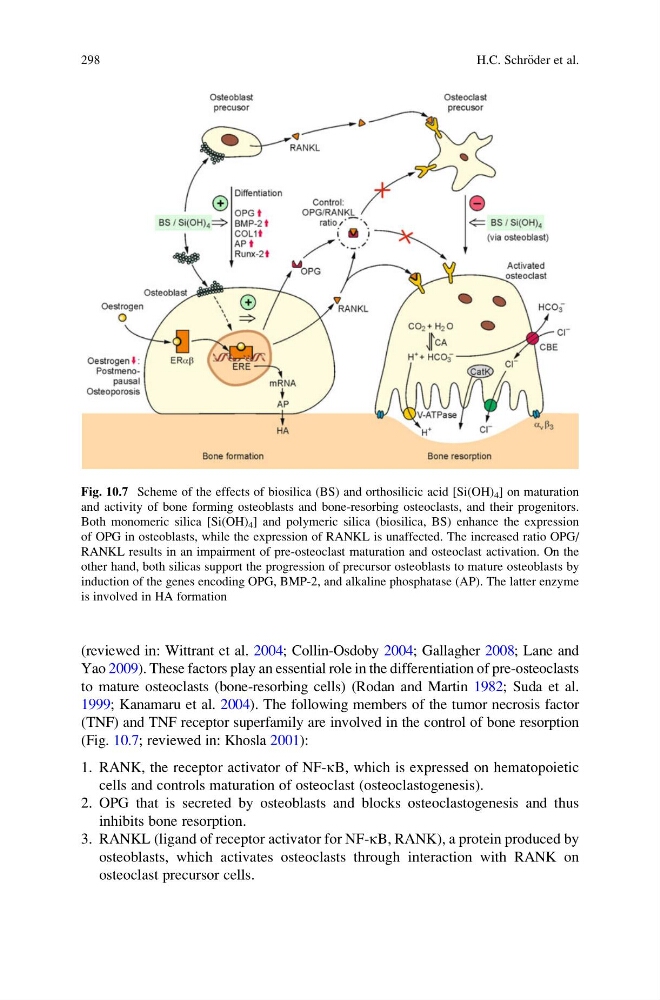
(Fig. 10.7; reviewed in: Khosla 2001):
1. RANK, the receptor activator of NF-kB, which is expressed on hematopoietic
cells and controls maturation of osteoclast (osteoclastogenesis).
2. OPG that is secreted by osteoblasts and blocks osteoclastogenesis and thus
inhibits bone resorption.
3. RANKL (ligand of receptor activator for NF-kB, RANK), a protein produced by
osteoblasts, which activates osteoclasts through interaction with RANK on
osteoclast precursor cells.
Fig. 10.7 Scheme of the effects of biosilica (BS) and orthosilicic acid [Si(OH) 4 ] on maturation
and activity of bone forming osteoblasts and bone-resorbing osteoclasts, and their progenitors.
Both monomeric silica [Si(OH) 4 ] and polymeric silica (biosilica, BS) enhance the expression
of OPG in osteoblasts, while the expression of RANKL is unaffected. The increased ratio OPG/
RANKL results in an impairment of pre-osteoclast maturation and osteoclast activation. On the
other hand, both silicas support the progression of precursor osteoblasts to mature osteoblasts by
induction of the genes encoding OPG, BMP-2, and alkaline phosphatase (AP). The latter enzyme
is involved in HA formation
298
H.C. Schr€ oder et al.
Yao 2009). These factors play an essential role in the differentiation of pre-osteoclasts
to mature osteoclasts (bone-resorbing cells) (Rodan and Martin 1982; Suda et al.
1999; Kanamaru et al. 2004). The following members of the tumor necrosis factor
(TNF) and TNF receptor superfamily are involved in the control of bone resorption
(Fig. 10.7; reviewed in: Khosla 2001):
1. RANK, the receptor activator of NF-kB, which is expressed on hematopoietic
cells and controls maturation of osteoclast (osteoclastogenesis).
2. OPG that is secreted by osteoblasts and blocks osteoclastogenesis and thus
inhibits bone resorption.
3. RANKL (ligand of receptor activator for NF-kB, RANK), a protein produced by
osteoblasts, which activates osteoclasts through interaction with RANK on
osteoclast precursor cells.
Fig. 10.7 Scheme of the effects of biosilica (BS) and orthosilicic acid [Si(OH) 4 ] on maturation
and activity of bone forming osteoblasts and bone-resorbing osteoclasts, and their progenitors.
Both monomeric silica [Si(OH) 4 ] and polymeric silica (biosilica, BS) enhance the expression
of OPG in osteoblasts, while the expression of RANKL is unaffected. The increased ratio OPG/
RANKL results in an impairment of pre-osteoclast maturation and osteoclast activation. On the
other hand, both silicas support the progression of precursor osteoblasts to mature osteoblasts by
induction of the genes encoding OPG, BMP-2, and alkaline phosphatase (AP). The latter enzyme
is involved in HA formation
298
H.C. Schr€ oder et al.