

self-assembly process, most likely due to a modification of the collagen helix before
fibril formation, while more concentrated solutions (presence of polysilicic acid
and/or silica nanoparticles) hinder collagen fibrillogenesis, most likely by electrostatic interactions and hydrogen bond formation (Eglin et al. 2006).
10.12 The RANK/RANKL/OPG System
Osteoprotegerin (OPG) and receptor activator for NF-kB ligand (RANKL) are
soluble factors released from bone-producing osteoblasts, which are part of one of
the most crucial signaling systems that are involved in modulating bone resorption
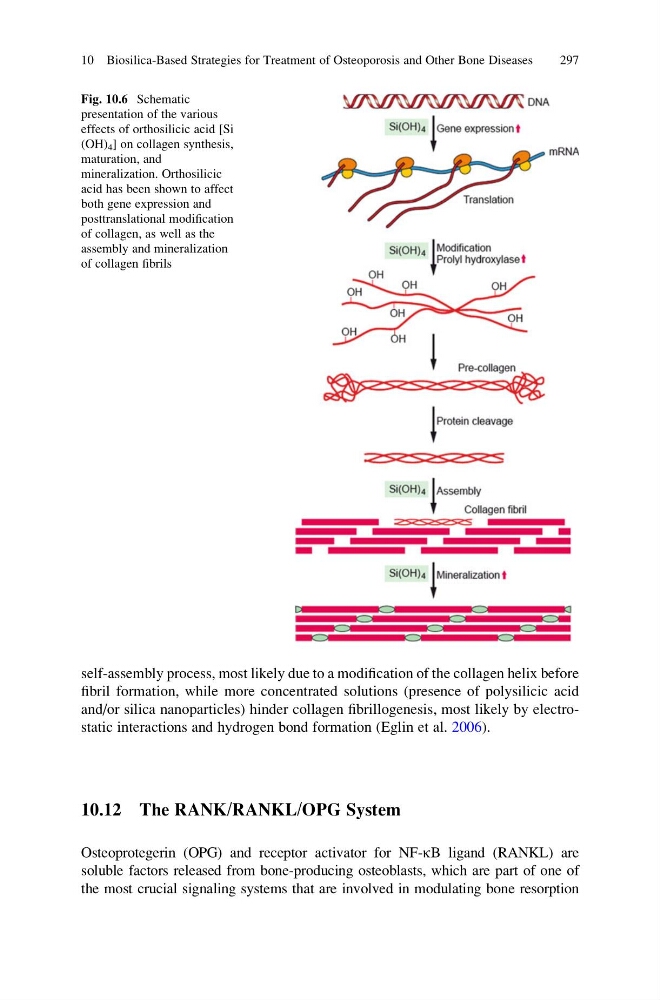
Fig. 10.6 Schematic
presentation of the various
effects of orthosilicic acid [Si
(OH) 4 ] on collagen synthesis,
maturation, and
mineralization. Orthosilicic
acid has been shown to affect
both gene expression and
posttranslational modification
of collagen, as well as the
assembly and mineralization
of collagen fibrils
10 Biosilica-Based Strategies for Treatment of Osteoporosis and Other Bone Diseases
297
fibril formation, while more concentrated solutions (presence of polysilicic acid
and/or silica nanoparticles) hinder collagen fibrillogenesis, most likely by electrostatic interactions and hydrogen bond formation (Eglin et al. 2006).
10.12 The RANK/RANKL/OPG System
Osteoprotegerin (OPG) and receptor activator for NF-kB ligand (RANKL) are
soluble factors released from bone-producing osteoblasts, which are part of one of
the most crucial signaling systems that are involved in modulating bone resorption
Fig. 10.6 Schematic
presentation of the various
effects of orthosilicic acid [Si
(OH) 4 ] on collagen synthesis,
maturation, and
mineralization. Orthosilicic
acid has been shown to affect
both gene expression and
posttranslational modification
of collagen, as well as the
assembly and mineralization
of collagen fibrils
10 Biosilica-Based Strategies for Treatment of Osteoporosis and Other Bone Diseases
297