

Subsequently, degenerate primers were designed, directed against those amino
acid (aa) sequences. After screening, the cDNA library from L. baicalensis highly
related sequences were isolated; the deduced polypeptides comprised only 108–110
aa in length and were termed “DUF” (for “domains of unknown function”) proteins
(Novatchkova et al. 2006). The three sequences obtained from L. baicalensis
(LBDUF614a, LBDUF614b, and LBDUF614c) comprise, clustered in the center
of their sequences, charged aa (Fig. 9.12a). The remaining aa moieties are primarily
neutral as reflected also by the respective Kyte–Doolittle hydrophobicity plots
(Kyte and Doolittle 1982) (Fig. 9.12b). Computational analysis reveals that each
of those three DUF sequences is assembled from three domains of pronounced
hydrophobic segments, each spanning around 35 aa. This finding contradicts earlier
assumptions that the spongin material in sponges in related to collagen (Gross et al.
1956; Aouacheria et al. 2006). The identification of spongin as hydrophobic DUF
sequences opens a new avenue in the understanding of protein–silica interactions
and allows a further exploitation for biotechnological applications as well.
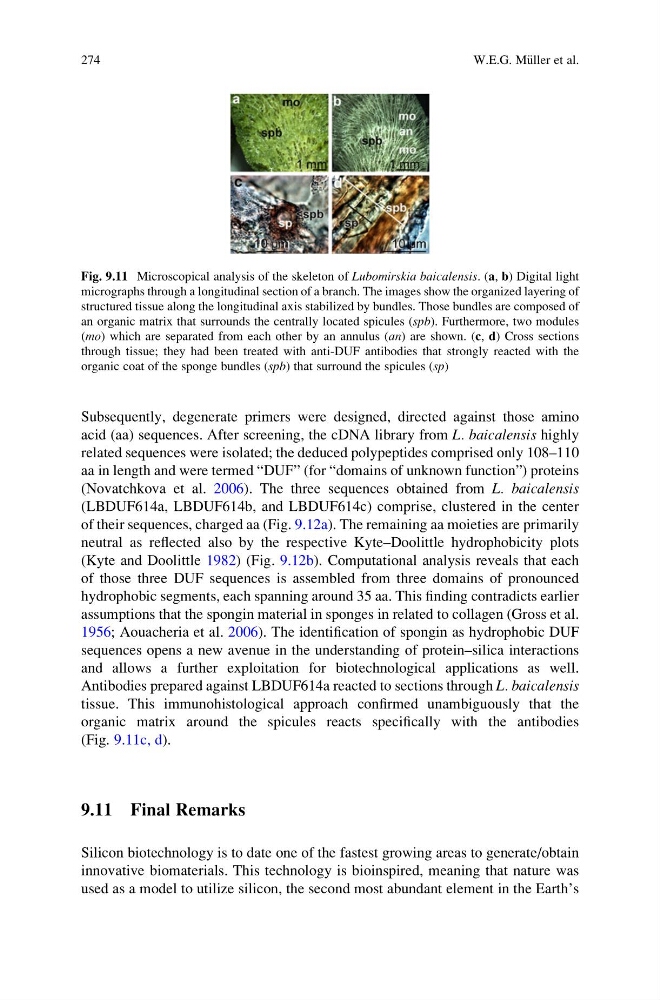
Antibodies prepared against LBDUF614a reacted to sections through L. baicalensis
tissue. This immunohistological approach confirmed unambiguously that the
organic matrix around the spicules reacts specifically with the antibodies
(Fig. 9.11c, d).
9.11 Final Remarks
Silicon biotechnology is to date one of the fastest growing areas to generate/obtain
innovative biomaterials. This technology is bioinspired, meaning that nature was
used as a model to utilize silicon, the second most abundant element in the Earth’s
Fig. 9.11 Microscopical analysis of the skeleton of Lubomirskia baicalensis. (a, b) Digital light
micrographs through a longitudinal section of a branch. The images show the organized layering of
structured tissue along the longitudinal axis stabilized by bundles. Those bundles are composed of
an organic matrix that surrounds the centrally located spicules (spb). Furthermore, two modules
(mo) which are separated from each other by an annulus (an) are shown. (c, d) Cross sections
through tissue; they had been treated with anti-DUF antibodies that strongly reacted with the
organic coat of the sponge bundles (spb) that surround the spicules (sp)
274
W.E.G. M€ uller et al.
acid (aa) sequences. After screening, the cDNA library from L. baicalensis highly
related sequences were isolated; the deduced polypeptides comprised only 108–110
aa in length and were termed “DUF” (for “domains of unknown function”) proteins
(Novatchkova et al. 2006). The three sequences obtained from L. baicalensis
(LBDUF614a, LBDUF614b, and LBDUF614c) comprise, clustered in the center
of their sequences, charged aa (Fig. 9.12a). The remaining aa moieties are primarily
neutral as reflected also by the respective Kyte–Doolittle hydrophobicity plots
(Kyte and Doolittle 1982) (Fig. 9.12b). Computational analysis reveals that each
of those three DUF sequences is assembled from three domains of pronounced
hydrophobic segments, each spanning around 35 aa. This finding contradicts earlier
assumptions that the spongin material in sponges in related to collagen (Gross et al.
1956; Aouacheria et al. 2006). The identification of spongin as hydrophobic DUF
sequences opens a new avenue in the understanding of protein–silica interactions
and allows a further exploitation for biotechnological applications as well.
Antibodies prepared against LBDUF614a reacted to sections through L. baicalensis
tissue. This immunohistological approach confirmed unambiguously that the
organic matrix around the spicules reacts specifically with the antibodies
(Fig. 9.11c, d).
9.11 Final Remarks
Silicon biotechnology is to date one of the fastest growing areas to generate/obtain
innovative biomaterials. This technology is bioinspired, meaning that nature was
used as a model to utilize silicon, the second most abundant element in the Earth’s
Fig. 9.11 Microscopical analysis of the skeleton of Lubomirskia baicalensis. (a, b) Digital light
micrographs through a longitudinal section of a branch. The images show the organized layering of
structured tissue along the longitudinal axis stabilized by bundles. Those bundles are composed of
an organic matrix that surrounds the centrally located spicules (spb). Furthermore, two modules
(mo) which are separated from each other by an annulus (an) are shown. (c, d) Cross sections
through tissue; they had been treated with anti-DUF antibodies that strongly reacted with the
organic coat of the sponge bundles (spb) that surround the spicules (sp)
274
W.E.G. M€ uller et al.