

515 Ma. In the Lower Cambrian Chengjiang fauna, the sponges are, after the
arthropods, the major taxon with respect to generic and specific diversity. Over
1,000 sponge body fossils, grouped to 15 genera and 30 species, have been
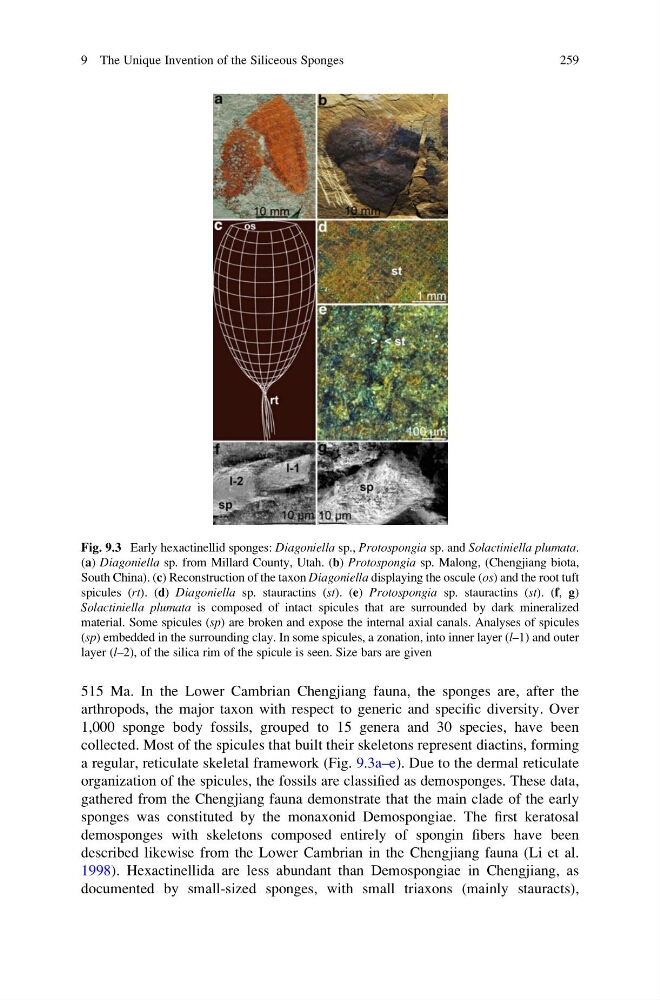
collected. Most of the spicules that built their skeletons represent diactins, forming
a regular, reticulate skeletal framework (Fig. 9.3a–e). Due to the dermal reticulate
organization of the spicules, the fossils are classified as demosponges. These data,
gathered from the Chengjiang fauna demonstrate that the main clade of the early
sponges was constituted by the monaxonid Demospongiae. The first keratosal
demosponges with skeletons composed entirely of spongin fibers have been
described likewise from the Lower Cambrian in the Chengjiang fauna (Li et al.
1998). Hexactinellida are less abundant than Demospongiae in Chengjiang, as
documented by small-sized sponges, with small triaxons (mainly stauracts),
Fig. 9.3 Early hexactinellid sponges: Diagoniella sp., Protospongia sp. and Solactiniella plumata.
(a) Diagoniella sp. from Millard County, Utah. (b) Protospongia sp. Malong, (Chengjiang biota,
South China). (c) Reconstruction of the taxon Diagoniella displaying the oscule (os) and the root tuft
spicules (rt). (d) Diagoniella sp. stauractins (st). (e) Protospongia sp. stauractins (st). (f, g)
Solactiniella plumata is composed of intact spicules that are surrounded by dark mineralized
material. Some spicules (sp) are broken and expose the internal axial canals. Analyses of spicules
(sp) embedded in the surrounding clay. In some spicules, a zonation, into inner layer (l–1) and outer
layer (l–2), of the silica rim of the spicule is seen. Size bars are given
9 The Unique Invention of the Siliceous Sponges
259
arthropods, the major taxon with respect to generic and specific diversity. Over
1,000 sponge body fossils, grouped to 15 genera and 30 species, have been
collected. Most of the spicules that built their skeletons represent diactins, forming
a regular, reticulate skeletal framework (Fig. 9.3a–e). Due to the dermal reticulate
organization of the spicules, the fossils are classified as demosponges. These data,
gathered from the Chengjiang fauna demonstrate that the main clade of the early
sponges was constituted by the monaxonid Demospongiae. The first keratosal
demosponges with skeletons composed entirely of spongin fibers have been
described likewise from the Lower Cambrian in the Chengjiang fauna (Li et al.
1998). Hexactinellida are less abundant than Demospongiae in Chengjiang, as
documented by small-sized sponges, with small triaxons (mainly stauracts),
Fig. 9.3 Early hexactinellid sponges: Diagoniella sp., Protospongia sp. and Solactiniella plumata.
(a) Diagoniella sp. from Millard County, Utah. (b) Protospongia sp. Malong, (Chengjiang biota,
South China). (c) Reconstruction of the taxon Diagoniella displaying the oscule (os) and the root tuft
spicules (rt). (d) Diagoniella sp. stauractins (st). (e) Protospongia sp. stauractins (st). (f, g)
Solactiniella plumata is composed of intact spicules that are surrounded by dark mineralized
material. Some spicules (sp) are broken and expose the internal axial canals. Analyses of spicules
(sp) embedded in the surrounding clay. In some spicules, a zonation, into inner layer (l–1) and outer
layer (l–2), of the silica rim of the spicule is seen. Size bars are given
9 The Unique Invention of the Siliceous Sponges
259