

spicules with their paratangentialia being in a diagonal arrangement (Rigby and
Hou 1995; Wu et al. 2005).
The organization of the spicules within the bodies of the Cambrian/Ediacaran
sponge classes has been described for the hexactinellid Protospongiidae
Protospongia tetranema and Triticispongia diagonata (see Hou et al. 1999, 2004)
as well as for Diagoniella sp. (Rigby and Collins 2004). Protospongia sp. and
Triticispongia sp. were considered the basic taxon from which the later groups were
derived (Finks 2003a, b); Fig. 9.3b. The thin-walled, vasiform body with one large
distal oscule and a basal root tuft is composed of simple diactins. The tissue is
stabilized by stauractins or pentactins (Fig. 9.3d, e). The approximately 50 mm
large, sessile animals were supported by basal rays (basal spicules) that could reach
lengths of 6 mm at a diameters of 0.3 mm. A similar body plan is displayed by other
hexactinellids, e.g., Diagoniella sp. (Fig. 9.3a). A reconstruction of an ancient
sessile animal (see Xiao and Laflamme 2008) is given in Fig. 9.3c. In contrast to
the Hexactinellida, the earliest Demospongiae with the family of the Choiidae
comprised freely moving species that lived unattached on the seafloor (Rigby and
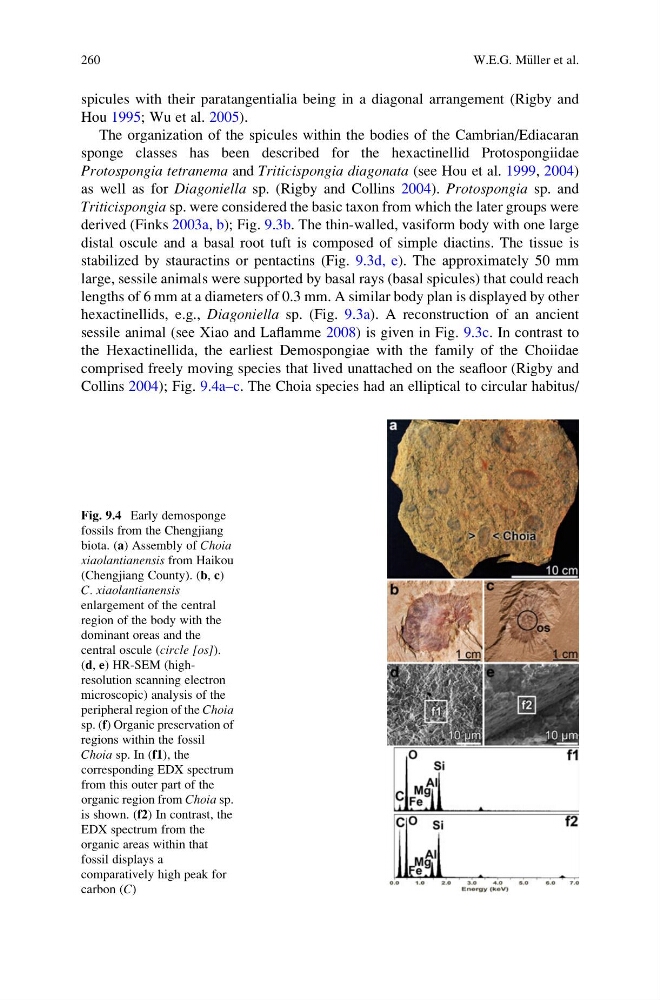
Collins 2004); Fig. 9.4a–c. The Choia species had an elliptical to circular habitus/
Fig. 9.4 Early demosponge
fossils from the Chengjiang
biota. (a) Assembly of Choia
xiaolantianensis from Haikou
(Chengjiang County). (b, c)
C. xiaolantianensis
enlargement of the central
region of the body with the
dominant oreas and the
central oscule (circle [os]).
(d, e) HR-SEM (highresolution scanning electron
microscopic) analysis of the
peripheral region of the Choia
sp. (f) Organic preservation of
regions within the fossil
Choia sp. In (f1), the
corresponding EDX spectrum
from this outer part of the
organic region from Choia sp.
is shown. (f2) In contrast, the
EDX spectrum from the
organic areas within that
fossil displays a
comparatively high peak for
carbon (C)
260
W.E.G. M€ uller et al.
Hou 1995; Wu et al. 2005).
The organization of the spicules within the bodies of the Cambrian/Ediacaran
sponge classes has been described for the hexactinellid Protospongiidae
Protospongia tetranema and Triticispongia diagonata (see Hou et al. 1999, 2004)
as well as for Diagoniella sp. (Rigby and Collins 2004). Protospongia sp. and
Triticispongia sp. were considered the basic taxon from which the later groups were
derived (Finks 2003a, b); Fig. 9.3b. The thin-walled, vasiform body with one large
distal oscule and a basal root tuft is composed of simple diactins. The tissue is
stabilized by stauractins or pentactins (Fig. 9.3d, e). The approximately 50 mm
large, sessile animals were supported by basal rays (basal spicules) that could reach
lengths of 6 mm at a diameters of 0.3 mm. A similar body plan is displayed by other
hexactinellids, e.g., Diagoniella sp. (Fig. 9.3a). A reconstruction of an ancient
sessile animal (see Xiao and Laflamme 2008) is given in Fig. 9.3c. In contrast to
the Hexactinellida, the earliest Demospongiae with the family of the Choiidae
comprised freely moving species that lived unattached on the seafloor (Rigby and
Collins 2004); Fig. 9.4a–c. The Choia species had an elliptical to circular habitus/
Fig. 9.4 Early demosponge
fossils from the Chengjiang
biota. (a) Assembly of Choia
xiaolantianensis from Haikou
(Chengjiang County). (b, c)
C. xiaolantianensis
enlargement of the central
region of the body with the
dominant oreas and the
central oscule (circle [os]).
(d, e) HR-SEM (highresolution scanning electron
microscopic) analysis of the
peripheral region of the Choia
sp. (f) Organic preservation of
regions within the fossil
Choia sp. In (f1), the
corresponding EDX spectrum
from this outer part of the
organic region from Choia sp.
is shown. (f2) In contrast, the
EDX spectrum from the
organic areas within that
fossil displays a
comparatively high peak for
carbon (C)
260
W.E.G. M€ uller et al.