

(China; Rigby and Hou 1995). In our studies of fossils from the Chengjiang
formation, we could prove the existence of organic material around the siliceous
skeleton by EDX spectroscopy.
The Chengjiang Lagerst€ atten, also known as Chengjiang Biota or the
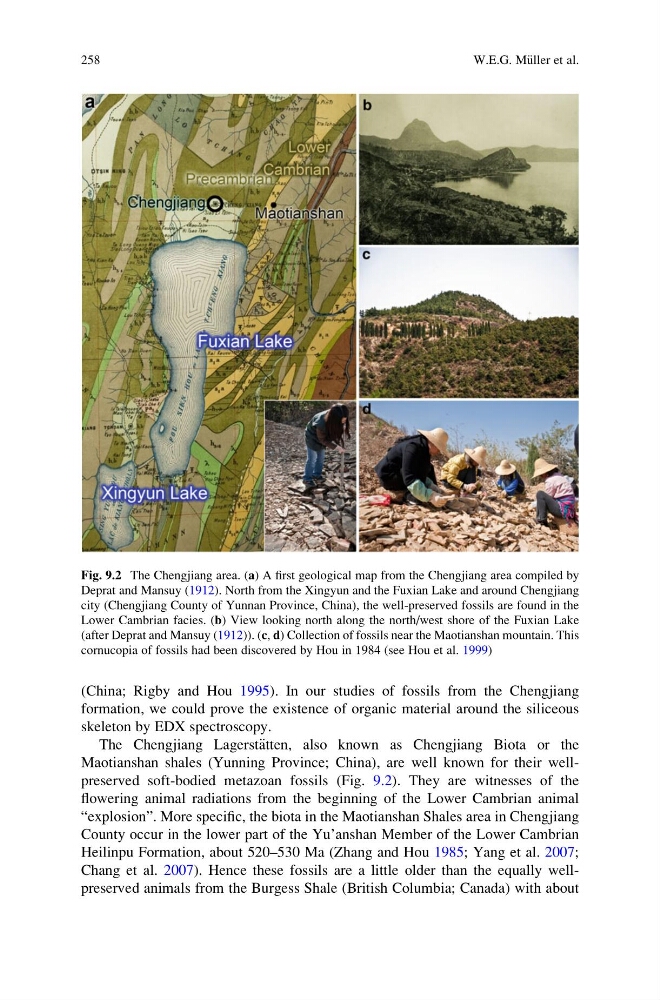
Maotianshan shales (Yunning Province; China), are well known for their wellpreserved soft-bodied metazoan fossils (Fig. 9.2). They are witnesses of the
flowering animal radiations from the beginning of the Lower Cambrian animal
“explosion”. More specific, the biota in the Maotianshan Shales area in Chengjiang
County occur in the lower part of the Yu’anshan Member of the Lower Cambrian
Heilinpu Formation, about 520–530 Ma (Zhang and Hou 1985; Yang et al. 2007;
Chang et al. 2007). Hence these fossils are a little older than the equally wellpreserved animals from the Burgess Shale (British Columbia; Canada) with about
Fig. 9.2 The Chengjiang area. (a) A first geological map from the Chengjiang area compiled by
Deprat and Mansuy (1912). North from the Xingyun and the Fuxian Lake and around Chengjiang
city (Chengjiang County of Yunnan Province, China), the well-preserved fossils are found in the
Lower Cambrian facies. (b) View looking north along the north/west shore of the Fuxian Lake
(after Deprat and Mansuy (1912)). (c, d) Collection of fossils near the Maotianshan mountain. This
cornucopia of fossils had been discovered by Hou in 1984 (see Hou et al. 1999)
258
W.E.G. M€ uller et al.
formation, we could prove the existence of organic material around the siliceous
skeleton by EDX spectroscopy.
The Chengjiang Lagerst€ atten, also known as Chengjiang Biota or the
Maotianshan shales (Yunning Province; China), are well known for their wellpreserved soft-bodied metazoan fossils (Fig. 9.2). They are witnesses of the
flowering animal radiations from the beginning of the Lower Cambrian animal
“explosion”. More specific, the biota in the Maotianshan Shales area in Chengjiang
County occur in the lower part of the Yu’anshan Member of the Lower Cambrian
Heilinpu Formation, about 520–530 Ma (Zhang and Hou 1985; Yang et al. 2007;
Chang et al. 2007). Hence these fossils are a little older than the equally wellpreserved animals from the Burgess Shale (British Columbia; Canada) with about
Fig. 9.2 The Chengjiang area. (a) A first geological map from the Chengjiang area compiled by
Deprat and Mansuy (1912). North from the Xingyun and the Fuxian Lake and around Chengjiang
city (Chengjiang County of Yunnan Province, China), the well-preserved fossils are found in the
Lower Cambrian facies. (b) View looking north along the north/west shore of the Fuxian Lake
(after Deprat and Mansuy (1912)). (c, d) Collection of fossils near the Maotianshan mountain. This
cornucopia of fossils had been discovered by Hou in 1984 (see Hou et al. 1999)
258
W.E.G. M€ uller et al.