

the template molecules act as nucleators for the inorganic material and that the
surface chemistry of the template induces oriented nucleation of the complementary crystal face. The history of using templates in in vitro mineralization
experiments could date back to 1988, when Mann et al. (1988) chose Langmuir
monomolecular membrane, took advantage of its ordered arrangement of radicals
to mediate calcium carbonate crystal growth.
6.4.2.1 Natural Biomineral Template
Qiao et al. (2008a) chose the fresh cross section of nacre surface of freshwater
lustrous pearls (aragonite) as templates without any additives in solutions. XPS
results showed that the surface is mainly composed of organic matrix particles,
AFM micrograph showed its size of 70 nm. The deposition proved that the
formation process was a complex and multistep one, from an ACC layer
(Fig. 6.19), iso-oriented nano-stacks to hexagonal aragonite tablets (Fig. 6.20).
The result not only proved the existence of ACC in aragonite formation process,
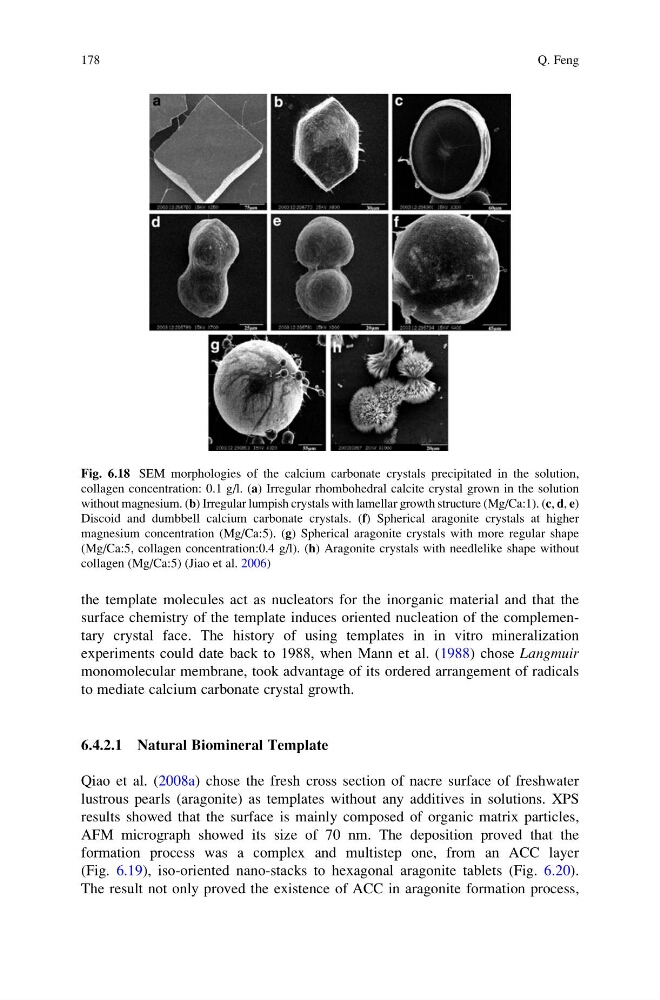
Fig. 6.18 SEM morphologies of the calcium carbonate crystals precipitated in the solution,
collagen concentration: 0.1 g/l. (a) Irregular rhombohedral calcite crystal grown in the solution
without magnesium. (b) Irregular lumpish crystals with lamellar growth structure (Mg/Ca:1). (c, d, e)
Discoid and dumbbell calcium carbonate crystals. (f) Spherical aragonite crystals at higher
magnesium concentration (Mg/Ca:5). (g) Spherical aragonite crystals with more regular shape
(Mg/Ca:5, collagen concentration:0.4 g/l). (h) Aragonite crystals with needlelike shape without
collagen (Mg/Ca:5) (Jiao et al. 2006)
178
Q. Feng
surface chemistry of the template induces oriented nucleation of the complementary crystal face. The history of using templates in in vitro mineralization
experiments could date back to 1988, when Mann et al. (1988) chose Langmuir
monomolecular membrane, took advantage of its ordered arrangement of radicals
to mediate calcium carbonate crystal growth.
6.4.2.1 Natural Biomineral Template
Qiao et al. (2008a) chose the fresh cross section of nacre surface of freshwater
lustrous pearls (aragonite) as templates without any additives in solutions. XPS
results showed that the surface is mainly composed of organic matrix particles,
AFM micrograph showed its size of 70 nm. The deposition proved that the
formation process was a complex and multistep one, from an ACC layer
(Fig. 6.19), iso-oriented nano-stacks to hexagonal aragonite tablets (Fig. 6.20).
The result not only proved the existence of ACC in aragonite formation process,
Fig. 6.18 SEM morphologies of the calcium carbonate crystals precipitated in the solution,
collagen concentration: 0.1 g/l. (a) Irregular rhombohedral calcite crystal grown in the solution
without magnesium. (b) Irregular lumpish crystals with lamellar growth structure (Mg/Ca:1). (c, d, e)
Discoid and dumbbell calcium carbonate crystals. (f) Spherical aragonite crystals at higher
magnesium concentration (Mg/Ca:5). (g) Spherical aragonite crystals with more regular shape
(Mg/Ca:5, collagen concentration:0.4 g/l). (h) Aragonite crystals with needlelike shape without
collagen (Mg/Ca:5) (Jiao et al. 2006)
178
Q. Feng