

but also verified that organic matrices could induce the same calcium carbonate
crystal polymorph in vitro as in vivo.
In order to further study different effects of WSM and ASM, only WSM and
ASM of asteriscus were added into the solution without templates. SEM results
showed that almost all the crystals were vaterite; there was a little difference in
crystal morphology between the vaterites induced by WSM and ASM respectively,
as showed in Fig. 6.21, the possible reason lies in different effects on the growth
rate of a-axis and c-axis.
Similar experiments were carried out by Li (2008), the templates were the fresh
cross section of lapillus and asteriscus. SEM and XRD showed that perfect aragonite formed on the surface of lapillus (aragonite), and perfect vaterite crystals
formed on the surface of asteriscus (vaterite) without any additive in solutions,
similar as the crystal forms in natural carp otolith. Calcium carbonate crystal
depositions on lapillus templates with lapillus WSM or ASM in solutions were all
tested to be aragonite ones, and their morphologies were both similar to that without
any additives (Fig. 6.22). While, when adding asteriscus WSM into the system of
asteriscus template, vaterite layers were viewed by SEM, and we deduce that WSM
was absorbed from solution onto vaterite layer, and then induced vaterite formation
on another exposed surface. An organic–inorganic complex structure was then
formed accordingly. When adding asteriscus ASM into the system of asteriscus
template, crystal particles formed were more intensive, and the morphology was not
the same as those deposited in systems without protein, or with WSM in the
solution, it tended to grow a platy form particles in solution (Fig. 6.23), rather
than grow a spherical form particles on the surface of asteriscus.
Another important natural biomineral template used in in vitro mineralization is
IM. Falini et al. (1996) showed that soluble shell protein matrix can determine the
polymorph of crystals grown on a substrate of squid chitin and silkworm fibroin, in
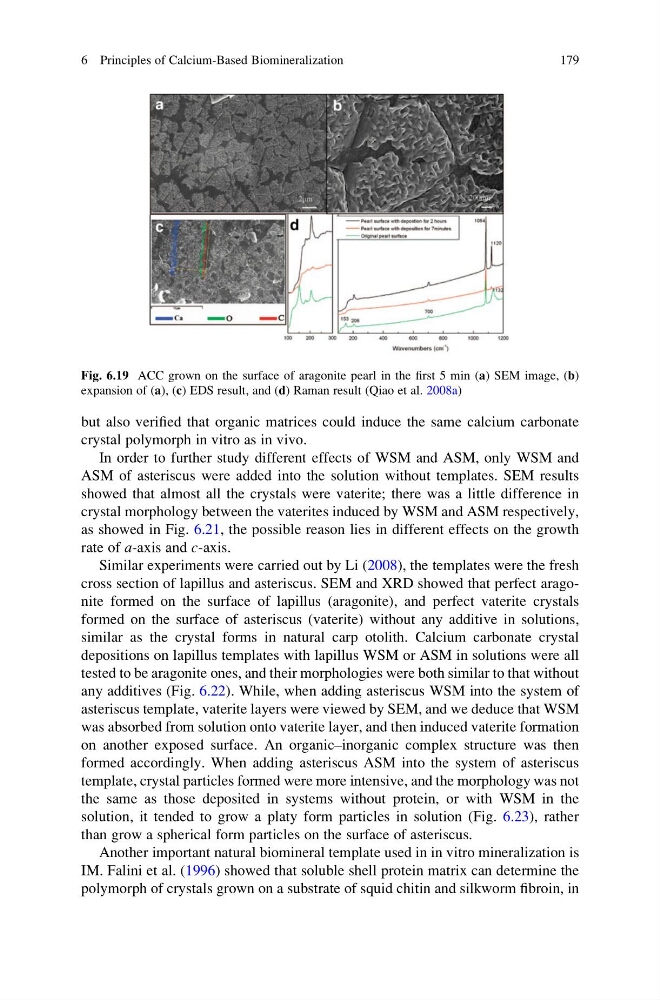
Fig. 6.19 ACC grown on the surface of aragonite pearl in the first 5 min (a) SEM image, (b)
expansion of (a), (c) EDS result, and (d) Raman result (Qiao et al. 2008a)
6 Principles of Calcium-Based Biomineralization
179
crystal polymorph in vitro as in vivo.
In order to further study different effects of WSM and ASM, only WSM and
ASM of asteriscus were added into the solution without templates. SEM results
showed that almost all the crystals were vaterite; there was a little difference in
crystal morphology between the vaterites induced by WSM and ASM respectively,
as showed in Fig. 6.21, the possible reason lies in different effects on the growth
rate of a-axis and c-axis.
Similar experiments were carried out by Li (2008), the templates were the fresh
cross section of lapillus and asteriscus. SEM and XRD showed that perfect aragonite formed on the surface of lapillus (aragonite), and perfect vaterite crystals
formed on the surface of asteriscus (vaterite) without any additive in solutions,
similar as the crystal forms in natural carp otolith. Calcium carbonate crystal
depositions on lapillus templates with lapillus WSM or ASM in solutions were all
tested to be aragonite ones, and their morphologies were both similar to that without
any additives (Fig. 6.22). While, when adding asteriscus WSM into the system of
asteriscus template, vaterite layers were viewed by SEM, and we deduce that WSM
was absorbed from solution onto vaterite layer, and then induced vaterite formation
on another exposed surface. An organic–inorganic complex structure was then
formed accordingly. When adding asteriscus ASM into the system of asteriscus
template, crystal particles formed were more intensive, and the morphology was not
the same as those deposited in systems without protein, or with WSM in the
solution, it tended to grow a platy form particles in solution (Fig. 6.23), rather
than grow a spherical form particles on the surface of asteriscus.
Another important natural biomineral template used in in vitro mineralization is
IM. Falini et al. (1996) showed that soluble shell protein matrix can determine the
polymorph of crystals grown on a substrate of squid chitin and silkworm fibroin, in
Fig. 6.19 ACC grown on the surface of aragonite pearl in the first 5 min (a) SEM image, (b)
expansion of (a), (c) EDS result, and (d) Raman result (Qiao et al. 2008a)
6 Principles of Calcium-Based Biomineralization
179