

amorphous calcium carbonate. This strategy has since been shown to be used by
animals from other phyla and for both aragonite and calcite. Recent evidence shows
that vertebrate bone mineral may also be formed via a precursor phase of amorphous calcium carbonate. This strategy thus appears to be widespread. The challenge now is to understand the mechanisms by which these unstable phases are
initially formed, how they are temporarily stabilized, and how they are destabilized
and transform into a crystalline mature product.
The basic paradigms in biomineralization are that minerals from a saturated
solution and that structured surfaces, as well as additives are intimately involved in
controlling the mineral formation process. The first-formed mineral may be relatively disordered, and over time transforms into more stable phases (Ostwald’s
Rule of Stages). It may also be similar or identical to the mature mineral phase.
The mineral formation process very much depends upon the mechanism of nucleation and the microenvironment in which this occurs. Studies of biomineralization
processes in a variety of different organisms from various phyla show that
transient minerals may first be formed and these subsequently crystallize upon
structured substrates. Furthermore, their growth may be modified by ions and
macromolecules. The recent studies focus on the development of the concept of
an amorphous precursor phase strategy in biomineralization, and the distribution of
this phenomenon, including the vertebrate phylum. This subject was briefly
reviewed by Weiner et al. (2005).
6.1.2 Calcium Phosphate
Bone and teeth are made from calcium phosphate in the form of the mineral
hydroxyapatite (HA), along with a large number of proteins. The structural chemistry of biological hydroxyapatite is very complex because the mineral is not
compositionally pure (non-stoichiometric), often being calcium deficient and
enriched in CO 3
2À , which replaces PO 4
3À ions in various lattice sites. In spite of
that bone mineral is referred to as hydroxyapatite, it is often known as “carbonated
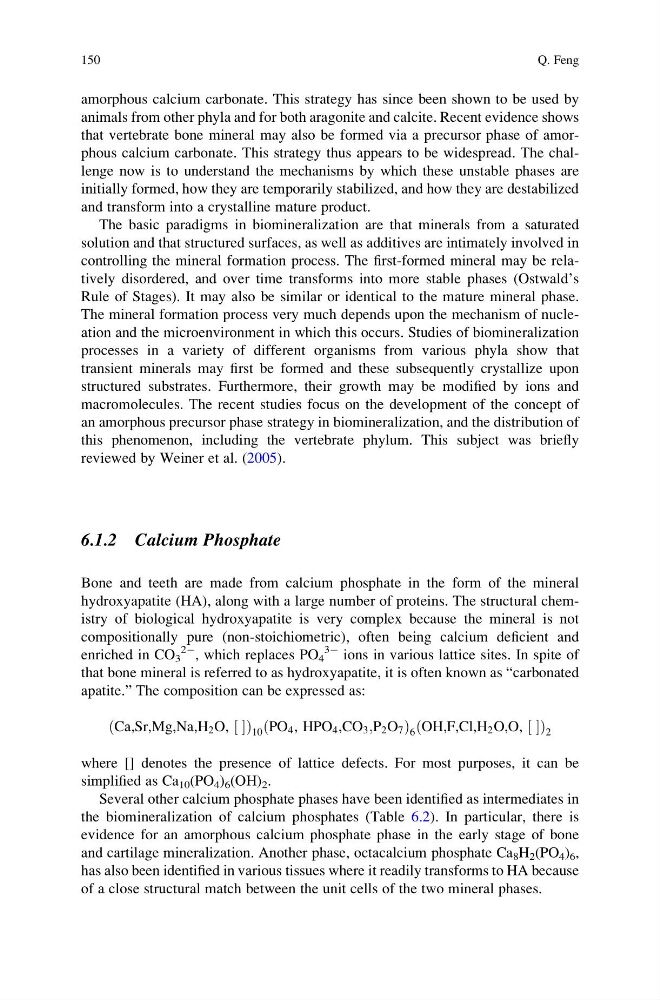
apatite.” The composition can be expressed as:
Ca,Sr,Mg,Na,H 2 O, ½
ð
Þ 10 PO 4 , HPO 4 ,CO 3 ;P 2 O 7
ð
Þ 6 OH,F,Cl,H 2 O,O, ½
ð
Þ 2
where [] denotes the presence of lattice defects. For most purposes, it can be
simplified as Ca 10 (PO 4 ) 6 (OH) 2 .
Several other calcium phosphate phases have been identified as intermediates in
the biomineralization of calcium phosphates (Table 6.2). In particular, there is
evidence for an amorphous calcium phosphate phase in the early stage of bone
and cartilage mineralization. Another phase, octacalcium phosphate Ca 8 H 2 (PO 4 ) 6 ,
has also been identified in various tissues where it readily transforms to HA because
of a close structural match between the unit cells of the two mineral phases.
150
Q. Feng
animals from other phyla and for both aragonite and calcite. Recent evidence shows
that vertebrate bone mineral may also be formed via a precursor phase of amorphous calcium carbonate. This strategy thus appears to be widespread. The challenge now is to understand the mechanisms by which these unstable phases are
initially formed, how they are temporarily stabilized, and how they are destabilized
and transform into a crystalline mature product.
The basic paradigms in biomineralization are that minerals from a saturated
solution and that structured surfaces, as well as additives are intimately involved in
controlling the mineral formation process. The first-formed mineral may be relatively disordered, and over time transforms into more stable phases (Ostwald’s
Rule of Stages). It may also be similar or identical to the mature mineral phase.
The mineral formation process very much depends upon the mechanism of nucleation and the microenvironment in which this occurs. Studies of biomineralization
processes in a variety of different organisms from various phyla show that
transient minerals may first be formed and these subsequently crystallize upon
structured substrates. Furthermore, their growth may be modified by ions and
macromolecules. The recent studies focus on the development of the concept of
an amorphous precursor phase strategy in biomineralization, and the distribution of
this phenomenon, including the vertebrate phylum. This subject was briefly
reviewed by Weiner et al. (2005).
6.1.2 Calcium Phosphate
Bone and teeth are made from calcium phosphate in the form of the mineral
hydroxyapatite (HA), along with a large number of proteins. The structural chemistry of biological hydroxyapatite is very complex because the mineral is not
compositionally pure (non-stoichiometric), often being calcium deficient and
enriched in CO 3
2À , which replaces PO 4
3À ions in various lattice sites. In spite of
that bone mineral is referred to as hydroxyapatite, it is often known as “carbonated
apatite.” The composition can be expressed as:
Ca,Sr,Mg,Na,H 2 O, ½
ð
Þ 10 PO 4 , HPO 4 ,CO 3 ;P 2 O 7
ð
Þ 6 OH,F,Cl,H 2 O,O, ½
ð
Þ 2
where [] denotes the presence of lattice defects. For most purposes, it can be
simplified as Ca 10 (PO 4 ) 6 (OH) 2 .
Several other calcium phosphate phases have been identified as intermediates in
the biomineralization of calcium phosphates (Table 6.2). In particular, there is
evidence for an amorphous calcium phosphate phase in the early stage of bone
and cartilage mineralization. Another phase, octacalcium phosphate Ca 8 H 2 (PO 4 ) 6 ,
has also been identified in various tissues where it readily transforms to HA because
of a close structural match between the unit cells of the two mineral phases.
150
Q. Feng