

easily. There are a few reports of vaterite minerals precipitated in aquatic
organisms. It occurs as elaborately shaped spicules in marine creatures called
ascidians (the majority of calcareous sponges have magnesium-rich calcite spines),
where it possibly acts as a structural support or as a deterrent against predators.
Vaterite has also been observed in the inner ears of two species of fish. Some
investigations showed that vaterite can exist in some extreme conditions with the
precise control of pH, temperature, and pressure (Vecht & Ireland 2000). Even
when vaterite is produced with organic additives or organic templates in lab, it is
still difficult for vaterite to resist aqueous solutions or higher temperatures (Kanakis
& Dalas 2000). Interestingly, living organisms can produce more vaterite in
biomineralization processes, such as gallstones, urinary calculi, microbial biscuits,
otolishs, and the eggshells of turtles. One of them, novel vaterite tablets are widely
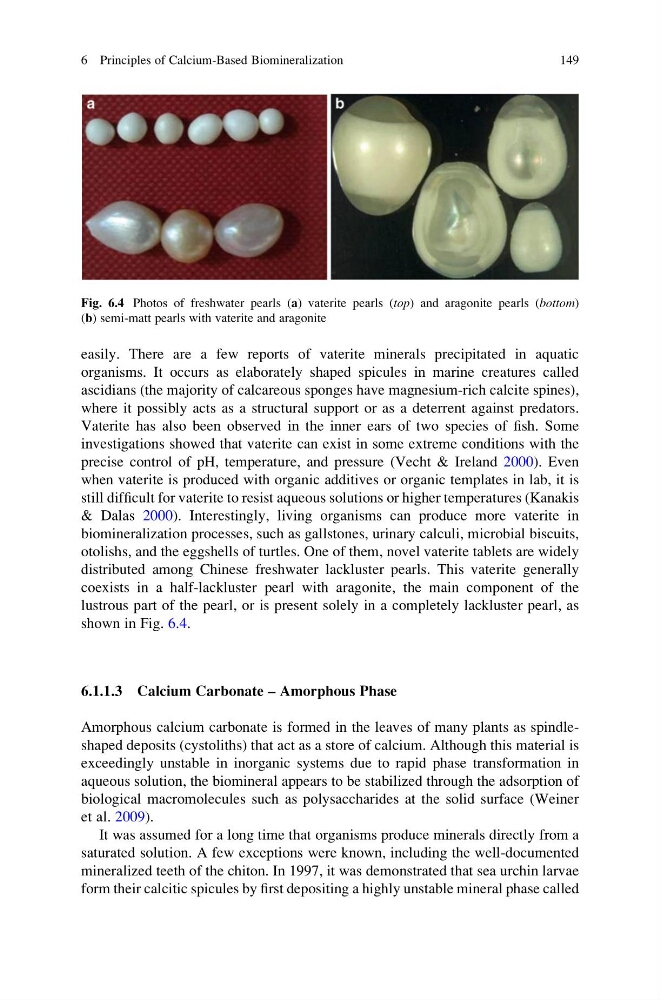
distributed among Chinese freshwater lackluster pearls. This vaterite generally
coexists in a half-lackluster pearl with aragonite, the main component of the
lustrous part of the pearl, or is present solely in a completely lackluster pearl, as
shown in Fig. 6.4.
6.1.1.3 Calcium Carbonate – Amorphous Phase
Amorphous calcium carbonate is formed in the leaves of many plants as spindleshaped deposits (cystoliths) that act as a store of calcium. Although this material is
exceedingly unstable in inorganic systems due to rapid phase transformation in
aqueous solution, the biomineral appears to be stabilized through the adsorption of
biological macromolecules such as polysaccharides at the solid surface (Weiner
et al. 2009).
It was assumed for a long time that organisms produce minerals directly from a
saturated solution. A few exceptions were known, including the well-documented
mineralized teeth of the chiton. In 1997, it was demonstrated that sea urchin larvae
form their calcitic spicules by first depositing a highly unstable mineral phase called
Fig. 6.4 Photos of freshwater pearls (a) vaterite pearls (top) and aragonite pearls (bottom)
(b) semi-matt pearls with vaterite and aragonite
6 Principles of Calcium-Based Biomineralization
149
organisms. It occurs as elaborately shaped spicules in marine creatures called
ascidians (the majority of calcareous sponges have magnesium-rich calcite spines),
where it possibly acts as a structural support or as a deterrent against predators.
Vaterite has also been observed in the inner ears of two species of fish. Some
investigations showed that vaterite can exist in some extreme conditions with the
precise control of pH, temperature, and pressure (Vecht & Ireland 2000). Even
when vaterite is produced with organic additives or organic templates in lab, it is
still difficult for vaterite to resist aqueous solutions or higher temperatures (Kanakis
& Dalas 2000). Interestingly, living organisms can produce more vaterite in
biomineralization processes, such as gallstones, urinary calculi, microbial biscuits,
otolishs, and the eggshells of turtles. One of them, novel vaterite tablets are widely
distributed among Chinese freshwater lackluster pearls. This vaterite generally
coexists in a half-lackluster pearl with aragonite, the main component of the
lustrous part of the pearl, or is present solely in a completely lackluster pearl, as
shown in Fig. 6.4.
6.1.1.3 Calcium Carbonate – Amorphous Phase
Amorphous calcium carbonate is formed in the leaves of many plants as spindleshaped deposits (cystoliths) that act as a store of calcium. Although this material is
exceedingly unstable in inorganic systems due to rapid phase transformation in
aqueous solution, the biomineral appears to be stabilized through the adsorption of
biological macromolecules such as polysaccharides at the solid surface (Weiner
et al. 2009).
It was assumed for a long time that organisms produce minerals directly from a
saturated solution. A few exceptions were known, including the well-documented
mineralized teeth of the chiton. In 1997, it was demonstrated that sea urchin larvae
form their calcitic spicules by first depositing a highly unstable mineral phase called
Fig. 6.4 Photos of freshwater pearls (a) vaterite pearls (top) and aragonite pearls (bottom)
(b) semi-matt pearls with vaterite and aragonite
6 Principles of Calcium-Based Biomineralization
149