

Sensor
Calcite and aragonite are also used as gravity sensors in sea animals. These devices
(generally referred to as statoliths, statoconia, otoliths, or otoconia) function in a
similar way to the fluid in the semicircular canals (which detect changes in angular
momentum). In the human ear, the crystals are made of calcite, spindle-shaped, and
sited on a specialized membrane under which sensory cells are located. During a
change in linear acceleration, the movement of the crystal mass relative to the
delicate hair-like extensions of the cells results in the electrical signaling of the
applied force to the brain.
The otoliths are calcium carbonate concretions in the inner ear of fish, which act
as sound transducers and play an important role in the teleost fish balance system.
Figure 6.2 shows the position of the otoliths in fish. Pannella discovered otolith
microincrements (Pannella 1971), which led to an increasing number of studies
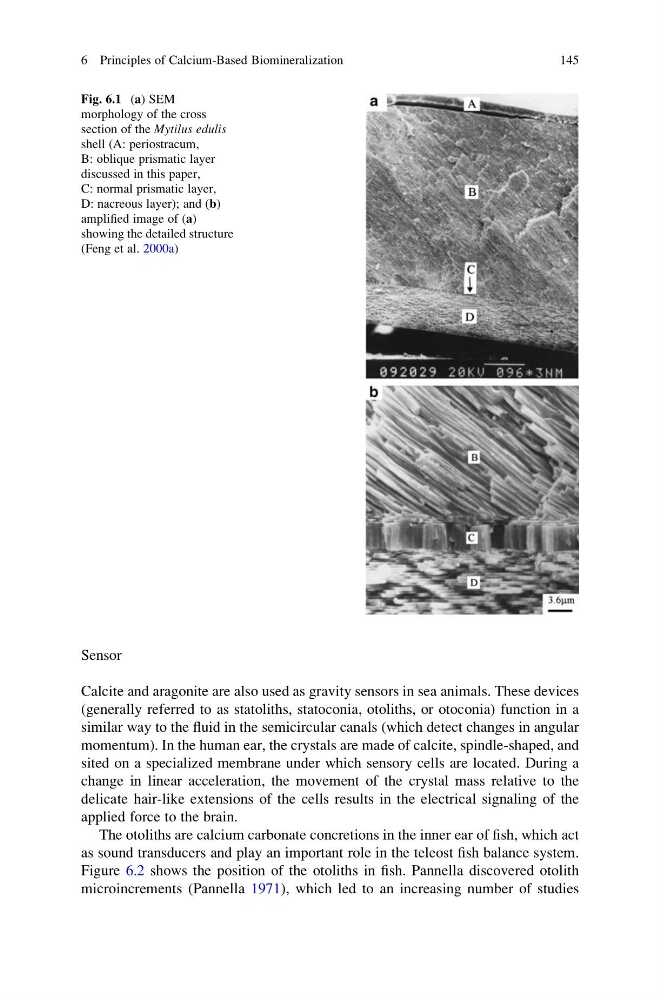
Fig. 6.1 (a) SEM
morphology of the cross
section of the Mytilus edulis
shell (A: periostracum,
B: oblique prismatic layer
discussed in this paper,
C: normal prismatic layer,
D: nacreous layer); and (b)
amplified image of (a)
showing the detailed structure
(Feng et al. 2000a)
6 Principles of Calcium-Based Biomineralization
145
Calcite and aragonite are also used as gravity sensors in sea animals. These devices
(generally referred to as statoliths, statoconia, otoliths, or otoconia) function in a
similar way to the fluid in the semicircular canals (which detect changes in angular
momentum). In the human ear, the crystals are made of calcite, spindle-shaped, and
sited on a specialized membrane under which sensory cells are located. During a
change in linear acceleration, the movement of the crystal mass relative to the
delicate hair-like extensions of the cells results in the electrical signaling of the
applied force to the brain.
The otoliths are calcium carbonate concretions in the inner ear of fish, which act
as sound transducers and play an important role in the teleost fish balance system.
Figure 6.2 shows the position of the otoliths in fish. Pannella discovered otolith
microincrements (Pannella 1971), which led to an increasing number of studies
Fig. 6.1 (a) SEM
morphology of the cross
section of the Mytilus edulis
shell (A: periostracum,
B: oblique prismatic layer
discussed in this paper,
C: normal prismatic layer,
D: nacreous layer); and (b)
amplified image of (a)
showing the detailed structure
(Feng et al. 2000a)
6 Principles of Calcium-Based Biomineralization
145