

Usually, the outer layer (prismatic layer) of the shell, as well as the growing
edge, consists of large crystals of calcite, whereas the inner region (nacre) is built
from a “brick wall” of plate-like aragonite crystals (Fig. 6.1). The prismatic layer is
first deposited and then the nacre is added with time as the shell grows in thickness.
The remarkable switching between the calcium carbonate polymorphs is controlled
by a layer of closely packed cells called the outer epithelium that is separated from
the inner shell surface by a space filled with an aqueous solution – the extrapallial
space and fluid, respectively. But the exact nature of how this process works is not
known. The calcite–aragonite switch is of key functional importance throughout
biomineralization and has been the research focus for decades.
The nacreous layer (mother-of-pearl) is a laminate of 0.5-mm thick aragonite
polygonal tablets sandwiched between thin (approximately 30 nm) sheets of a
protein–polysaccharide organic matrix. The matrix plays a key role in limiting
the thickness of the crystals and is structurally important in the mechanical design
of the shell. It reduces the number of voids in the shell wall and so inhibits crack
propagation by dissipating the energy; associated with an expanding defect along
the organic layers rather than through the inorganic crystals. This makes nacre
approximately 3,000 times as tough as inorganic aragonite.
Many marine single-celled organisms produce elaborate externally mineralized
structures that serve as all “exoskeleton” in which the organism lives. Many of the
most fascinating structures are found in a group of marine algae commonly known
as coccolithophores. The mineralized shells (coccospheres) consist of wonderfully
sculpted calcite plates called coccoliths, with additional decorative features such as
long trumpet-shaped spines.
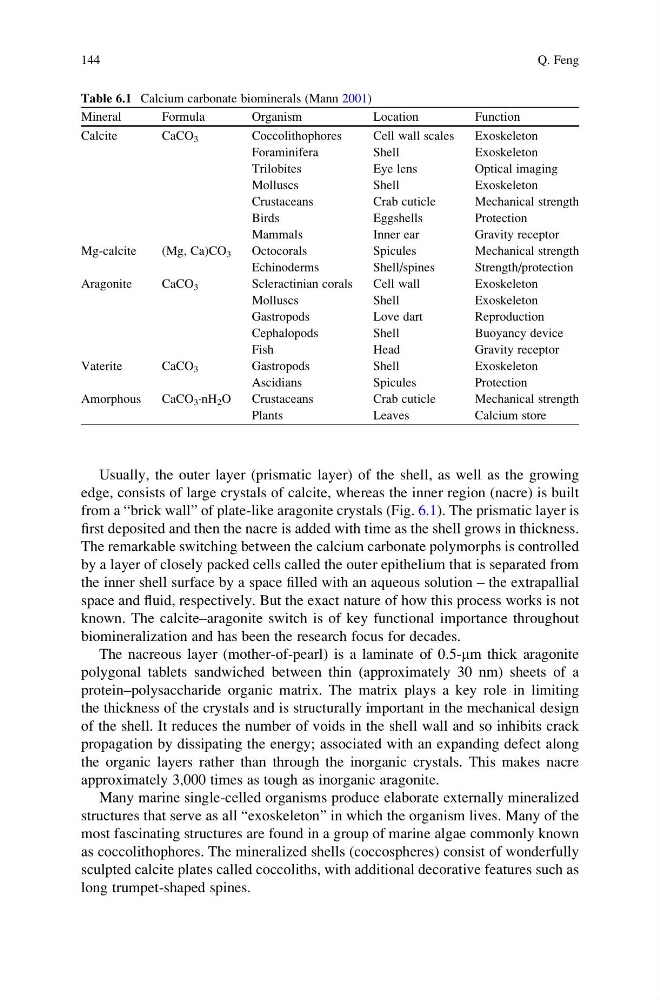
Table 6.1 Calcium carbonate biominerals (Mann 2001)
Mineral
Formula
Organism
Location
Function
Calcite
CaCO 3
Coccolithophores
Cell wall scales
Exoskeleton
Foraminifera
Shell
Exoskeleton
Trilobites
Eye lens
Optical imaging
Molluscs
Shell
Exoskeleton
Crustaceans
Crab cuticle
Mechanical strength
Birds
Eggshells
Protection
Mammals
Inner ear
Gravity receptor
Mg-calcite
(Mg, Ca)CO 3
Octocorals
Spicules
Mechanical strength
Echinoderms
Shell/spines
Strength/protection
Aragonite
CaCO 3
Scleractinian corals
Cell wall
Exoskeleton
Molluscs
Shell
Exoskeleton
Gastropods
Love dart
Reproduction
Cephalopods
Shell
Buoyancy device
Fish
Head
Gravity receptor
Vaterite
CaCO 3
Gastropods
Shell
Exoskeleton
Ascidians
Spicules
Protection
Amorphous
CaCO 3 ·nH 2 O
Crustaceans
Crab cuticle
Mechanical strength
Plants
Leaves
Calcium store
144
Q. Feng
edge, consists of large crystals of calcite, whereas the inner region (nacre) is built
from a “brick wall” of plate-like aragonite crystals (Fig. 6.1). The prismatic layer is
first deposited and then the nacre is added with time as the shell grows in thickness.
The remarkable switching between the calcium carbonate polymorphs is controlled
by a layer of closely packed cells called the outer epithelium that is separated from
the inner shell surface by a space filled with an aqueous solution – the extrapallial
space and fluid, respectively. But the exact nature of how this process works is not
known. The calcite–aragonite switch is of key functional importance throughout
biomineralization and has been the research focus for decades.
The nacreous layer (mother-of-pearl) is a laminate of 0.5-mm thick aragonite
polygonal tablets sandwiched between thin (approximately 30 nm) sheets of a
protein–polysaccharide organic matrix. The matrix plays a key role in limiting
the thickness of the crystals and is structurally important in the mechanical design
of the shell. It reduces the number of voids in the shell wall and so inhibits crack
propagation by dissipating the energy; associated with an expanding defect along
the organic layers rather than through the inorganic crystals. This makes nacre
approximately 3,000 times as tough as inorganic aragonite.
Many marine single-celled organisms produce elaborate externally mineralized
structures that serve as all “exoskeleton” in which the organism lives. Many of the
most fascinating structures are found in a group of marine algae commonly known
as coccolithophores. The mineralized shells (coccospheres) consist of wonderfully
sculpted calcite plates called coccoliths, with additional decorative features such as
long trumpet-shaped spines.
Table 6.1 Calcium carbonate biominerals (Mann 2001)
Mineral
Formula
Organism
Location
Function
Calcite
CaCO 3
Coccolithophores
Cell wall scales
Exoskeleton
Foraminifera
Shell
Exoskeleton
Trilobites
Eye lens
Optical imaging
Molluscs
Shell
Exoskeleton
Crustaceans
Crab cuticle
Mechanical strength
Birds
Eggshells
Protection
Mammals
Inner ear
Gravity receptor
Mg-calcite
(Mg, Ca)CO 3
Octocorals
Spicules
Mechanical strength
Echinoderms
Shell/spines
Strength/protection
Aragonite
CaCO 3
Scleractinian corals
Cell wall
Exoskeleton
Molluscs
Shell
Exoskeleton
Gastropods
Love dart
Reproduction
Cephalopods
Shell
Buoyancy device
Fish
Head
Gravity receptor
Vaterite
CaCO 3
Gastropods
Shell
Exoskeleton
Ascidians
Spicules
Protection
Amorphous
CaCO 3 ·nH 2 O
Crustaceans
Crab cuticle
Mechanical strength
Plants
Leaves
Calcium store
144
Q. Feng