

can, in presence of calcium ions, foster CCP when a state of oversaturation
develops (Fortin et al. 1997). Dupraz et al. (2009) talk of “alkaline engine” as a
series of processes (microbial metabolism and environmental conditions impacting
the CC SI) through which generation of carbonate ions occurs. Zavarzin (2002)
talks of an alkaline barrier, formed as result of microbial activities, responsible for
Fig. 5.1 (continued) cocoon. (6) Part of a colony of cocooned cells showing the pores (arrows)
which maintain nutritional and gaseous exchanges between cells in spite of the cocoons. A broken
cocoon let appear the inside carbonate products (with permission from Castanier et al. 1999)
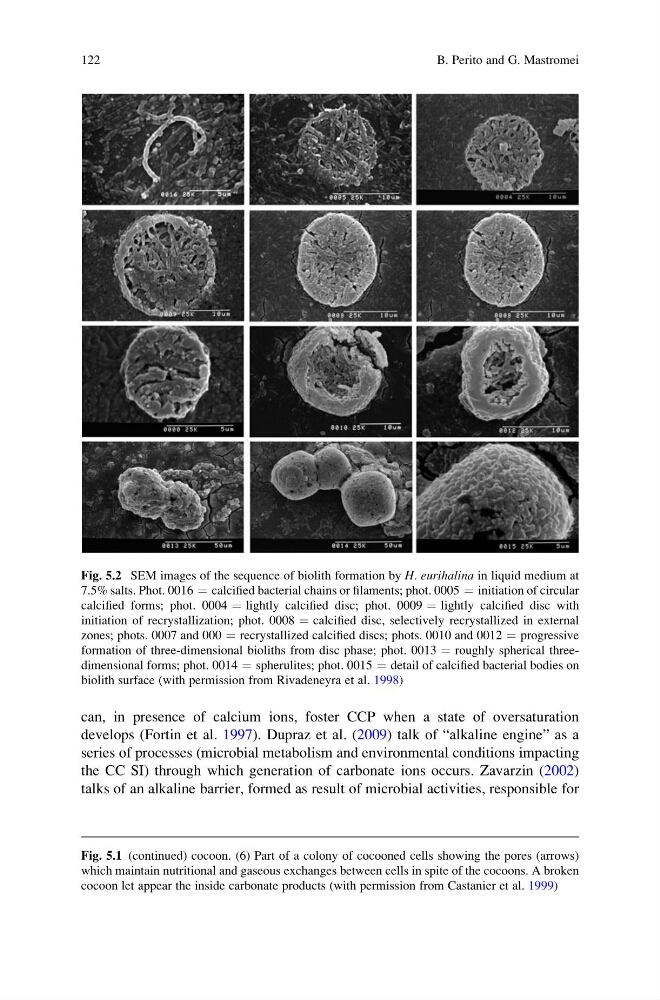
Fig. 5.2 SEM images of the sequence of biolith formation by H. eurihalina in liquid medium at
7.5% salts. Phot. 0016 ¼ calcified bacterial chains or filaments; phot. 0005 ¼ initiation of circular
calcified forms; phot. 0004 ¼ lightly calcified disc; phot. 0009 ¼ lightly calcified disc with
initiation of recrystallization; phot. 0008 ¼ calcified disc, selectively recrystallized in external
zones; phots. 0007 and 000 ¼ recrystallized calcified discs; phots. 0010 and 0012 ¼ progressive
formation of three-dimensional bioliths from disc phase; phot. 0013 ¼ roughly spherical threedimensional forms; phot. 0014 ¼ spherulites; phot. 0015 ¼ detail of calcified bacterial bodies on
biolith surface (with permission from Rivadeneyra et al. 1998)
122
B. Perito and G. Mastromei
develops (Fortin et al. 1997). Dupraz et al. (2009) talk of “alkaline engine” as a
series of processes (microbial metabolism and environmental conditions impacting
the CC SI) through which generation of carbonate ions occurs. Zavarzin (2002)
talks of an alkaline barrier, formed as result of microbial activities, responsible for
Fig. 5.1 (continued) cocoon. (6) Part of a colony of cocooned cells showing the pores (arrows)
which maintain nutritional and gaseous exchanges between cells in spite of the cocoons. A broken
cocoon let appear the inside carbonate products (with permission from Castanier et al. 1999)
Fig. 5.2 SEM images of the sequence of biolith formation by H. eurihalina in liquid medium at
7.5% salts. Phot. 0016 ¼ calcified bacterial chains or filaments; phot. 0005 ¼ initiation of circular
calcified forms; phot. 0004 ¼ lightly calcified disc; phot. 0009 ¼ lightly calcified disc with
initiation of recrystallization; phot. 0008 ¼ calcified disc, selectively recrystallized in external
zones; phots. 0007 and 000 ¼ recrystallized calcified discs; phots. 0010 and 0012 ¼ progressive
formation of three-dimensional bioliths from disc phase; phot. 0013 ¼ roughly spherical threedimensional forms; phot. 0014 ¼ spherulites; phot. 0015 ¼ detail of calcified bacterial bodies on
biolith surface (with permission from Rivadeneyra et al. 1998)
122
B. Perito and G. Mastromei