

calcium-mediated precipitation. This alkaline barrier is primarily due to decomposition of anions rather than to production of alkali. Organisms which increase the
medium pH by elimination of anions leave the scene ready for calcium precipitation. Rather than activities of single species or groups, activities of microbial
communities should be considered in natural environments. Metabolic pathways
involved in BCCP are described in Castanier et al. (1999); interactions of calcium
cycle with carbon, nitrogen, and sulfur and the microbial groups involved are
described by Zavarzin (2002).
Metabolic pathways involved in BCCP include autotrophic as well as heterotrophic pathways (both in aerobiosis and in anaerobiosis) with a different contribute.
Three main kinds of bacteria are involved in autotrophic production (Castanier
et al. 1999): methanogenic archaebacteria, sulfurous or non-sulfurous, purple
and green bacteria, and cyanobacteria. All obtain carbon from gaseous or dissolved
CO 2 , the origin of which is complex (atmosphere, eukaryotic and prokaryotic
respiration, fermentation) and use it as carbon source to produce organic matter.
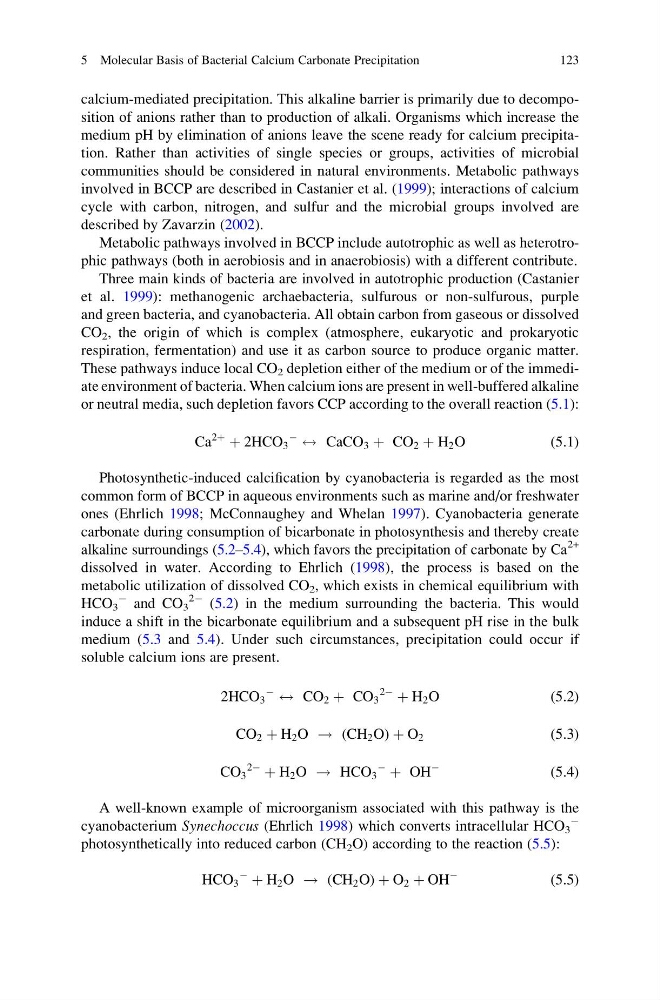
These pathways induce local CO 2 depletion either of the medium or of the immediate environment of bacteria. When calcium ions are present in well-buffered alkaline
or neutral media, such depletion favors CCP according to the overall reaction (5.1):
Ca
2þ
þ 2HCO 3
À
$ CaCO 3 þ CO 2 þ H 2 O
(5.1)
Photosynthetic-induced calcification by cyanobacteria is regarded as the most
common form of BCCP in aqueous environments such as marine and/or freshwater
ones (Ehrlich 1998; McConnaughey and Whelan 1997). Cyanobacteria generate
carbonate during consumption of bicarbonate in photosynthesis and thereby create
alkaline surroundings (5.2–5.4), which favors the precipitation of carbonate by Ca
2+
dissolved in water. According to Ehrlich (1998), the process is based on the
metabolic utilization of dissolved CO 2 , which exists in chemical equilibrium with
HCO 3
À and CO 3
2À (5.2) in the medium surrounding the bacteria. This would
induce a shift in the bicarbonate equilibrium and a subsequent pH rise in the bulk
medium (5.3 and 5.4). Under such circumstances, precipitation could occur if
soluble calcium ions are present.
2HCO 3
À
$ CO 2 þ CO 3
2À
þ H 2 O
(5.2)
CO 2 þ H 2 O ! (CH 2 O) þ O 2
(5.3)
CO 3
2À
þ H 2 O ! HCO 3
À
þ OH
À
(5.4)
A well-known example of microorganism associated with this pathway is the
cyanobacterium Synechoccus (Ehrlich 1998) which converts intracellular HCO 3
À
photosynthetically into reduced carbon (CH 2 O) according to the reaction (5.5):
HCO 3
À
þ H 2 O ! (CH 2 O) þ O 2 þ OH
À
(5.5)
5 Molecular Basis of Bacterial Calcium Carbonate Precipitation
123
medium pH by elimination of anions leave the scene ready for calcium precipitation. Rather than activities of single species or groups, activities of microbial
communities should be considered in natural environments. Metabolic pathways
involved in BCCP are described in Castanier et al. (1999); interactions of calcium
cycle with carbon, nitrogen, and sulfur and the microbial groups involved are
described by Zavarzin (2002).
Metabolic pathways involved in BCCP include autotrophic as well as heterotrophic pathways (both in aerobiosis and in anaerobiosis) with a different contribute.
Three main kinds of bacteria are involved in autotrophic production (Castanier
et al. 1999): methanogenic archaebacteria, sulfurous or non-sulfurous, purple
and green bacteria, and cyanobacteria. All obtain carbon from gaseous or dissolved
CO 2 , the origin of which is complex (atmosphere, eukaryotic and prokaryotic
respiration, fermentation) and use it as carbon source to produce organic matter.
These pathways induce local CO 2 depletion either of the medium or of the immediate environment of bacteria. When calcium ions are present in well-buffered alkaline
or neutral media, such depletion favors CCP according to the overall reaction (5.1):
Ca
2þ
þ 2HCO 3
À
$ CaCO 3 þ CO 2 þ H 2 O
(5.1)
Photosynthetic-induced calcification by cyanobacteria is regarded as the most
common form of BCCP in aqueous environments such as marine and/or freshwater
ones (Ehrlich 1998; McConnaughey and Whelan 1997). Cyanobacteria generate
carbonate during consumption of bicarbonate in photosynthesis and thereby create
alkaline surroundings (5.2–5.4), which favors the precipitation of carbonate by Ca
2+
dissolved in water. According to Ehrlich (1998), the process is based on the
metabolic utilization of dissolved CO 2 , which exists in chemical equilibrium with
HCO 3
À and CO 3
2À (5.2) in the medium surrounding the bacteria. This would
induce a shift in the bicarbonate equilibrium and a subsequent pH rise in the bulk
medium (5.3 and 5.4). Under such circumstances, precipitation could occur if
soluble calcium ions are present.
2HCO 3
À
$ CO 2 þ CO 3
2À
þ H 2 O
(5.2)
CO 2 þ H 2 O ! (CH 2 O) þ O 2
(5.3)
CO 3
2À
þ H 2 O ! HCO 3
À
þ OH
À
(5.4)
A well-known example of microorganism associated with this pathway is the
cyanobacterium Synechoccus (Ehrlich 1998) which converts intracellular HCO 3
À
photosynthetically into reduced carbon (CH 2 O) according to the reaction (5.5):
HCO 3
À
þ H 2 O ! (CH 2 O) þ O 2 þ OH
À
(5.5)
5 Molecular Basis of Bacterial Calcium Carbonate Precipitation
123