

form from Co
2+ to Co
3+ ), Pb, titanium (Ti), thallium (Tl), and cerium (Ce),
probably also as a result of oxidation. The concentrations of these minor elements
in the minerals reflect their concentrations in the actual environment. Recent results
suggested that the growth of crusts might also involve bio-seeds as a biogenic
component (Wang et al. 2009a).
4.6 Mineralization/Biomineralization Processes
During Formation of Hydrothermal Vents
A new formation of oceanic crust through seafloor spreading, associated with
hydrothermal venting and formation of metallic mineral deposits at the seafloor,
had been discovered in 1979 with locating the black smokers at the East Pacific Rise
(Francheteau et al. 1979; RISE Project 1980). It had been discovered that heat was
released by the upwelling of hot magma between the Earth’s tectonic plates. The
studies revealed that the supply of hydrothermal fluids, released through the basaltic
rocks at the ocean floor, originate from the seawater that had been drawn from its
vicinity. The water is heated through close contact with crystallizing magma
chambers. After enrichment with minerals through interaction with the surrounding
rocks, the water is expelled back to the marine environment. Due to intimate fluidrock interactions during the transport through the crust, the hydrothermal fluids are
hot, acidic, highly reduced, and metal-enriched in comparison to ambient seawater
(see: Herzig and Hannington 2006). Venting of the hydrothermal fluids at the
seafloor takes place at > 250
C. During mixing of the high-temperature fluids
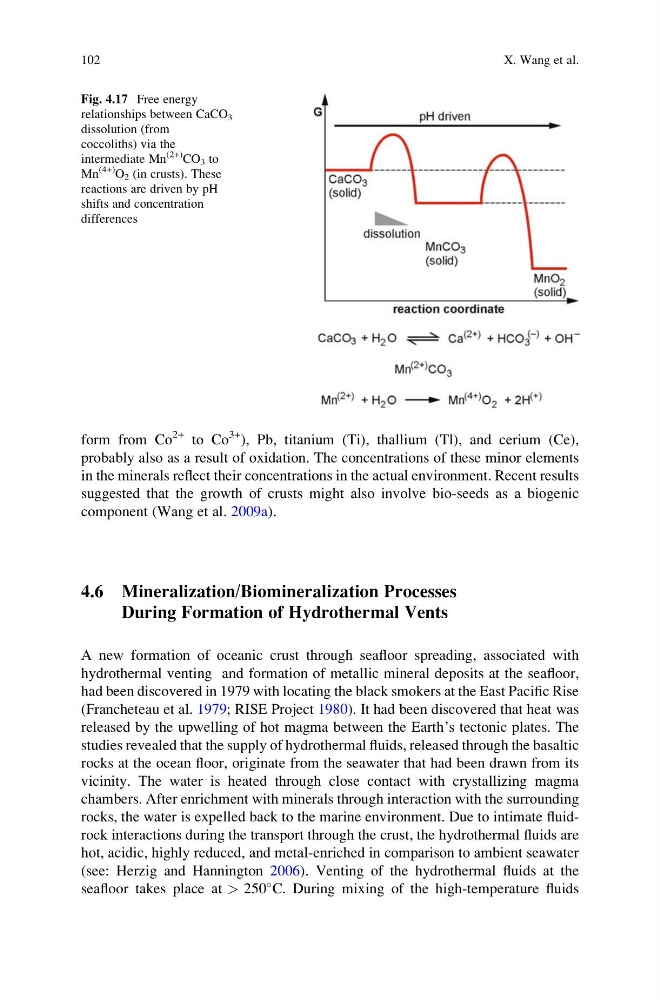
Fig. 4.17 Free energy
relationships between CaCO 3
dissolution (from
coccoliths) via the
intermediate Mn
(2+) CO 3 to
Mn
(4+) O 2 (in crusts). These
reactions are driven by pH
shifts and concentration
differences
102
X. Wang et al.
2+ to Co
3+ ), Pb, titanium (Ti), thallium (Tl), and cerium (Ce),
probably also as a result of oxidation. The concentrations of these minor elements
in the minerals reflect their concentrations in the actual environment. Recent results
suggested that the growth of crusts might also involve bio-seeds as a biogenic
component (Wang et al. 2009a).
4.6 Mineralization/Biomineralization Processes
During Formation of Hydrothermal Vents
A new formation of oceanic crust through seafloor spreading, associated with
hydrothermal venting and formation of metallic mineral deposits at the seafloor,
had been discovered in 1979 with locating the black smokers at the East Pacific Rise
(Francheteau et al. 1979; RISE Project 1980). It had been discovered that heat was
released by the upwelling of hot magma between the Earth’s tectonic plates. The
studies revealed that the supply of hydrothermal fluids, released through the basaltic
rocks at the ocean floor, originate from the seawater that had been drawn from its
vicinity. The water is heated through close contact with crystallizing magma
chambers. After enrichment with minerals through interaction with the surrounding
rocks, the water is expelled back to the marine environment. Due to intimate fluidrock interactions during the transport through the crust, the hydrothermal fluids are
hot, acidic, highly reduced, and metal-enriched in comparison to ambient seawater
(see: Herzig and Hannington 2006). Venting of the hydrothermal fluids at the
seafloor takes place at > 250
C. During mixing of the high-temperature fluids
Fig. 4.17 Free energy
relationships between CaCO 3
dissolution (from
coccoliths) via the
intermediate Mn
(2+) CO 3 to
Mn
(4+) O 2 (in crusts). These
reactions are driven by pH
shifts and concentration
differences
102
X. Wang et al.