

4.5.6 Bio-seeds
In their theoretical considerations, Halbach (1986) and Koschinsky and Halbach
(1995) proposed that calcareous particles facilitate the formation of Mn(IV) from
Mn(II). They postulated that in the mixing zone [the region in which Mn(II) is
oxidized to Mn(III) and Mn(IV)] Mn(II) adsorb physically on CaCO 3 surfaces a
process that facilitates the oxidation of Mn(II). The two-step process involves first
dissolution of calcium carbonate to bicarbonate, a reaction during which free
hydroxyl groups are released [CaCO 3 + H 2 O ! Ca
2+ + HCO 3
À + OH
À ]. This
reaction results in an increase of the pH value during which a microenvironment
is created that favors precipitation of MnO 2 (Stumm and Morgan 1996; Glasby and
Schulz 1999). Following this coupled chemical reaction, it can be accepted that during
CaCO 3 dissolution and in the presence of oxygen, Mn(II) is oxidized to Mn(III) and
Mn(IV) under simultaneous proton release (Mendhom et al. 2000) [Mn(II) + H 2 O !
Mn(IV)O 2 + 2H
+
]; Fig. 4.17.
An important step toward an understanding of crust formation, based on
principles of inorganic mineralization alone, came from the observation that these
deposits occur within the mixing zone between the upper oxygen-minimum zone
(OMZ) and the lower ORZ of deep seas (see above). In the mixing zone where the
ORZ and OMZ overlap, crusts are formed by precipitation of Mn oxyhydroxides
and Fe hydroxides via an intermediate colloidal state. It has been proposed
that these colloids adsorb to the hard-rock surfaces, a process that could be
promoted, or even catalyzed, by unicellular organisms (Fig. 4.17; left panel).
After this initial mineral deposition of the first molecular layers, mineralization
proceeds autocatalytically and coincides with co-precipitation of Co (in oxidized
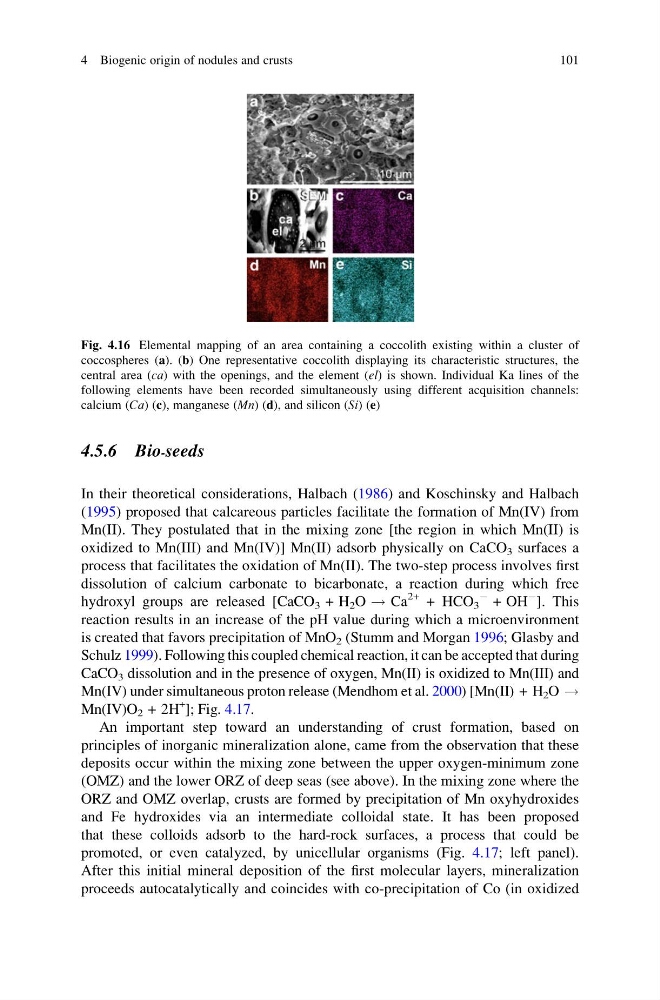
Fig. 4.16 Elemental mapping of an area containing a coccolith existing within a cluster of
coccospheres (a). (b) One representative coccolith displaying its characteristic structures, the
central area (ca) with the openings, and the element (el) is shown. Individual Ka lines of the
following elements have been recorded simultaneously using different acquisition channels:
calcium (Ca) (c), manganese (Mn) (d), and silicon (Si) (e)
4 Biogenic origin of nodules and crusts
101
In their theoretical considerations, Halbach (1986) and Koschinsky and Halbach
(1995) proposed that calcareous particles facilitate the formation of Mn(IV) from
Mn(II). They postulated that in the mixing zone [the region in which Mn(II) is
oxidized to Mn(III) and Mn(IV)] Mn(II) adsorb physically on CaCO 3 surfaces a
process that facilitates the oxidation of Mn(II). The two-step process involves first
dissolution of calcium carbonate to bicarbonate, a reaction during which free
hydroxyl groups are released [CaCO 3 + H 2 O ! Ca
2+ + HCO 3
À + OH
À ]. This
reaction results in an increase of the pH value during which a microenvironment
is created that favors precipitation of MnO 2 (Stumm and Morgan 1996; Glasby and
Schulz 1999). Following this coupled chemical reaction, it can be accepted that during
CaCO 3 dissolution and in the presence of oxygen, Mn(II) is oxidized to Mn(III) and
Mn(IV) under simultaneous proton release (Mendhom et al. 2000) [Mn(II) + H 2 O !
Mn(IV)O 2 + 2H
+
]; Fig. 4.17.
An important step toward an understanding of crust formation, based on
principles of inorganic mineralization alone, came from the observation that these
deposits occur within the mixing zone between the upper oxygen-minimum zone
(OMZ) and the lower ORZ of deep seas (see above). In the mixing zone where the
ORZ and OMZ overlap, crusts are formed by precipitation of Mn oxyhydroxides
and Fe hydroxides via an intermediate colloidal state. It has been proposed
that these colloids adsorb to the hard-rock surfaces, a process that could be
promoted, or even catalyzed, by unicellular organisms (Fig. 4.17; left panel).
After this initial mineral deposition of the first molecular layers, mineralization
proceeds autocatalytically and coincides with co-precipitation of Co (in oxidized
Fig. 4.16 Elemental mapping of an area containing a coccolith existing within a cluster of
coccospheres (a). (b) One representative coccolith displaying its characteristic structures, the
central area (ca) with the openings, and the element (el) is shown. Individual Ka lines of the
following elements have been recorded simultaneously using different acquisition channels:
calcium (Ca) (c), manganese (Mn) (d), and silicon (Si) (e)
4 Biogenic origin of nodules and crusts
101