

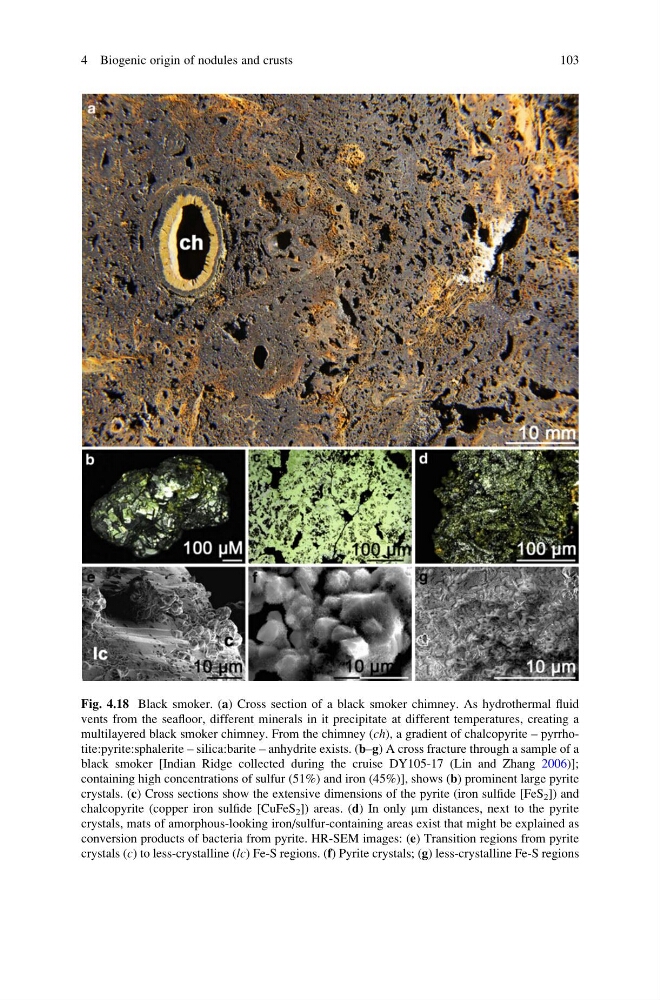
Fig. 4.18 Black smoker. (a) Cross section of a black smoker chimney. As hydrothermal fluid
vents from the seafloor, different minerals in it precipitate at different temperatures, creating a
multilayered black smoker chimney. From the chimney (ch), a gradient of chalcopyrite – pyrrhotite:pyrite:sphalerite – silica:barite – anhydrite exists. (b–g) A cross fracture through a sample of a
black smoker [Indian Ridge collected during the cruise DY105-17 (Lin and Zhang 2006)];
containing high concentrations of sulfur (51%) and iron (45%)], shows (b) prominent large pyrite
crystals. (c) Cross sections show the extensive dimensions of the pyrite (iron sulfide [FeS 2 ]) and
chalcopyrite (copper iron sulfide [CuFeS 2 ]) areas. (d) In only mm distances, next to the pyrite
crystals, mats of amorphous-looking iron/sulfur-containing areas exist that might be explained as
conversion products of bacteria from pyrite. HR-SEM images: (e) Transition regions from pyrite
crystals (c) to less-crystalline (lc) Fe-S regions. (f) Pyrite crystals; (g) less-crystalline Fe-S regions
4 Biogenic origin of nodules and crusts
103
vents from the seafloor, different minerals in it precipitate at different temperatures, creating a
multilayered black smoker chimney. From the chimney (ch), a gradient of chalcopyrite – pyrrhotite:pyrite:sphalerite – silica:barite – anhydrite exists. (b–g) A cross fracture through a sample of a
black smoker [Indian Ridge collected during the cruise DY105-17 (Lin and Zhang 2006)];
containing high concentrations of sulfur (51%) and iron (45%)], shows (b) prominent large pyrite
crystals. (c) Cross sections show the extensive dimensions of the pyrite (iron sulfide [FeS 2 ]) and
chalcopyrite (copper iron sulfide [CuFeS 2 ]) areas. (d) In only mm distances, next to the pyrite
crystals, mats of amorphous-looking iron/sulfur-containing areas exist that might be explained as
conversion products of bacteria from pyrite. HR-SEM images: (e) Transition regions from pyrite
crystals (c) to less-crystalline (lc) Fe-S regions. (f) Pyrite crystals; (g) less-crystalline Fe-S regions
4 Biogenic origin of nodules and crusts
103