

Bacterio Plankton
87
H,%.----------------------------------------.
700
75
5(}
(J ~~--~----~----~----~----~~----~
lO(J
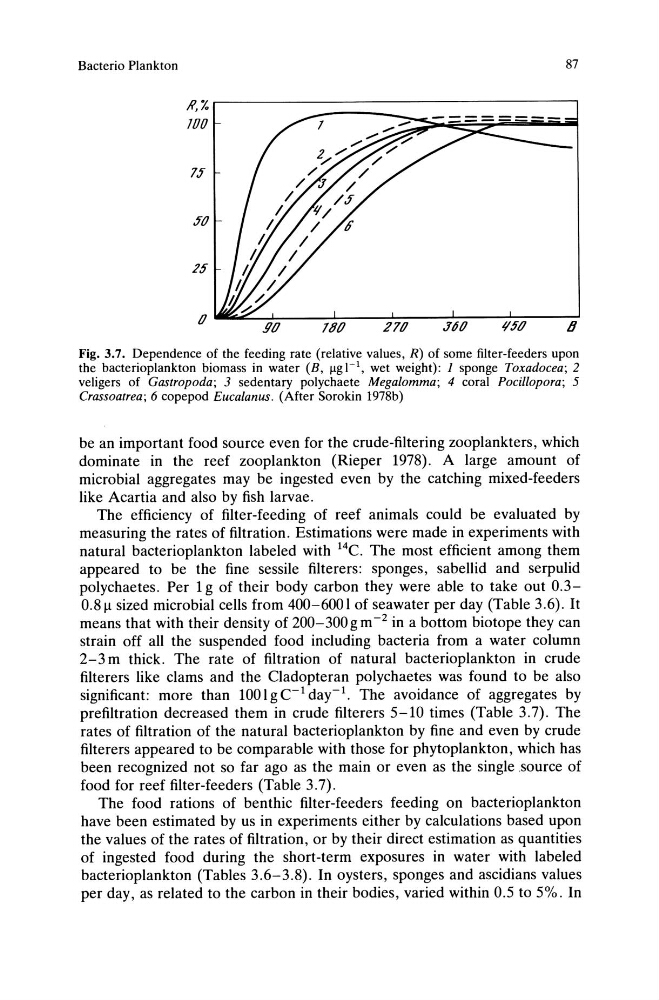
Fig. 3.7. Dependence of the feeding rate (relative values, R) of some filter-feeders upon
the bacterioplankton biomass in water (B, ~gl-l, wet weight): 1 sponge Toxadocea; 2
veligers of Gastropoda; 3 sedentary polychaete Megalomma; 4 coral Pocillopora; 5
Crassoatrea; 6 copepod Eucalanus. (After Sorokin 1978b)
be an important food source even for the crude-filtering zooplankters, which
dominate in the reef zooplankton (Rieper 1978). A large amount of
microbial aggregates may be ingested even by the catching mixed-feeders
like Acartia and also by fish larvae.
The efficiency of filter-feeding of reef animals could be evaluated by
measuring the rates of filtration. Estimations were made in experiments with
natural bacterioplankton labeled with 14c. The most efficient among them
appeared to be the fine sessile filterers: sponges, sabellid and serpulid
polychaetes. Per 1 g of their body carbon they were able to take out 0.30.811 sized microbial cells from 400-600 I of seawater per day (Table 3.6). It
means that with their density of 200- 300 g m - 2 in a bottom biotope they can
strain off all the suspended food including bacteria from a water column
2-3 m thick. The rate of filtration of natural bacterioplankton in crude
filterers like clams and the Cladopteran polychaetes was found to be also
significant: more than 100 I g C- l day-I. The avoidance of aggregates by
prefiltration decreased them in crude filterers 5 -10 times (Table 3.7). The
rates of filtration of the natural bacterioplankton by fine and even by crude
filterers appeared to be comparable with those for phytoplankton, which has
been recognized not so far ago as the main or even as the single .source of
food for reef filter-feeders (Table 3.7).
The food rations of benthic filter-feeders feeding on bacterioplankton
have been estimated by us in experiments either by calculations based upon
the values of the rates of filtration, or by their direct estimation as quantities
of ingested food during the short-term exposures in water with labeled
bacterioplankton (Tables 3.6-3.8). In oysters, sponges and ascidians values
per day, as related to the carbon in their bodies, varied within 0.5 to 5%. In
87
H,%.----------------------------------------.
700
75
5(}
(J ~~--~----~----~----~----~~----~
lO(J
Fig. 3.7. Dependence of the feeding rate (relative values, R) of some filter-feeders upon
the bacterioplankton biomass in water (B, ~gl-l, wet weight): 1 sponge Toxadocea; 2
veligers of Gastropoda; 3 sedentary polychaete Megalomma; 4 coral Pocillopora; 5
Crassoatrea; 6 copepod Eucalanus. (After Sorokin 1978b)
be an important food source even for the crude-filtering zooplankters, which
dominate in the reef zooplankton (Rieper 1978). A large amount of
microbial aggregates may be ingested even by the catching mixed-feeders
like Acartia and also by fish larvae.
The efficiency of filter-feeding of reef animals could be evaluated by
measuring the rates of filtration. Estimations were made in experiments with
natural bacterioplankton labeled with 14c. The most efficient among them
appeared to be the fine sessile filterers: sponges, sabellid and serpulid
polychaetes. Per 1 g of their body carbon they were able to take out 0.30.811 sized microbial cells from 400-600 I of seawater per day (Table 3.6). It
means that with their density of 200- 300 g m - 2 in a bottom biotope they can
strain off all the suspended food including bacteria from a water column
2-3 m thick. The rate of filtration of natural bacterioplankton in crude
filterers like clams and the Cladopteran polychaetes was found to be also
significant: more than 100 I g C- l day-I. The avoidance of aggregates by
prefiltration decreased them in crude filterers 5 -10 times (Table 3.7). The
rates of filtration of the natural bacterioplankton by fine and even by crude
filterers appeared to be comparable with those for phytoplankton, which has
been recognized not so far ago as the main or even as the single .source of
food for reef filter-feeders (Table 3.7).
The food rations of benthic filter-feeders feeding on bacterioplankton
have been estimated by us in experiments either by calculations based upon
the values of the rates of filtration, or by their direct estimation as quantities
of ingested food during the short-term exposures in water with labeled
bacterioplankton (Tables 3.6-3.8). In oysters, sponges and ascidians values
per day, as related to the carbon in their bodies, varied within 0.5 to 5%. In