

86
Plankton in Coral-Reef Waters
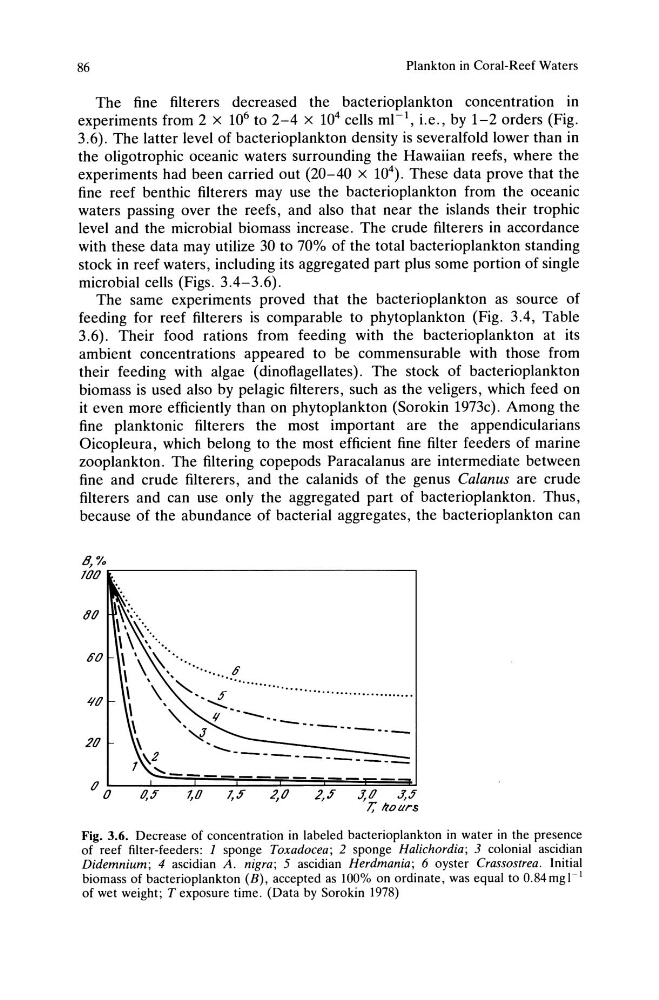
The fine filterers decreased the bacterioplankton concentration in
experiments from 2 x 10 6 to 2-4 X 10 4 cells ml-l, i.e., by 1-2 orders (Fig.
3.6). The latter level of bacterioplankton density is severalfold lower than in
the oligotrophic oceanic waters surrounding the Hawaiian reefs, where the
experiments had been carried out (20-40 x 10 4 ). These data prove that the
fine reef benthic filterers may use the bacterioplankton from the oceanic
waters passing over the reefs, and also that near the islands their trophic
level and the microbial biomass increase. The crude filterers in accordance
with these data may utilize 30 to 70% of the total bacterioplankton standing
stock in reef waters, including its aggregated part plus some portion of single
microbial cells (Figs. 3.4-3.6).
The same experiments proved that the bacterioplankton as source of
feeding for reef filterers is comparable to phytoplankton (Fig. 3.4, Table
3.6). Their food rations from feeding with the bacterioplankton at its
ambient concentrations appeared to be commensurable with those from
their feeding with algae (dinoflagellates). The stock of bacterioplankton
biomass is used also by pelagic filterers, such as the veligers, which feed on
it even more efficiently than on phytoplankton (Sorokin 1973c). Among the
fine planktonic filterers the most important are the appendicularians
Oicopleura, which belong to the most efficient fine filter feeders of marine
zooplankton. The filtering copepods Paracalanus are intermediate between
fine and crude filterers, and the calanids of the genus Calanus are crude
filterers and can use only the aggregated part of bacterioplankton. Thus,
because of the abundance of bacterial aggregates, the bacterioplankton can
8, "10
700~---------------------------------'
'.
80
0'0
20
........ ......................
.... _--- --------- - - - - .. -
---------1,0
7,.7
~O
2J '" Il J,.7
T, hours
Fig. 3.6. Decrease of concentration in labeled bacterioplankton in water in the presence
of reef filter-feeders: 1 sponge Toxadocea; 2 sponge Halichordia; 3 colonial ascidian
Didemnium; 4 ascidian A. nigra; 5 ascidian Herdmania; 6 oyster Crassostrea. Initial
biomass of bacterioplankton (B), accepted as 100% on ordinate, was equal to 0.84mgl- 1
of wet weight; T exposure time. (Data by Sorokin 1978)
Plankton in Coral-Reef Waters
The fine filterers decreased the bacterioplankton concentration in
experiments from 2 x 10 6 to 2-4 X 10 4 cells ml-l, i.e., by 1-2 orders (Fig.
3.6). The latter level of bacterioplankton density is severalfold lower than in
the oligotrophic oceanic waters surrounding the Hawaiian reefs, where the
experiments had been carried out (20-40 x 10 4 ). These data prove that the
fine reef benthic filterers may use the bacterioplankton from the oceanic
waters passing over the reefs, and also that near the islands their trophic
level and the microbial biomass increase. The crude filterers in accordance
with these data may utilize 30 to 70% of the total bacterioplankton standing
stock in reef waters, including its aggregated part plus some portion of single
microbial cells (Figs. 3.4-3.6).
The same experiments proved that the bacterioplankton as source of
feeding for reef filterers is comparable to phytoplankton (Fig. 3.4, Table
3.6). Their food rations from feeding with the bacterioplankton at its
ambient concentrations appeared to be commensurable with those from
their feeding with algae (dinoflagellates). The stock of bacterioplankton
biomass is used also by pelagic filterers, such as the veligers, which feed on
it even more efficiently than on phytoplankton (Sorokin 1973c). Among the
fine planktonic filterers the most important are the appendicularians
Oicopleura, which belong to the most efficient fine filter feeders of marine
zooplankton. The filtering copepods Paracalanus are intermediate between
fine and crude filterers, and the calanids of the genus Calanus are crude
filterers and can use only the aggregated part of bacterioplankton. Thus,
because of the abundance of bacterial aggregates, the bacterioplankton can
8, "10
700~---------------------------------'
'.
80
0'0
20
........ ......................
.... _--- --------- - - - - .. -
---------1,0
7,.7
~O
2J '" Il J,.7
T, hours
Fig. 3.6. Decrease of concentration in labeled bacterioplankton in water in the presence
of reef filter-feeders: 1 sponge Toxadocea; 2 sponge Halichordia; 3 colonial ascidian
Didemnium; 4 ascidian A. nigra; 5 ascidian Herdmania; 6 oyster Crassostrea. Initial
biomass of bacterioplankton (B), accepted as 100% on ordinate, was equal to 0.84mgl- 1
of wet weight; T exposure time. (Data by Sorokin 1978)