

88
Plankton in Coral-Reef Waters
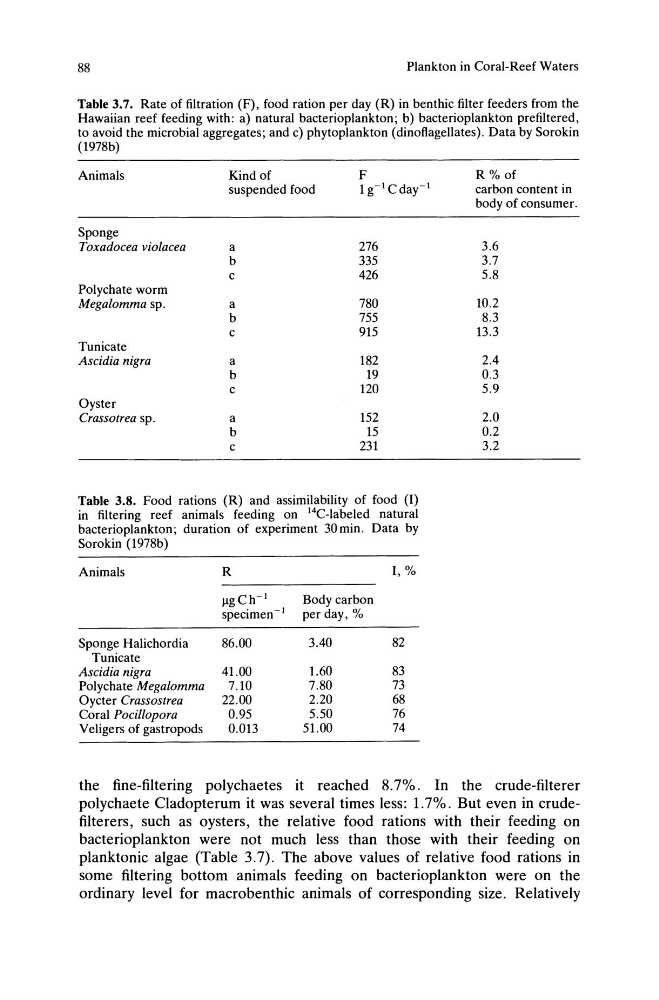
Table 3.7. Rate of filtration (F), food ration per day (R) in benthic filter feeders from the
Hawaiian reef feeding with: a) natural bacterioplankton; b) bacterioplankton prefiltered,
to avoid the microbial aggregates; and c) phytoplankton (dinoflagellates). Data by Sorokin
(1978b)
Animals
Kind of
F
suspended food
Ig- 1 Cday-l
Sponge
Toxadocea violacea
a
276
b
335
c
426
Polychate worm
Megalomma sp.
a
780
b
755
c
915
Tunicate
Ascidia nigra
a
182
b
19
c
120
Oyster
Crassotrea sp.
a
152
b
15
c
231
Table 3.8. Food rations (R) and assimilability of food (I)
in filtering reef animals feeding on 14C-labeled natural
bacterioplankton; duration of experiment 30 min. Data by
Sorokin (1978b)
Animals
Sponge Halichordia
Tunicate
Ascidia nigra
Polychate Megalomma
Oycter Crassostrea
Coral Pocil/opora
Veligers of gastropods
R
J.lgCh- 1
specimen- 1
86.00
41.00
7.10
22.00
0.95
0.013
Body carbon
per day, %
3.40
1.60
7.80
2.20
5.50
51.00
I, %
82
83
73
68
76
74
R % of
carbon content in
body of consumer.
3.6
3.7
5.8
10.2
8.3
13.3
2.4
0.3
5.9
2.0
0.2
3.2
the fine-filtering polychaetes it reached 8.7%. In the crude-filterer
polychaete Cladopterum it was several times less: 1.7%. But even in crudefilterers, such as oysters, the relative food rations with their feeding on
bacterioplankton were not much less than those with their feeding on
planktonic algae (Table 3.7). The above values of relative food rations in
some filtering bottom animals feeding on bacterioplankton were on the
ordinary level for macrobenthic animals of corresponding size. Relatively
Plankton in Coral-Reef Waters
Table 3.7. Rate of filtration (F), food ration per day (R) in benthic filter feeders from the
Hawaiian reef feeding with: a) natural bacterioplankton; b) bacterioplankton prefiltered,
to avoid the microbial aggregates; and c) phytoplankton (dinoflagellates). Data by Sorokin
(1978b)
Animals
Kind of
F
suspended food
Ig- 1 Cday-l
Sponge
Toxadocea violacea
a
276
b
335
c
426
Polychate worm
Megalomma sp.
a
780
b
755
c
915
Tunicate
Ascidia nigra
a
182
b
19
c
120
Oyster
Crassotrea sp.
a
152
b
15
c
231
Table 3.8. Food rations (R) and assimilability of food (I)
in filtering reef animals feeding on 14C-labeled natural
bacterioplankton; duration of experiment 30 min. Data by
Sorokin (1978b)
Animals
Sponge Halichordia
Tunicate
Ascidia nigra
Polychate Megalomma
Oycter Crassostrea
Coral Pocil/opora
Veligers of gastropods
R
J.lgCh- 1
specimen- 1
86.00
41.00
7.10
22.00
0.95
0.013
Body carbon
per day, %
3.40
1.60
7.80
2.20
5.50
51.00
I, %
82
83
73
68
76
74
R % of
carbon content in
body of consumer.
3.6
3.7
5.8
10.2
8.3
13.3
2.4
0.3
5.9
2.0
0.2
3.2
the fine-filtering polychaetes it reached 8.7%. In the crude-filterer
polychaete Cladopterum it was several times less: 1.7%. But even in crudefilterers, such as oysters, the relative food rations with their feeding on
bacterioplankton were not much less than those with their feeding on
planktonic algae (Table 3.7). The above values of relative food rations in
some filtering bottom animals feeding on bacterioplankton were on the
ordinary level for macrobenthic animals of corresponding size. Relatively