

78
Plankton in Coral-Reef Waters
Bp , Bs
1000
800
600
400
200
B
--p-.-_ . . . . . . . -- . . . . . . . . . . . .
-------~
O~~-----------------------------------sl 1
+
•
o
Scheme
of cross
seclion
sl 2
sl 3
sl 4
sl 5
sl 6 sl 7
+
+
+
+
+ +
50
100
150
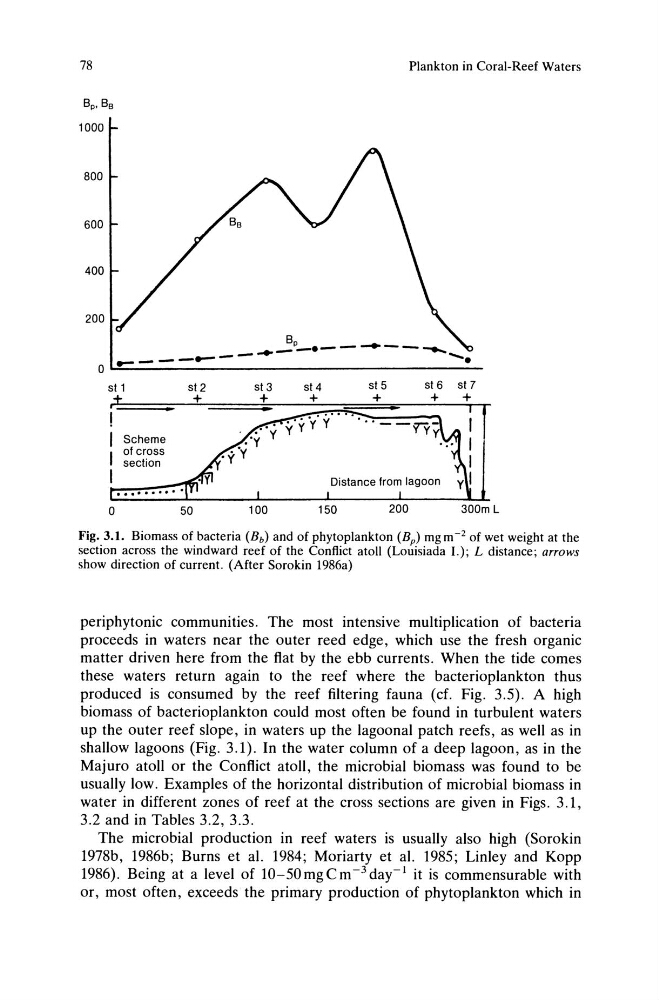
Fig. 3.1. Biomass of bacteria (Bb) and of phytoplankton (Bp) mg m- 2 of wet weight at the
section across the windward reef of the Conflict atoll (Louisiada I.); L distance; arrows
show direction of current. (After Sorokin 1986a)
periphytonic commumtIes. The most intensive multiplication of bacteria
proceeds in waters near the outer reed edge, which use the fresh organic
matter driven here from the flat by the ebb currents. When the tide comes
these waters return again to the reef where the bacterioplankton thus
produced is consumed by the reef filtering fauna (cf. Fig. 3.5). A high
biomass of bacterioplankton could most often be found in turbulent waters
up the outer reef slope, in waters up the lagoonal patch reefs, as well as in
shallow lagoons (Fig. 3.1). In the water column of a deep lagoon, as in the
Majuro atoll or the Conflict atoll, the microbial biomass was found to be
usually low. Examples of the horizontal distribution of microbial biomass in
water in different zones of reef at the cross sections are given in Figs. 3.1,
3.2 and in Tables 3.2, 3.3.
The microbial production in reef waters is usually also high (Sorokin
1978b, 1986b; Burns et al. 1984; Moriarty et al. 1985; Linley and Kopp
1986). Being at a level of 1O-50mgCm- 3 day-l it is commensurable with
or, most often, exceeds the primary production of phytoplankton which in
Plankton in Coral-Reef Waters
Bp , Bs
1000
800
600
400
200
B
--p-.-_ . . . . . . . -- . . . . . . . . . . . .
-------~
O~~-----------------------------------sl 1
+
•
o
Scheme
of cross
seclion
sl 2
sl 3
sl 4
sl 5
sl 6 sl 7
+
+
+
+
+ +
50
100
150
Fig. 3.1. Biomass of bacteria (Bb) and of phytoplankton (Bp) mg m- 2 of wet weight at the
section across the windward reef of the Conflict atoll (Louisiada I.); L distance; arrows
show direction of current. (After Sorokin 1986a)
periphytonic commumtIes. The most intensive multiplication of bacteria
proceeds in waters near the outer reed edge, which use the fresh organic
matter driven here from the flat by the ebb currents. When the tide comes
these waters return again to the reef where the bacterioplankton thus
produced is consumed by the reef filtering fauna (cf. Fig. 3.5). A high
biomass of bacterioplankton could most often be found in turbulent waters
up the outer reef slope, in waters up the lagoonal patch reefs, as well as in
shallow lagoons (Fig. 3.1). In the water column of a deep lagoon, as in the
Majuro atoll or the Conflict atoll, the microbial biomass was found to be
usually low. Examples of the horizontal distribution of microbial biomass in
water in different zones of reef at the cross sections are given in Figs. 3.1,
3.2 and in Tables 3.2, 3.3.
The microbial production in reef waters is usually also high (Sorokin
1978b, 1986b; Burns et al. 1984; Moriarty et al. 1985; Linley and Kopp
1986). Being at a level of 1O-50mgCm- 3 day-l it is commensurable with
or, most often, exceeds the primary production of phytoplankton which in