

Bacterio Plankton
77
poor in waters of the formerly rich but cyclone-damaged reefs of the
Funafuti atoll. In the vicinity of the Lopevi I., where real reef was absent,
up the rocky slopes with rear corals the microbial biomass was as low as in
the surrounding oceanic waters: 1-2 mg C m -3 day-I. High values of
microbial number and biomass were recorded on such reefs rich with living
corals as the atolls Tarawa, Majuro, Butaritari, Heron, One Tree, Scott
reefs and the barrier and fringing reefs off Lizard I. and New Guinea.
To evaluate the significance of the above levels of biomass standing stock
of bacterioplankton as a food source, it is necessary to compare them with
values of levels optimal for feeding or filtering reef fauna. For the crude
filterers this is 20-40 mg C m -3 and for the fine filterers 6-10 mg C m -3 (cf.
Sect. 3.1.2). Thus even at an average level of its standing stock the
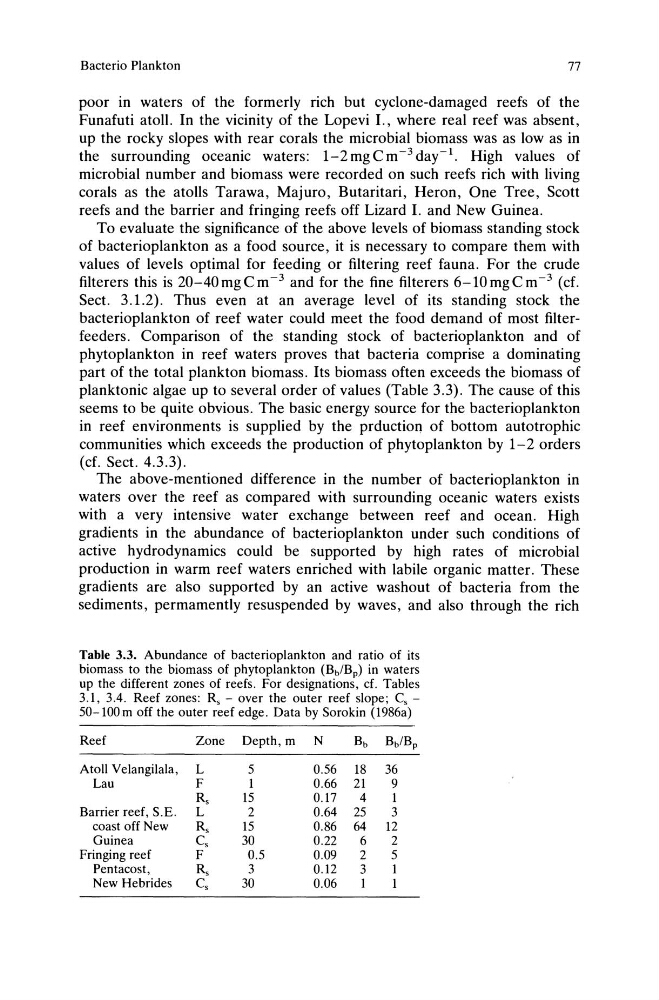
bacterioplankton of reef water could meet the food demand of most filterfeeders. Comparison of the standing stock of bacterioplankton and of
phytoplankton in reef waters proves that bacteria comprise a dominating
part of the total plankton biomass. Its biomass often exceeds the biomass of
planktonic algae up to several order of values (Table 3.3). The cause of this
seems to be quite obvious. The basic energy source for the bacterioplankton
in reef environments is supplied by the prduction of bottom autotrophic
communities which exceeds the production of phytoplankton by 1-2 orders
(cf. Sect. 4.3.3).
The above-mentioned difference in the number of bacterioplankton in
waters over the reef as compared with surrounding oceanic waters exists
with a very intensive water exchange between reef and ocean. High
gradients in the abundance of bacterioplankton under such conditions of
active hydrodynamics could be supported by high rates of microbial
production in warm reef waters enriched with labile organic matter. These
gradients are also supported by an active washout of bacteria from the
sediments, permamently resuspended by waves, and also through the rich
Table 3.3. Abundance of bacterioplankton and ratio of its
biomass to the biomass of phytoplankton (Bb/Bp) in waters
up the different zones of reefs. For designations, cf. Tables
3.1, 3.4. Reef zones: Rs - over the outer reef slope; Cs -
50-100 m off the outer reef edge. Data by Sorokin (1986a)
Reef
Zone Depth, m N
Bb Bb/Bp
Atoll Velangilala, L
5
0.56 18 36
Lau
F
1
0.66 21
9
Rs
15
0.17
4
1
Barrier reef, S.E.
L
2
0.64 25
3
coast off New
Rs
15
0.86 64
12
Guinea
Cs
30
0.22
6
2
Fringing reef
F
0.5
0.09
2
5
Pentacost,
Rs
3
0.12
3
1
New Hebrides
Cs
30
0.06
1
1
77
poor in waters of the formerly rich but cyclone-damaged reefs of the
Funafuti atoll. In the vicinity of the Lopevi I., where real reef was absent,
up the rocky slopes with rear corals the microbial biomass was as low as in
the surrounding oceanic waters: 1-2 mg C m -3 day-I. High values of
microbial number and biomass were recorded on such reefs rich with living
corals as the atolls Tarawa, Majuro, Butaritari, Heron, One Tree, Scott
reefs and the barrier and fringing reefs off Lizard I. and New Guinea.
To evaluate the significance of the above levels of biomass standing stock
of bacterioplankton as a food source, it is necessary to compare them with
values of levels optimal for feeding or filtering reef fauna. For the crude
filterers this is 20-40 mg C m -3 and for the fine filterers 6-10 mg C m -3 (cf.
Sect. 3.1.2). Thus even at an average level of its standing stock the
bacterioplankton of reef water could meet the food demand of most filterfeeders. Comparison of the standing stock of bacterioplankton and of
phytoplankton in reef waters proves that bacteria comprise a dominating
part of the total plankton biomass. Its biomass often exceeds the biomass of
planktonic algae up to several order of values (Table 3.3). The cause of this
seems to be quite obvious. The basic energy source for the bacterioplankton
in reef environments is supplied by the prduction of bottom autotrophic
communities which exceeds the production of phytoplankton by 1-2 orders
(cf. Sect. 4.3.3).
The above-mentioned difference in the number of bacterioplankton in
waters over the reef as compared with surrounding oceanic waters exists
with a very intensive water exchange between reef and ocean. High
gradients in the abundance of bacterioplankton under such conditions of
active hydrodynamics could be supported by high rates of microbial
production in warm reef waters enriched with labile organic matter. These
gradients are also supported by an active washout of bacteria from the
sediments, permamently resuspended by waves, and also through the rich
Table 3.3. Abundance of bacterioplankton and ratio of its
biomass to the biomass of phytoplankton (Bb/Bp) in waters
up the different zones of reefs. For designations, cf. Tables
3.1, 3.4. Reef zones: Rs - over the outer reef slope; Cs -
50-100 m off the outer reef edge. Data by Sorokin (1986a)
Reef
Zone Depth, m N
Bb Bb/Bp
Atoll Velangilala, L
5
0.56 18 36
Lau
F
1
0.66 21
9
Rs
15
0.17
4
1
Barrier reef, S.E.
L
2
0.64 25
3
coast off New
Rs
15
0.86 64
12
Guinea
Cs
30
0.22
6
2
Fringing reef
F
0.5
0.09
2
5
Pentacost,
Rs
3
0.12
3
1
New Hebrides
Cs
30
0.06
1
1