

352
Nutrition of Corals
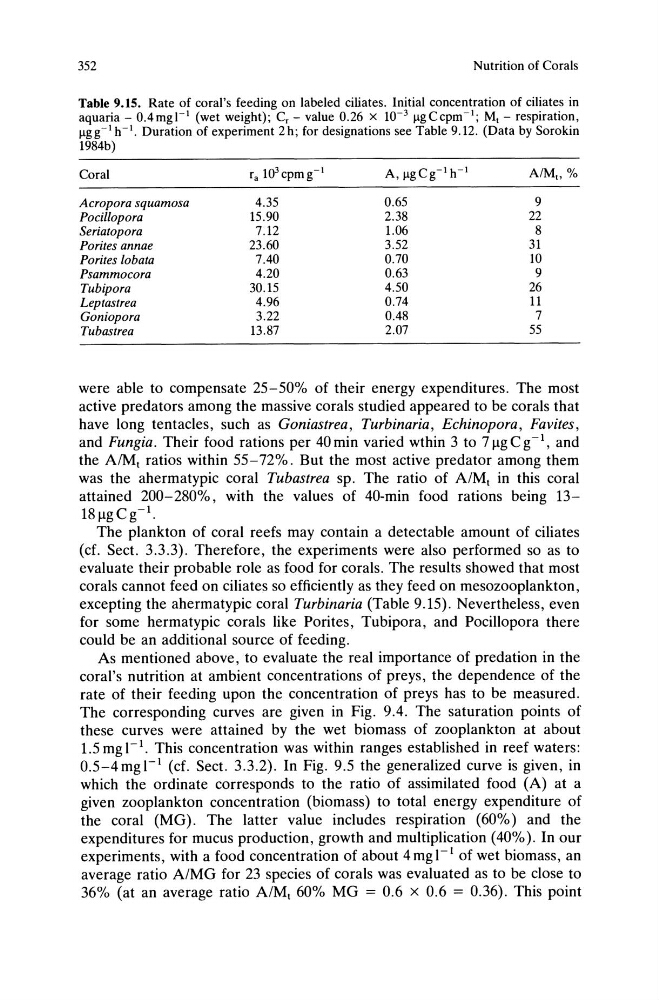
Table 9.15. Rate of coral's feeding on labeled ciliates. Initial concentration of ciliates in
aquaria - 0.4mgl- 1 (wet weight); Cr - value 0.26 x 10- 3 J,!gCcpm- l ; M, - respiration,
J,!g g-I h -I. Duration of experiment 2 h; for designations see Table 9.12. (Data by Sorokin
1984b)
Coral
ra 10 3 cpmg- 1
A, J,!gCg-1h- 1
AIM" %
Acropora squamosa
4.35
0.65
9
Pocillopora
15.90
2.38
22
Seriatopora
7.12
1.06
8
Porites annae
23.60
3.52
31
Porites {obata
7.40
0.70
10
Psammocora
4.20
0.63
9
Tubipora
30.15
4.50
26
Leptastrea
4.96
0.74
11
Goniopora
3.22
0.48
7
Tubastrea
13.87
2.07
55
were able to compensate 25-50% of their energy expenditures. The most
active predators among the massive corals studied appeared to be corals that
have long tentacles, such as Goniastrea, Turbinaria, Echinopora, Favites,
and Fungia. Their food rations per 40 min varied wthin 3 to 71lg C g-l, and
the AIM! ratios within 55-72 % • But the most active predator among them
was the ahermatypic coral Tubastrea sp. The ratio of AIM! in this coral
attained 200-280%, with the values of 40-min food rations being 13181lg Cg- 1 .
The plankton of coral reefs may contain a detectable amount of ciliates
(ct. Sect. 3.3.3). Therefore, the experiments were also performed so as to
evaluate their probable role as food for corals. The results showed that most
corals cannot feed on ciliates so efficiently as they feed on mesozooplankton,
excepting the ahermatypic coral Turbinaria (Table 9.15). Nevertheless, even
for some hermatypic corals like Porites, Tubipora, and Pocillopora there
could be an additional source of feeding.
As mentioned above, to evaluate the real importance of predation in the
coral's nutrition at ambient concentrations of preys, the dependence of the
rate of their feeding upon the concentration of preys has to be measured.
The corresponding curves are given in Fig. 9.4. The saturation points of
these curves were attained by the wet biomass of zooplankton at about
1.5 mg 1-1. This concentration was within ranges established in reef waters:
0.5-4mgl- 1 (ct. Sect. 3.3.2). In Fig. 9.5 the generalized curve is given, in
which the ordinate corresponds to the ratio of assimilated food (A) at a
given zooplankton concentration (biomass) to total energy expenditure of
the coral (MG). The latter value includes respiration (60%) and the
expenditures for mucus production, growth and multiplication (40%). In our
experiments, with a food concentration of about 4 mg 1-1 of wet biomass, an
average ratio A/MG for 23 species of corals was evaluated as to be close to
36% (at an average ratio AIM! 60% MG = 0.6 x 0.6 = 0.36). This point
Nutrition of Corals
Table 9.15. Rate of coral's feeding on labeled ciliates. Initial concentration of ciliates in
aquaria - 0.4mgl- 1 (wet weight); Cr - value 0.26 x 10- 3 J,!gCcpm- l ; M, - respiration,
J,!g g-I h -I. Duration of experiment 2 h; for designations see Table 9.12. (Data by Sorokin
1984b)
Coral
ra 10 3 cpmg- 1
A, J,!gCg-1h- 1
AIM" %
Acropora squamosa
4.35
0.65
9
Pocillopora
15.90
2.38
22
Seriatopora
7.12
1.06
8
Porites annae
23.60
3.52
31
Porites {obata
7.40
0.70
10
Psammocora
4.20
0.63
9
Tubipora
30.15
4.50
26
Leptastrea
4.96
0.74
11
Goniopora
3.22
0.48
7
Tubastrea
13.87
2.07
55
were able to compensate 25-50% of their energy expenditures. The most
active predators among the massive corals studied appeared to be corals that
have long tentacles, such as Goniastrea, Turbinaria, Echinopora, Favites,
and Fungia. Their food rations per 40 min varied wthin 3 to 71lg C g-l, and
the AIM! ratios within 55-72 % • But the most active predator among them
was the ahermatypic coral Tubastrea sp. The ratio of AIM! in this coral
attained 200-280%, with the values of 40-min food rations being 13181lg Cg- 1 .
The plankton of coral reefs may contain a detectable amount of ciliates
(ct. Sect. 3.3.3). Therefore, the experiments were also performed so as to
evaluate their probable role as food for corals. The results showed that most
corals cannot feed on ciliates so efficiently as they feed on mesozooplankton,
excepting the ahermatypic coral Turbinaria (Table 9.15). Nevertheless, even
for some hermatypic corals like Porites, Tubipora, and Pocillopora there
could be an additional source of feeding.
As mentioned above, to evaluate the real importance of predation in the
coral's nutrition at ambient concentrations of preys, the dependence of the
rate of their feeding upon the concentration of preys has to be measured.
The corresponding curves are given in Fig. 9.4. The saturation points of
these curves were attained by the wet biomass of zooplankton at about
1.5 mg 1-1. This concentration was within ranges established in reef waters:
0.5-4mgl- 1 (ct. Sect. 3.3.2). In Fig. 9.5 the generalized curve is given, in
which the ordinate corresponds to the ratio of assimilated food (A) at a
given zooplankton concentration (biomass) to total energy expenditure of
the coral (MG). The latter value includes respiration (60%) and the
expenditures for mucus production, growth and multiplication (40%). In our
experiments, with a food concentration of about 4 mg 1-1 of wet biomass, an
average ratio A/MG for 23 species of corals was evaluated as to be close to
36% (at an average ratio AIM! 60% MG = 0.6 x 0.6 = 0.36). This point