

350
Nutrition of Corals
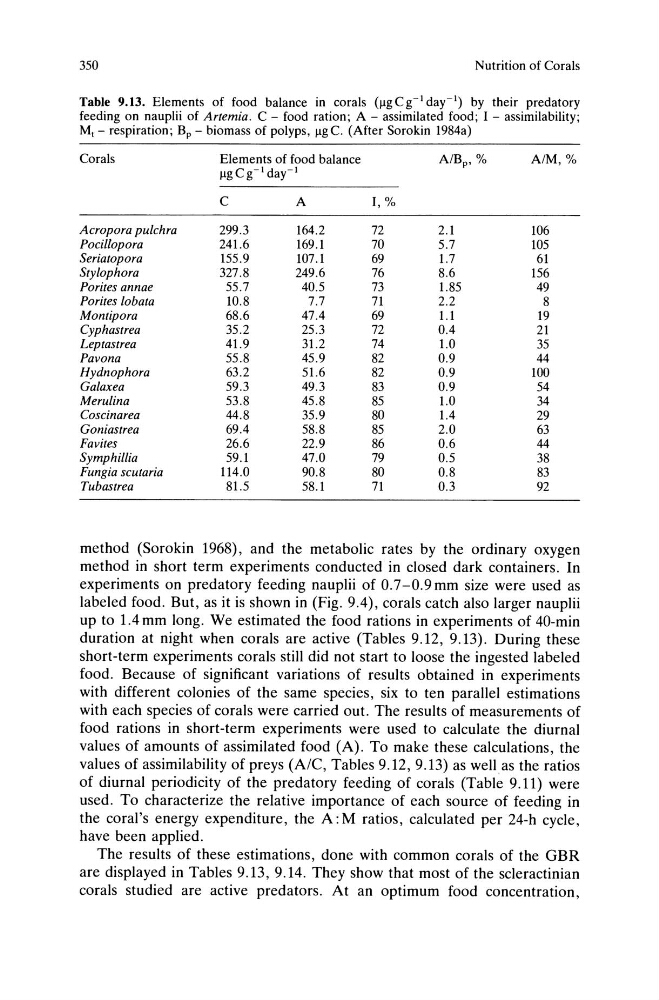
Table 9.13. Elements of food balance in corals (Ilg C g-l day-I) by their predatory
feeding on nauplii of Artemia. C - food ration; A - assimilated food; I - assimilability;
M, - respiration; Bp - biomass of polyps, Ilgc. (After Sorokin 1984a)
Corals
Elements of food balance
A/Bp, %
AIM, %
Ilg C g- lday-1
C
A
I, %
Acropora pulchra
299.3
164.2
72
2.1
106
Pocillopora
241.6
169.1
70
5.7
105
Seriatopora
155.9
107.1
69
1.7
61
Stylophora
327.8
249.6
76
8.6
156
Porites annae
55.7
40.5
73
1.85
49
Porites lobata
10.8
7.7
71
2.2
8
Montipora
68.6
47.4
69
l.l
19
Cyphastrea
35.2
25.3
72
0.4
21
Leptastrea
41.9
31.2
74
1.0
35
Pavona
55.8
45.9
82
0.9
44
Hydnophora
63.2
51.6
82
0.9
100
Galaxea
59.3
49.3
83
0.9
54
Merulina
53.8
45.8
85
1.0
34
Coscinarea
44.8
35.9
80
1.4
29
Goniastrea
69.4
58.8
85
2.0
63
Favites
26.6
22.9
86
0.6
44
Symphillia
59.1
47.0
79
0.5
38
Fungia scutaria
114.0
90.8
80
0.8
83
Tubastrea
81.5
58.1
71
0.3
92
method (Sorokin 1968), and the metabolic rates by the ordinary oxygen
method in short term experiments conducted in closed dark containers. In
experiments on predatory feeding nauplii of 0.7-0.9 mm size were used as
labeled food. But, as it is shown in (Fig. 9.4), corals catch also larger nauplii
up to 1.4 mm long. We estimated the food rations in experiments of 40-min
duration at night when corals are active (Tables 9.12, 9.13). During these
short-term experiments corals still did not start to loose the ingested labeled
food. Because of significant variations of results obtained in experiments
with different colonies of the same species, six to ten parallel estimations
with each species of corals were carried out. The results of measurements of
food rations in short-term experiments were used to calculate the diurnal
values of amounts of assimilated food (A). To make these calculations, the
values of assimilability of preys (A/C, Tables 9.12,9.13) as well as the ratios
of diurnal periodicity of the predatory feeding of corals (Table 9.11) were
used. To characterize the relative importance of each source of feeding in
the coral's energy expenditure, the A: M ratios, calculated per 24-h cycle,
have been applied.
The results of these estimations, done with common corals of the GBR
are displayed in Tables 9.13, 9.14. They show that most of the scleractinian
corals studied are active predators. At an optimum food concentration,
Nutrition of Corals
Table 9.13. Elements of food balance in corals (Ilg C g-l day-I) by their predatory
feeding on nauplii of Artemia. C - food ration; A - assimilated food; I - assimilability;
M, - respiration; Bp - biomass of polyps, Ilgc. (After Sorokin 1984a)
Corals
Elements of food balance
A/Bp, %
AIM, %
Ilg C g- lday-1
C
A
I, %
Acropora pulchra
299.3
164.2
72
2.1
106
Pocillopora
241.6
169.1
70
5.7
105
Seriatopora
155.9
107.1
69
1.7
61
Stylophora
327.8
249.6
76
8.6
156
Porites annae
55.7
40.5
73
1.85
49
Porites lobata
10.8
7.7
71
2.2
8
Montipora
68.6
47.4
69
l.l
19
Cyphastrea
35.2
25.3
72
0.4
21
Leptastrea
41.9
31.2
74
1.0
35
Pavona
55.8
45.9
82
0.9
44
Hydnophora
63.2
51.6
82
0.9
100
Galaxea
59.3
49.3
83
0.9
54
Merulina
53.8
45.8
85
1.0
34
Coscinarea
44.8
35.9
80
1.4
29
Goniastrea
69.4
58.8
85
2.0
63
Favites
26.6
22.9
86
0.6
44
Symphillia
59.1
47.0
79
0.5
38
Fungia scutaria
114.0
90.8
80
0.8
83
Tubastrea
81.5
58.1
71
0.3
92
method (Sorokin 1968), and the metabolic rates by the ordinary oxygen
method in short term experiments conducted in closed dark containers. In
experiments on predatory feeding nauplii of 0.7-0.9 mm size were used as
labeled food. But, as it is shown in (Fig. 9.4), corals catch also larger nauplii
up to 1.4 mm long. We estimated the food rations in experiments of 40-min
duration at night when corals are active (Tables 9.12, 9.13). During these
short-term experiments corals still did not start to loose the ingested labeled
food. Because of significant variations of results obtained in experiments
with different colonies of the same species, six to ten parallel estimations
with each species of corals were carried out. The results of measurements of
food rations in short-term experiments were used to calculate the diurnal
values of amounts of assimilated food (A). To make these calculations, the
values of assimilability of preys (A/C, Tables 9.12,9.13) as well as the ratios
of diurnal periodicity of the predatory feeding of corals (Table 9.11) were
used. To characterize the relative importance of each source of feeding in
the coral's energy expenditure, the A: M ratios, calculated per 24-h cycle,
have been applied.
The results of these estimations, done with common corals of the GBR
are displayed in Tables 9.13, 9.14. They show that most of the scleractinian
corals studied are active predators. At an optimum food concentration,