

Heterotrophic Feeding of Corals
349
Favites, and Symphillia, the share of these food components was up to 50%,
and in the coral Leptastrea up to 57% (Fig. 9.3, Table 9.14). These numbers
reflect the potential ability of common corals of the Indo-Pacific to use
various sources of heterotrophic nutrition.
The rate and the efficiency of heterotrophic nutrition in corals could be
characterized by the elements of food balance: e = A + M + F, where: e is
food ration, A assimilated food, M respiratory losses, F nondigested food.
The ratio A: e reflects the assimilability of the ingested food, and the ratio
A: M the degree of compensation of respiratory losses by the assimilated
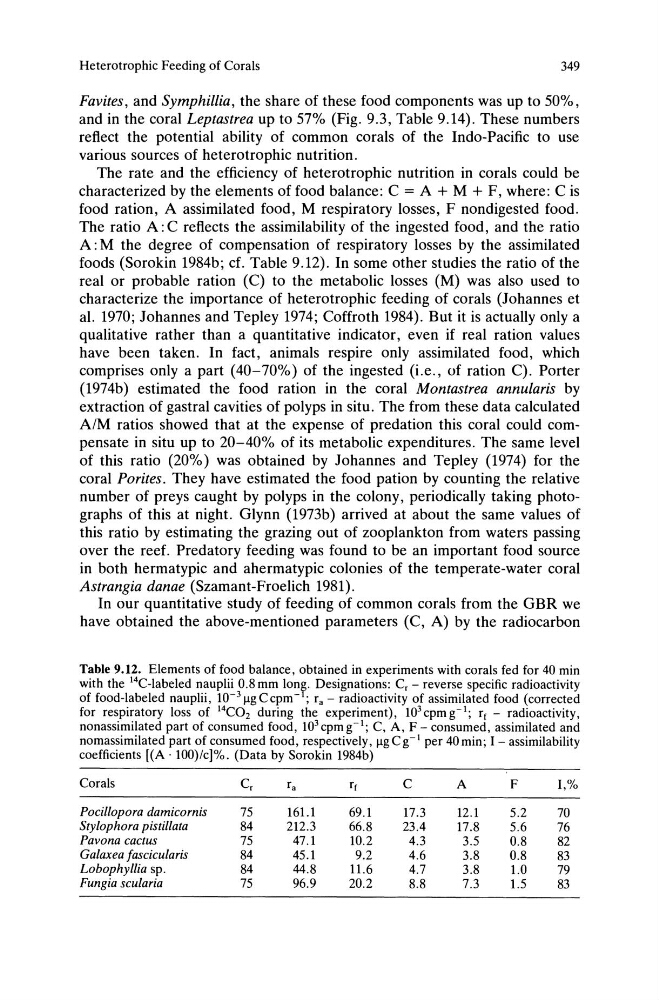
foods (Sorokin 1984b; d. Table 9.12). In some other studies the ratio of the
real or probable ration (C) to the metabolic losses (M) was also used to
characterize the importance of heterotrophic feeding of corals (Johannes et
al. 1970; Johannes and Tepley 1974; eoffroth 1984). But it is actually only a
qualitative rather than a quantitative indicator, even if real ration values
have been taken. In fact, animals respire only assimilated food, which
comprises only a part (40-70%) of the ingested (i.e., of ration C). Porter
(1974b) estimated the food ration in the coral Montastrea annularis by
extraction of gastral cavities of polyps in situ. The from these data calculated
AIM ratios showed that at the expense of predation this coral could compensate in situ up to 20-40% of its metabolic expenditures. The same level
of this ratio (20%) was obtained by Johannes and Tepley (1974) for the
coral Porites. They have estimated the food pation by counting the relative
number of preys caught by polyps in the colony, periodically taking photographs of this at night. Glynn (1973b) arrived at about the same values of
this ratio by estimating the grazing out of zooplankton from waters passing
over the reef. Predatory feeding was found to be an important food source
in both hermatypic and ahermatypic colonies of the temperate-water coral
Astrangia danae (Szamant-Froelich 1981).
In our quantitative study of feeding of common corals from the GBR we
have obtained the above-mentioned parameters (e, A) by the radiocarbon
Table 9.12. Elements of food balance, obtained in experiments with corals fed for 40 min
with the 14C-Iabeled nauplii 0.8 mm Ion? Designations: Cr - reverse specific radioactivity
of food-labeled nauplii, 10- 3 ~g C cpm- ; ra - radioactivity of assimilated food (corrected
for respiratory loss of 14COZ during the experiment), 10 3 cpmg- 1 ; rf - radioactivity,
nonassimilated part of consumed food, 10 3 cpmg- 1 ; C, A, F - consumed, assimilated and
nomassimilated part of consumed food, respectively, ~g C g-l per 40 min; I - assimilability
coefficients [(A, 100)/c]%. (Data by Sorokin 1984b)
Corals
Cr
ra
rf
C
A
F
1,%
Pocillopora damicornis
75
161.1
69.1
17.3
12.1
5.2
70
Stylophora pistil/ata
84
212.3
66.8
23.4
17.8
5.6
76
Pavona cactus
75
47.1
10.2
4.3
3.5
0.8
82
Galaxea fascicularis
84
45.1
9.2
4.6
3.8
0.8
83
Lobophyllia sp.
84
44.8
11.6
4.7
3.8
1.0
79
Fungia scularia
75
96.9
20.2
8.8
7.3
1.5
83
349
Favites, and Symphillia, the share of these food components was up to 50%,
and in the coral Leptastrea up to 57% (Fig. 9.3, Table 9.14). These numbers
reflect the potential ability of common corals of the Indo-Pacific to use
various sources of heterotrophic nutrition.
The rate and the efficiency of heterotrophic nutrition in corals could be
characterized by the elements of food balance: e = A + M + F, where: e is
food ration, A assimilated food, M respiratory losses, F nondigested food.
The ratio A: e reflects the assimilability of the ingested food, and the ratio
A: M the degree of compensation of respiratory losses by the assimilated
foods (Sorokin 1984b; d. Table 9.12). In some other studies the ratio of the
real or probable ration (C) to the metabolic losses (M) was also used to
characterize the importance of heterotrophic feeding of corals (Johannes et
al. 1970; Johannes and Tepley 1974; eoffroth 1984). But it is actually only a
qualitative rather than a quantitative indicator, even if real ration values
have been taken. In fact, animals respire only assimilated food, which
comprises only a part (40-70%) of the ingested (i.e., of ration C). Porter
(1974b) estimated the food ration in the coral Montastrea annularis by
extraction of gastral cavities of polyps in situ. The from these data calculated
AIM ratios showed that at the expense of predation this coral could compensate in situ up to 20-40% of its metabolic expenditures. The same level
of this ratio (20%) was obtained by Johannes and Tepley (1974) for the
coral Porites. They have estimated the food pation by counting the relative
number of preys caught by polyps in the colony, periodically taking photographs of this at night. Glynn (1973b) arrived at about the same values of
this ratio by estimating the grazing out of zooplankton from waters passing
over the reef. Predatory feeding was found to be an important food source
in both hermatypic and ahermatypic colonies of the temperate-water coral
Astrangia danae (Szamant-Froelich 1981).
In our quantitative study of feeding of common corals from the GBR we
have obtained the above-mentioned parameters (e, A) by the radiocarbon
Table 9.12. Elements of food balance, obtained in experiments with corals fed for 40 min
with the 14C-Iabeled nauplii 0.8 mm Ion? Designations: Cr - reverse specific radioactivity
of food-labeled nauplii, 10- 3 ~g C cpm- ; ra - radioactivity of assimilated food (corrected
for respiratory loss of 14COZ during the experiment), 10 3 cpmg- 1 ; rf - radioactivity,
nonassimilated part of consumed food, 10 3 cpmg- 1 ; C, A, F - consumed, assimilated and
nomassimilated part of consumed food, respectively, ~g C g-l per 40 min; I - assimilability
coefficients [(A, 100)/c]%. (Data by Sorokin 1984b)
Corals
Cr
ra
rf
C
A
F
1,%
Pocillopora damicornis
75
161.1
69.1
17.3
12.1
5.2
70
Stylophora pistil/ata
84
212.3
66.8
23.4
17.8
5.6
76
Pavona cactus
75
47.1
10.2
4.3
3.5
0.8
82
Galaxea fascicularis
84
45.1
9.2
4.6
3.8
0.8
83
Lobophyllia sp.
84
44.8
11.6
4.7
3.8
1.0
79
Fungia scularia
75
96.9
20.2
8.8
7.3
1.5
83