

348
Nutrition of Corals
nematods, polychaetes, small jelly fish and salps. The dominating
components in the gut contents were zoea and copepods. The suspended
organic material ingested by corals in situ via sedimentary filtration included
bacteria, protozoa, detritus, and dead zooplamkters (Lewis and Price 1975;
Lewis 1976). Corals readily ingest also the faeces of fish (Mc Closkey and
Chester 1971). As regards algae and other plant material, the scleractinian
corals rejected them. Even if swallowed by the polyp, this material was not
digested and was soon regurgitated (Yonge 1973; Sorokin 1973a).
The quantitative characteristics of the spectrum of feeding in corals and
their food preferences could be arrived at experimentally by estimating the
relative rates of their feeding and assimilation of various kinds of possible
food in equal concentrations. Under these conditions the rate of assimilation
will reflect the food preferences of the coral (Sorokin 1968, 1984a). The
rates of feeding and assimilation of food consumed in the experiments have
been estimated by employing the radiocarbon method mentioned above.
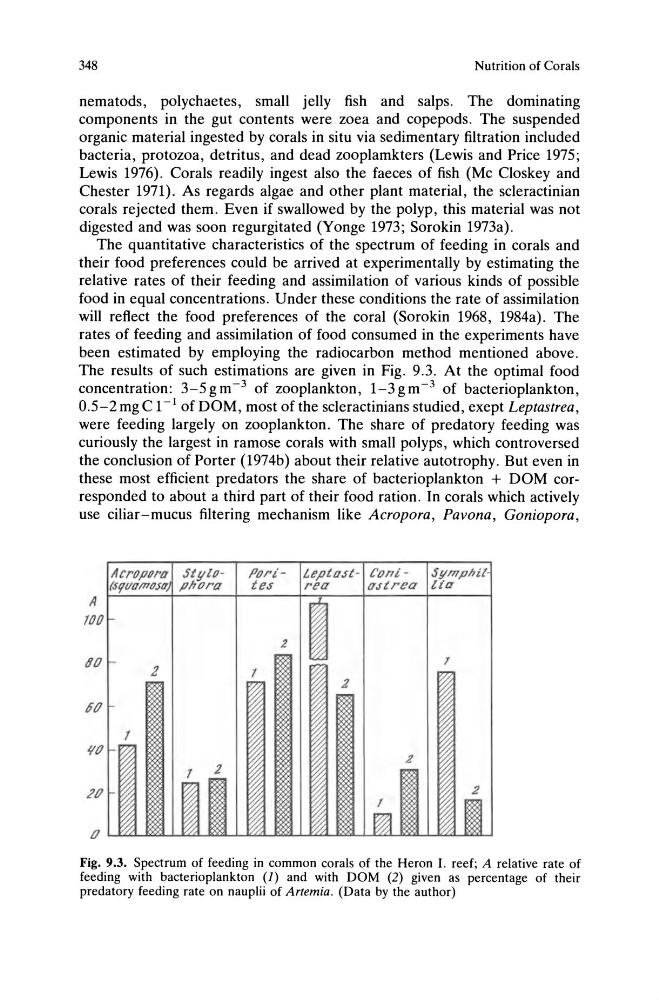
The results of such estimations are given in Fig. 9.3. At the optimal food
concentration: 3-5gm- 3 of zooplankton, 1-3gm- 3 of bacterioplankton,
0.5-2 mg C 1-1 of DOM, most of the scleractinians studied, exept Leptastrea,
were feeding largely on zooplankton. The share of predatory feeding was
curiously the largest in ramose corals with small polyps, which controversed
the conclusion of Porter (1974b) about their relative autotrophy. But even in
these most efficient predators the share of bacterioplankton + DOM corresponded to about a third part of their food ration. In corals which actively
use ciliar-mucus filtering mechanism like Acropora, Pavona, Goniopora,
A
700
80
00
'10
.?Il
Sf !lIPPpri - f.eptost- Coni -
la,ruom~~ol phoro
tes
reo
OJtrea
2
2
Fig. 9.3. Spectrum of feeding in common corals of the Heron I. reef; A relative rate of
feeding with bacterioplankton (1) and with DOM (2) given as percentage of their
predatory feeding rate on nauplii of Artemia. (Data by the author)
Nutrition of Corals
nematods, polychaetes, small jelly fish and salps. The dominating
components in the gut contents were zoea and copepods. The suspended
organic material ingested by corals in situ via sedimentary filtration included
bacteria, protozoa, detritus, and dead zooplamkters (Lewis and Price 1975;
Lewis 1976). Corals readily ingest also the faeces of fish (Mc Closkey and
Chester 1971). As regards algae and other plant material, the scleractinian
corals rejected them. Even if swallowed by the polyp, this material was not
digested and was soon regurgitated (Yonge 1973; Sorokin 1973a).
The quantitative characteristics of the spectrum of feeding in corals and
their food preferences could be arrived at experimentally by estimating the
relative rates of their feeding and assimilation of various kinds of possible
food in equal concentrations. Under these conditions the rate of assimilation
will reflect the food preferences of the coral (Sorokin 1968, 1984a). The
rates of feeding and assimilation of food consumed in the experiments have
been estimated by employing the radiocarbon method mentioned above.
The results of such estimations are given in Fig. 9.3. At the optimal food
concentration: 3-5gm- 3 of zooplankton, 1-3gm- 3 of bacterioplankton,
0.5-2 mg C 1-1 of DOM, most of the scleractinians studied, exept Leptastrea,
were feeding largely on zooplankton. The share of predatory feeding was
curiously the largest in ramose corals with small polyps, which controversed
the conclusion of Porter (1974b) about their relative autotrophy. But even in
these most efficient predators the share of bacterioplankton + DOM corresponded to about a third part of their food ration. In corals which actively
use ciliar-mucus filtering mechanism like Acropora, Pavona, Goniopora,
A
700
80
00
'10
.?Il
Sf !lIPPpri - f.eptost- Coni -
la,ruom~~ol phoro
tes
reo
OJtrea
2
2
Fig. 9.3. Spectrum of feeding in common corals of the Heron I. reef; A relative rate of
feeding with bacterioplankton (1) and with DOM (2) given as percentage of their
predatory feeding rate on nauplii of Artemia. (Data by the author)