

Heterotrophic Feeding of Corals
347
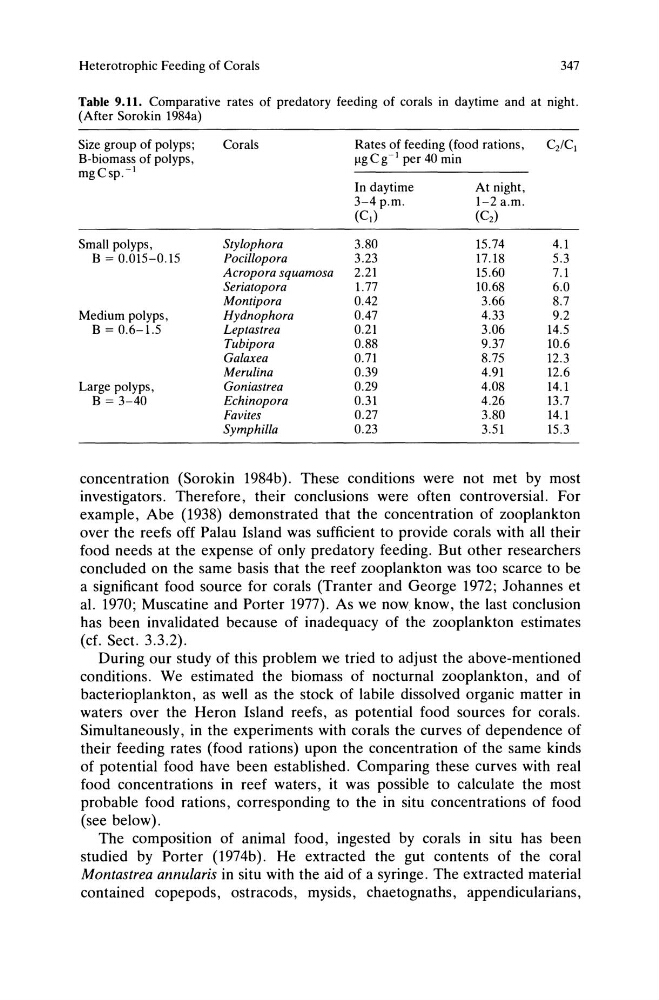
Table 9.11. Comparative rates of predatory feeding of corals in daytime and at night.
(After Sorokin 1984a)
Size group of polyps;
Corals
Rates of feeding (food rations,
C2/C 1
B-biomass of polyps,
I1gCg-1 per 40 min
mgCsp.-l
In daytime
At night,
3-4 p.m.
1-2 a.m.
(Cd
(C2)
Small polyps,
Stylophora
3.80
15.74
4.1
B = 0.D15-0.15
Pocillopora
3.23
17.18
5.3
Acropora squamosa
2.21
15.60
7.1
Seriatopora
1.77
10.68
6.0
Montipora
0.42
3.66
8.7
Medium polyps,
Hydnophora
0.47
4.33
9.2
B = 0.6-1.5
Leptastrea
0.21
3.06
14.5
Tubipora
0.88
9.37
10.6
Galaxea
0.71
8.75
12.3
Merulina
0.39
4.91
12.6
Large polyps,
Goniastrea
0.29
4.08
14.1
B = 3-40
Echinopora
0.31
4.26
13.7
Favites
0.27
3.80
14.1
Symphilla
0.23
3.51
15.3
concentration (Sorokin 1984b). These conditions were not met by most
investigators. Therefore, their conclusions were often controversial. For
example, Abe (1938) demonstrated that the concentration of zooplankton
over the reefs off Palau Island was sufficient to provide corals with all their
food needs at the expense of only predatory feeding. But other researchers
concluded on the same basis that the reef zooplankton was too scarce to be
a significant food source for corals (Tranter and George 1972; Johannes et
al. 1970; Muscatine and Porter 1977). As we now know, the last conclusion
has been invalidated because of inadequacy of the zooplankton estimates
(cf. Sect. 3.3.2).
During our study of this problem we tried to adjust the above-mentioned
conditions. We estimated the biomass of nocturnal zooplankton, and of
bacterioplankton, as well as the stock of labile dissolved organic matter in
waters over the Heron Island reefs, as potential food sources for corals.
Simultaneously, in the experiments with corals the curves of dependence of
their feeding rates (food rations) upon the concentration of the same kinds
of potential food have been established. Comparing these curves with real
food concentrations in reef waters, it was possible to calculate the most
probable food rations, corresponding to the in situ concentrations of food
(see below).
The composition of animal food, ingested by corals in situ has been
studied by Porter (1974b). He extracted the gut contents of the coral
Montastrea annularis in situ with the aid of a syringe. The extracted material
contained copepods, ostracods, mysids, chaetognaths, appendicularians,
347
Table 9.11. Comparative rates of predatory feeding of corals in daytime and at night.
(After Sorokin 1984a)
Size group of polyps;
Corals
Rates of feeding (food rations,
C2/C 1
B-biomass of polyps,
I1gCg-1 per 40 min
mgCsp.-l
In daytime
At night,
3-4 p.m.
1-2 a.m.
(Cd
(C2)
Small polyps,
Stylophora
3.80
15.74
4.1
B = 0.D15-0.15
Pocillopora
3.23
17.18
5.3
Acropora squamosa
2.21
15.60
7.1
Seriatopora
1.77
10.68
6.0
Montipora
0.42
3.66
8.7
Medium polyps,
Hydnophora
0.47
4.33
9.2
B = 0.6-1.5
Leptastrea
0.21
3.06
14.5
Tubipora
0.88
9.37
10.6
Galaxea
0.71
8.75
12.3
Merulina
0.39
4.91
12.6
Large polyps,
Goniastrea
0.29
4.08
14.1
B = 3-40
Echinopora
0.31
4.26
13.7
Favites
0.27
3.80
14.1
Symphilla
0.23
3.51
15.3
concentration (Sorokin 1984b). These conditions were not met by most
investigators. Therefore, their conclusions were often controversial. For
example, Abe (1938) demonstrated that the concentration of zooplankton
over the reefs off Palau Island was sufficient to provide corals with all their
food needs at the expense of only predatory feeding. But other researchers
concluded on the same basis that the reef zooplankton was too scarce to be
a significant food source for corals (Tranter and George 1972; Johannes et
al. 1970; Muscatine and Porter 1977). As we now know, the last conclusion
has been invalidated because of inadequacy of the zooplankton estimates
(cf. Sect. 3.3.2).
During our study of this problem we tried to adjust the above-mentioned
conditions. We estimated the biomass of nocturnal zooplankton, and of
bacterioplankton, as well as the stock of labile dissolved organic matter in
waters over the Heron Island reefs, as potential food sources for corals.
Simultaneously, in the experiments with corals the curves of dependence of
their feeding rates (food rations) upon the concentration of the same kinds
of potential food have been established. Comparing these curves with real
food concentrations in reef waters, it was possible to calculate the most
probable food rations, corresponding to the in situ concentrations of food
(see below).
The composition of animal food, ingested by corals in situ has been
studied by Porter (1974b). He extracted the gut contents of the coral
Montastrea annularis in situ with the aid of a syringe. The extracted material
contained copepods, ostracods, mysids, chaetognaths, appendicularians,