

346
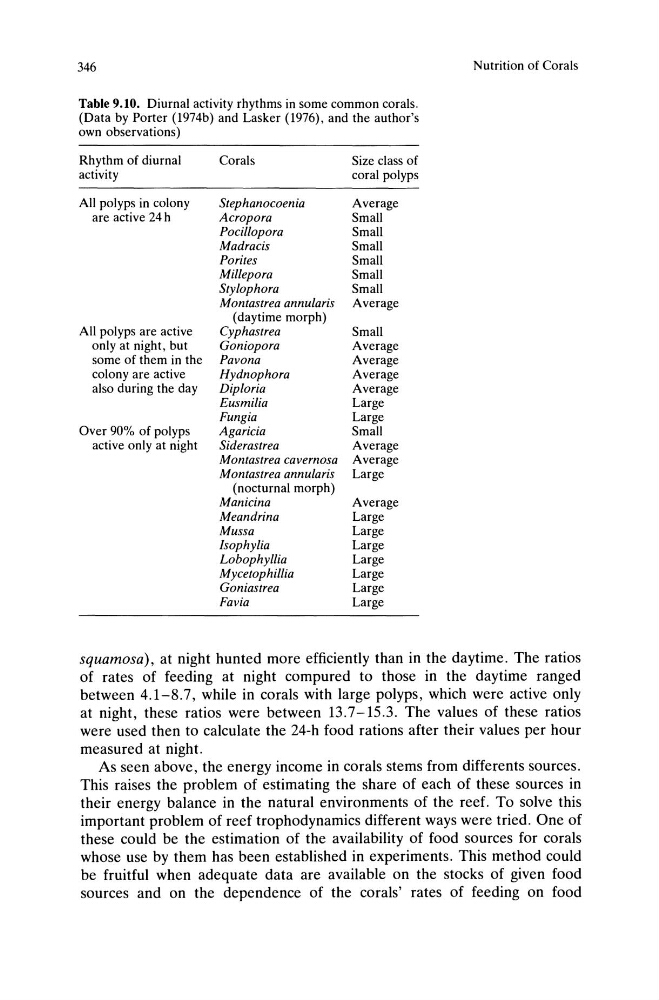
Table 9.10. Diurnal activity rhythms in some common corals.
(Data by Porter (1974b) and Lasker (1976), and the author's
own observations)
Rhythm of diurnal
activity
All polyps in colony
are active 24 h
All polyps are active
only at night, but
some of them in the
colony are active
also during the day
Over 90% of polyps
active only at night
Corals
Stephanocoenia
Acropora
Pocillopora
Madracis
Porites
Millepora
Stylophora
Montastrea annularis
(daytime morph)
Cyphastrea
Goniopora
Pavona
Hydnophora
Diploria
Eusmilia
Fungia
Agaricia
Siderastrea
Montastrea cavernosa
Montastrea annularis
(nocturnal morph)
Manicina
Meandrina
Mussa
Isophylia
Lobophyllia
Mycetophillia
Goniastrea
Favia
Size class of
coral polyps
Average
Small
Small
Small
Small
Small
Small
Average
Small
Average
Average
Average
Average
Large
Large
Small
Average
Average
Large
Average
Large
Large
Large
Large
Large
Large
Large
Nutrition of Corals
squamosa), at night hunted more efficiently than in the daytime. The ratios
of rates of feeding at night compured to those in the daytime ranged
between 4.1-8.7, while in corals with large polyps, which were active only
at night, these ratios were between 13.7-15.3. The values of these ratios
were used then to calculate the 24-h food rations after their values per hour
measured at night.
As seen above, the energy income in corals stems from differents sources.
This raises the problem of estimating the share of each of these sources in
their energy balance in the natural environments of the reef. To solve this
important problem of reef trophodynamics different ways were tried. One of
these could be the estimation of the availability of food sources for corals
whose use by them has been established in experiments. This method could
be fruitful when adequate data are available on the stocks of given food
sources and on the dependence of the corals' rates of feeding on food
Table 9.10. Diurnal activity rhythms in some common corals.
(Data by Porter (1974b) and Lasker (1976), and the author's
own observations)
Rhythm of diurnal
activity
All polyps in colony
are active 24 h
All polyps are active
only at night, but
some of them in the
colony are active
also during the day
Over 90% of polyps
active only at night
Corals
Stephanocoenia
Acropora
Pocillopora
Madracis
Porites
Millepora
Stylophora
Montastrea annularis
(daytime morph)
Cyphastrea
Goniopora
Pavona
Hydnophora
Diploria
Eusmilia
Fungia
Agaricia
Siderastrea
Montastrea cavernosa
Montastrea annularis
(nocturnal morph)
Manicina
Meandrina
Mussa
Isophylia
Lobophyllia
Mycetophillia
Goniastrea
Favia
Size class of
coral polyps
Average
Small
Small
Small
Small
Small
Small
Average
Small
Average
Average
Average
Average
Large
Large
Small
Average
Average
Large
Average
Large
Large
Large
Large
Large
Large
Large
Nutrition of Corals
squamosa), at night hunted more efficiently than in the daytime. The ratios
of rates of feeding at night compured to those in the daytime ranged
between 4.1-8.7, while in corals with large polyps, which were active only
at night, these ratios were between 13.7-15.3. The values of these ratios
were used then to calculate the 24-h food rations after their values per hour
measured at night.
As seen above, the energy income in corals stems from differents sources.
This raises the problem of estimating the share of each of these sources in
their energy balance in the natural environments of the reef. To solve this
important problem of reef trophodynamics different ways were tried. One of
these could be the estimation of the availability of food sources for corals
whose use by them has been established in experiments. This method could
be fruitful when adequate data are available on the stocks of given food
sources and on the dependence of the corals' rates of feeding on food