

320
Morphology and Ecological Physiology of Corals
~ _ _ - - J
!.f
10
.f
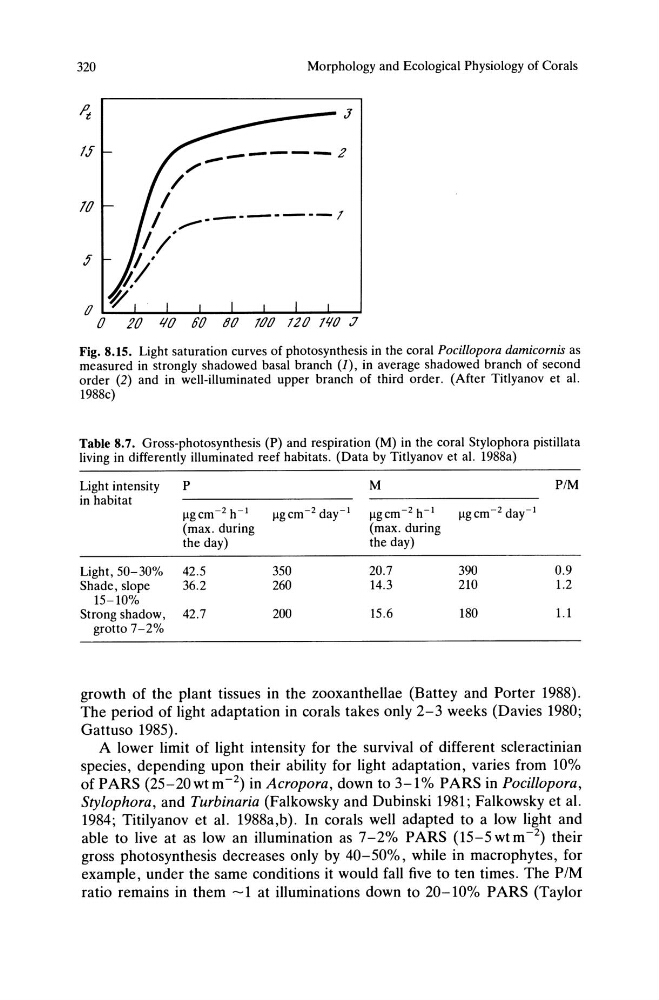
Fig. 8.15. Light saturation curves of photosynthesis in the coral Pocillopora damicornis as
measured in strongly shadowed basal branch (1), in average shadowed branch of second
order (2) and in well-illuminated upper branch of third order. (After Titlyanov et at.
1988c)
Table 8.7. Gross-photosynthesis (P) and respiration (M) in the coral Stylophora pistillata
living in differently illuminated reef habitats. (Data by Titlyanov et at. 1988a)
Light intensity
in habitat
Light, 50-30%
Shade, slope
15-10%
Strong shadow,
grotto 7-2%
P
~gcm-2 h- 1
(max. during
the day)
42.5
36.2
42.7
~gcm-2 day-l
350
260
200
M
P/M
~gcm-2 h- 1
~gcm-2 day-l
(max. during
the day)
20.7
390
0.9
14.3
210
1.2
15.6
180
1.1
growth of the plant tissues in the zooxanthellae (Battey and Porter 1988).
The period of light adaptation in corals takes only 2-3 weeks (Davies 1980;
Gattuso 1985).
A lower limit of light intensity for the survival of different scIeractinian
species, depending upon their ability for light adaptation, varies from 10%
of PARS (25-20wt m- 2 ) in Acropora, down to 3-1 % PARS in Pocillopora,
Stylophora, and Turbinaria (Falkowsky and Dubinski 1981; Falkowsky et al.
1984; Titilyanov et al. 1988a,b). In corals well adapted to a low light and
able to live at as Iowan illumination as 7-2% PARS (15-5wtm- 2 ) their
gross photosynthesis decreases only by 40-50%, while in macrophytes, for
example, under the same conditions it would fall five to ten times. The P/M
ratio remains in them -1 at illuminations down to 20-10% PARS (Taylor
Morphology and Ecological Physiology of Corals
~ _ _ - - J
!.f
10
.f
Fig. 8.15. Light saturation curves of photosynthesis in the coral Pocillopora damicornis as
measured in strongly shadowed basal branch (1), in average shadowed branch of second
order (2) and in well-illuminated upper branch of third order. (After Titlyanov et at.
1988c)
Table 8.7. Gross-photosynthesis (P) and respiration (M) in the coral Stylophora pistillata
living in differently illuminated reef habitats. (Data by Titlyanov et at. 1988a)
Light intensity
in habitat
Light, 50-30%
Shade, slope
15-10%
Strong shadow,
grotto 7-2%
P
~gcm-2 h- 1
(max. during
the day)
42.5
36.2
42.7
~gcm-2 day-l
350
260
200
M
P/M
~gcm-2 h- 1
~gcm-2 day-l
(max. during
the day)
20.7
390
0.9
14.3
210
1.2
15.6
180
1.1
growth of the plant tissues in the zooxanthellae (Battey and Porter 1988).
The period of light adaptation in corals takes only 2-3 weeks (Davies 1980;
Gattuso 1985).
A lower limit of light intensity for the survival of different scIeractinian
species, depending upon their ability for light adaptation, varies from 10%
of PARS (25-20wt m- 2 ) in Acropora, down to 3-1 % PARS in Pocillopora,
Stylophora, and Turbinaria (Falkowsky and Dubinski 1981; Falkowsky et al.
1984; Titilyanov et al. 1988a,b). In corals well adapted to a low light and
able to live at as Iowan illumination as 7-2% PARS (15-5wtm- 2 ) their
gross photosynthesis decreases only by 40-50%, while in macrophytes, for
example, under the same conditions it would fall five to ten times. The P/M
ratio remains in them -1 at illuminations down to 20-10% PARS (Taylor